

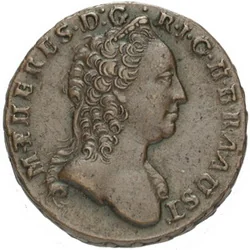
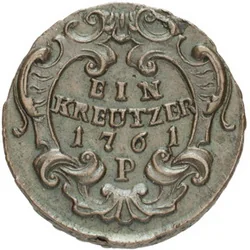
1 Kreuzer – Kingdom of Bohemia
Context
Years: 1760–1764
Country: Bohemia
Issuer: Kingdom of Bohemia
Ruler: Maria Theresa
Currency:
(1754—1857)
Demonetized: Yes
References
KM: #Click to copy to clipboard792
Numista: #107094
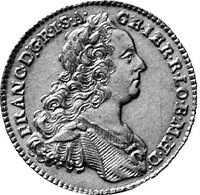
Obverse
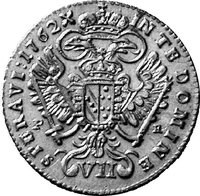
Reverse
Edge
Mints
| Name | Mark |
|---|---|
| Prague | — |
Mintings
| Year | Mint Mark | Mintage | Quality | Collection |
|---|---|---|---|---|
| 1760 | — | — | ||
| 1760 | P | — | ||
| 1761 | P | — | ||
| 1762 | P | — | ||
| 1763 | P | — | ||
| 1764 | P | — |
Historical background
In 1760, the Kingdom of Bohemia, a core crown land of the Habsburg Monarchy, operated within a complex and strained currency system. The primary unit was the Conventionsthaler (also called the Konventionsthaler), established by the monetary convention of 1753 between Austria and Bavaria. This silver standard aimed to bring stability to the region, with 1 Conventionsthaler equal to 2 Gulden (florins), and each Gulden subdivided into 60 Kreuzer. However, the system was burdened by the immense financial demands of the ongoing Seven Years' War (1756-1763), in which Habsburg Austria, including Bohemia, was a primary belligerent against Prussia.
To fund the war effort, the state resorted to the debasement of coinage and increased issuance of paper money. The Vienna City Bank (Wiener Stadtbank), acting as a state finance vehicle, circulated substantial amounts of Bancozettel, a form of inconvertible paper currency. While not yet the catastrophic inflation seen later, these notes began to trade at a discount against silver coin, creating a de facto bi-metallic system of "hard" silver and "soft" paper. This erosion of trust was exacerbated by the circulation of older, debased coins and the constant pressure to extract silver and taxes from Bohemia's productive economy to fuel the military campaigns.
Consequently, the daily reality for Bohemia's population and merchants was one of monetary confusion and uncertainty. Transactions required careful negotiation between different types of coinage and depreciating paper, hindering commerce. The situation reflected the broader Habsburg fiscal crisis, where the theoretical stability of the Conventionsthaler standard was undermined by the pragmatic and desperate financial policies of a monarchy at war, placing a heavy economic burden on Bohemia's lands and people.
To fund the war effort, the state resorted to the debasement of coinage and increased issuance of paper money. The Vienna City Bank (Wiener Stadtbank), acting as a state finance vehicle, circulated substantial amounts of Bancozettel, a form of inconvertible paper currency. While not yet the catastrophic inflation seen later, these notes began to trade at a discount against silver coin, creating a de facto bi-metallic system of "hard" silver and "soft" paper. This erosion of trust was exacerbated by the circulation of older, debased coins and the constant pressure to extract silver and taxes from Bohemia's productive economy to fuel the military campaigns.
Consequently, the daily reality for Bohemia's population and merchants was one of monetary confusion and uncertainty. Transactions required careful negotiation between different types of coinage and depreciating paper, hindering commerce. The situation reflected the broader Habsburg fiscal crisis, where the theoretical stability of the Conventionsthaler standard was undermined by the pragmatic and desperate financial policies of a monarchy at war, placing a heavy economic burden on Bohemia's lands and people.
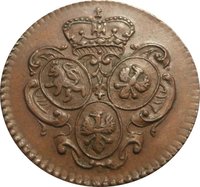
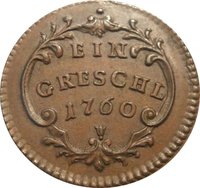
⭐ Rare