

12 Shillings – Scotland
United Kingdom
Context
Years: 1639–1641
Country: United Kingdom 
Issuer: Scotland 
Ruler: Charles I
Currency:
(1136—1707)
Demonetized: Yes
Material
References
KM: #Click to copy to clipboard83
Numista: #18008
Value
Bullion value: $16.05
Obverse
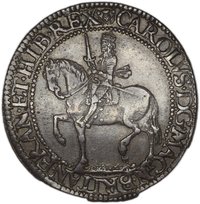
Description:

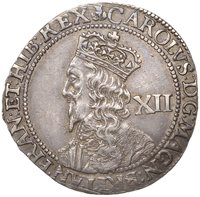
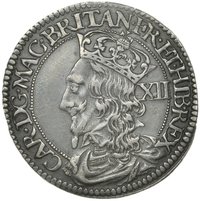
Charles I left-facing bust, breaching inner circle, value mark to right.
Inscription:
CAROLVS : D : G : MAGN : BRITAN : FRAN : ET : HIB : REX
Script: Latin
Reverse
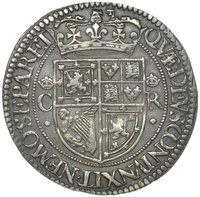
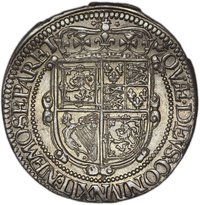
Description:

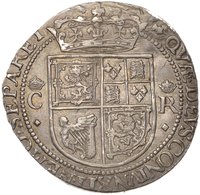
Royal arms with a crowned 'F' above, flanked by crowned 'C' and 'R'.
Inscription:
QVÆ · DEVS · CONIVNXIT · NEMO · SEPARET
Script: Latin
Edge
Mints
| Name | Mark |
|---|---|
| Edinburgh | — |
Mintings
| Year | Mint Mark | Mintage | Quality | Collection |
|---|---|---|---|---|
| — | — | — |
Historical background
In 1639, Scotland was embroiled in the Bishops' Wars, a conflict rooted in religious and political opposition to King Charles I's attempts to impose Anglican-style prayer books and royal supremacy on the Presbyterian Kirk. This rebellion, led by the Covenanters, created an immediate and severe financial crisis for both the Crown and the Scottish provisional government. Military mobilization demanded vast sums for arms, supplies, and soldiers' pay, straining a kingdom without a standing army or a centralized fiscal-military state.
The currency itself was part of a broader, long-standing monetary problem shared across the British Isles. Scotland operated on the Pound Scots, a separate currency from the Pound Sterling, but its value had been severely debased over the preceding century, leaving it at a fixed exchange rate of £12 Scots to £1 Sterling. The coinage in circulation was a patchwork of often worn and clipped domestic issues, alongside a multitude of foreign coins, particularly Spanish dollars and Dutch guilders, which circulated by weight and intrinsic value. There was no central bank, and credit systems were rudimentary.
Consequently, the war effort was funded through expedients rather than a stable currency system. The Covenanting government levied taxes and borrowed heavily from wealthy supporters, while Charles I struggled to raise funds from a reluctant English Parliament. Both sides resorted to requisitioning supplies and demanding free quarter from communities. While no new debasement of the coinage occurred in 1639 itself, the financial pressures highlighted the fragility of Scotland's monetary system, setting the stage for the severe coinage debasements and economic hardship that would follow in the 1640s as the conflict merged into the wider Wars of the Three Kingdoms.
The currency itself was part of a broader, long-standing monetary problem shared across the British Isles. Scotland operated on the Pound Scots, a separate currency from the Pound Sterling, but its value had been severely debased over the preceding century, leaving it at a fixed exchange rate of £12 Scots to £1 Sterling. The coinage in circulation was a patchwork of often worn and clipped domestic issues, alongside a multitude of foreign coins, particularly Spanish dollars and Dutch guilders, which circulated by weight and intrinsic value. There was no central bank, and credit systems were rudimentary.
Consequently, the war effort was funded through expedients rather than a stable currency system. The Covenanting government levied taxes and borrowed heavily from wealthy supporters, while Charles I struggled to raise funds from a reluctant English Parliament. Both sides resorted to requisitioning supplies and demanding free quarter from communities. While no new debasement of the coinage occurred in 1639 itself, the financial pressures highlighted the fragility of Scotland's monetary system, setting the stage for the severe coinage debasements and economic hardship that would follow in the 1640s as the conflict merged into the wider Wars of the Three Kingdoms.
Series: 1639 Scotland circulation coins
✨ Legendary