

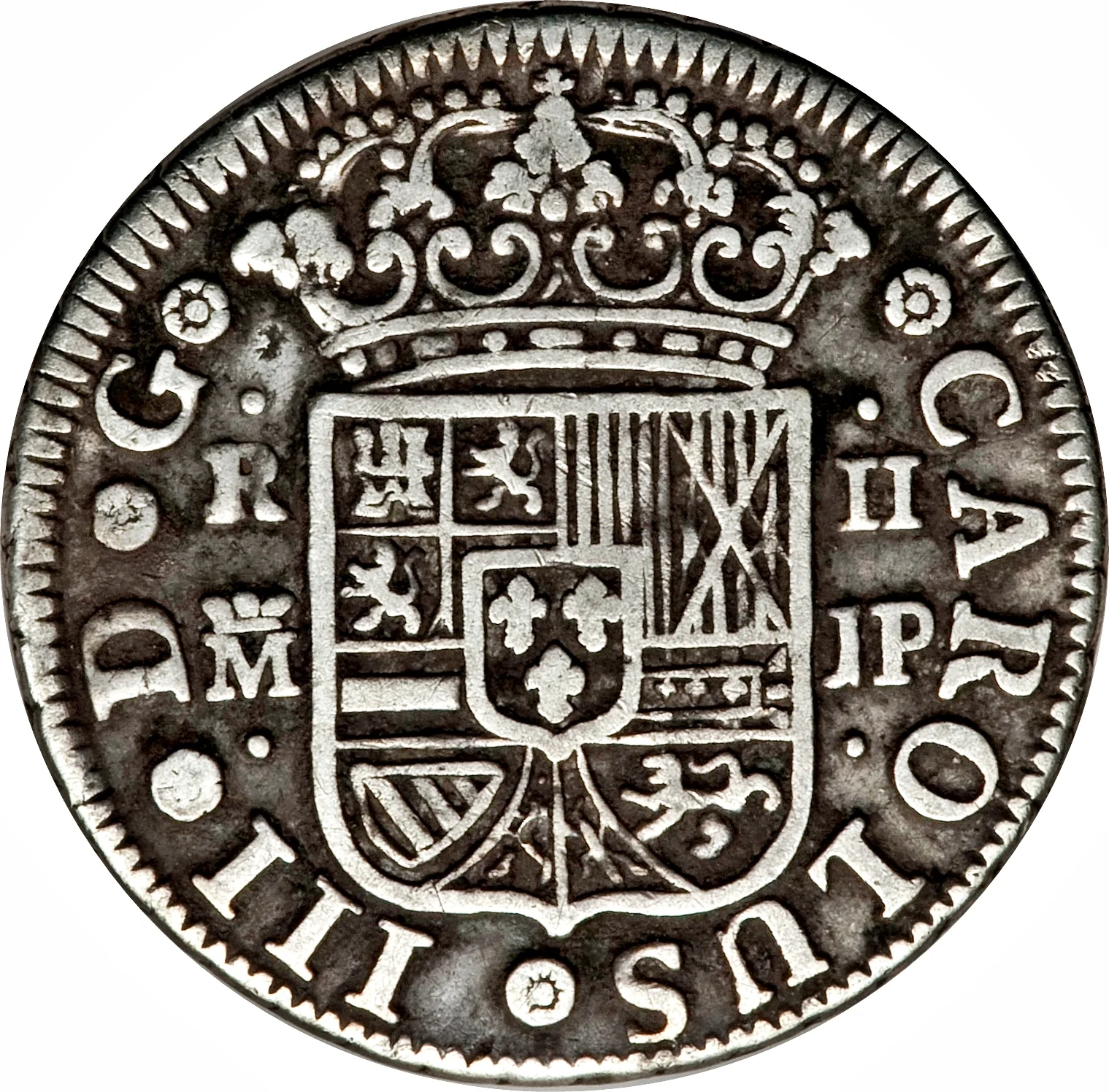
Obverse
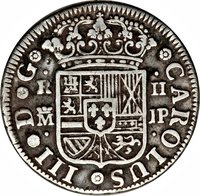
Description:
Royal arms of Spain.
Inscription:
✿ CAROLUS ✿ III ✿ D ✿ G ✿
· ·
R II
M JP
· ·
· ·
R II
M JP
· ·
Script: Latin
Engraver: Tomás Francisco Prieto Martin
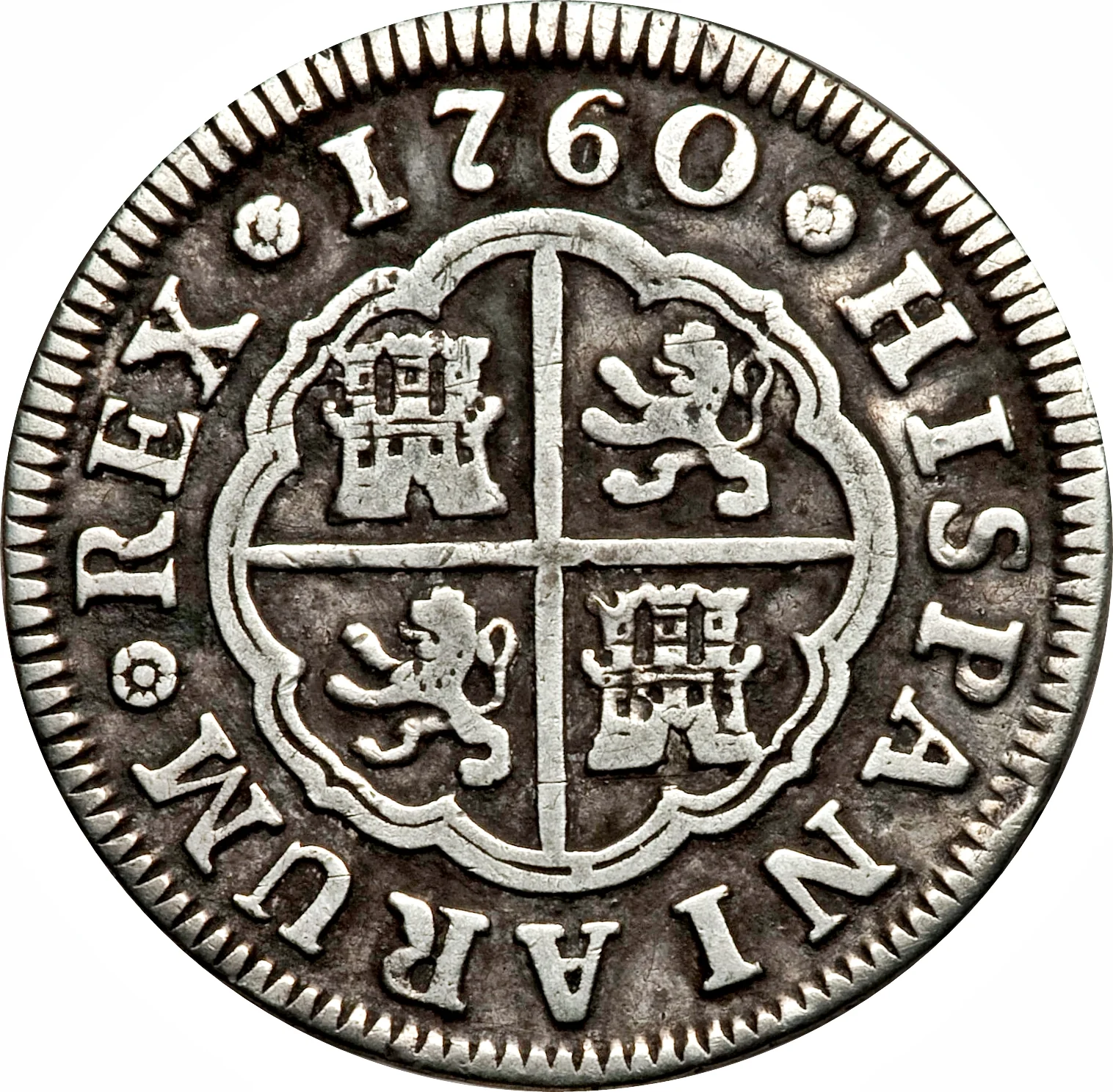
Reverse
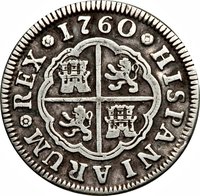
Description:
Castile and León's coat of arms in an octolobe.
Inscription:
✿ 1760 ✿ HISPANIARUM ✿ REX
Script: Latin
Engraver: Tomás Francisco Prieto Martin
Edge
Categories
| Symbols> Coat of Arms |
Mints
| Name | Mark |
|---|---|
| Royal Mint of Madrid | (M) |
| Royal Mint of Seville | (S) |
Mintings
| Year | Mint Mark | Mintage | Quality | Collection |
|---|---|---|---|---|
| 1759 | MJ | — | ||
| 1759 | MJP | — | ||
| 1760 | MJP | — | ||
| 1760 | S | — | ||
| 1760 | SJV | — | ||
| 1761 | MJP | — | ||
| 1761 | SJV | — | ||
| 1762 | MJP | — | ||
| 1762 | SJV | — | ||
| 1763 | MJP | — | ||
| 1764 | MPJ | — | ||
| 1765 | MPJ | — | ||
| 1766 | MPJ | — | ||
| 1766 | SVC | — | ||
| 1767 | MPJ | — | ||
| 1768 | MPJ | — | ||
| 1768 | SCF | — | ||
| 1769 | MPJ | — | ||
| 1770 | MPJ | — | ||
| 1770 | SCF | — | ||
| 1771 | MPJ | — | ||
| 1771 | SCF | — |
Historical background
In 1759, Spain's currency situation was characterized by a complex and debased monetary system, a direct legacy of the costly wars and fiscal strains of the previous decades under the Bourbon monarchy. The primary circulating coins were silver reales and gold escudos, but their intrinsic metal value often exceeded their face value, leading to frequent hoarding and exportation. Furthermore, a proliferation of low-quality vellón (copper alloy) coinage, heavily minted by King Philip V to finance the War of Spanish Succession, flooded the economy, causing severe inflation and public distrust in the currency. This created a dual problem: a shortage of "good" precious metal coinage for international trade and an unstable, inflated copper currency for everyday domestic use.
The accession of King Charles III in 1759 marked a potential turning point. A reform-minded monarch influenced by Enlightenment principles, he inherited this chaotic system and recognized that monetary stability was foundational for economic recovery and imperial strength. His administration would soon embark on significant reforms, though the major overhaul—the currency reform of 1772—was still over a decade away. Therefore, the situation in 1759 was one of a low point, a lingering crisis awaiting decisive action.
Consequently, the monetary landscape was not uniform across the empire. In Spain itself, transactions were a confusing mix of undervalued silver and inflated copper. Meanwhile, in the American viceroyalties, silver production from mines in Mexico and Peru remained the lifeblood of the empire, minted into legendary "pieces of eight" (reales de a ocho). These coins were crucial for international finance and Asian trade, but their flow to peninsular Spain was often disrupted to service foreign debt and pay for imports, exacerbating the metropolis's specie shortage. Thus, Spain in 1759 possessed vast nominal wealth in colonial silver yet struggled with a dysfunctional and inflationary domestic currency system.
The accession of King Charles III in 1759 marked a potential turning point. A reform-minded monarch influenced by Enlightenment principles, he inherited this chaotic system and recognized that monetary stability was foundational for economic recovery and imperial strength. His administration would soon embark on significant reforms, though the major overhaul—the currency reform of 1772—was still over a decade away. Therefore, the situation in 1759 was one of a low point, a lingering crisis awaiting decisive action.
Consequently, the monetary landscape was not uniform across the empire. In Spain itself, transactions were a confusing mix of undervalued silver and inflated copper. Meanwhile, in the American viceroyalties, silver production from mines in Mexico and Peru remained the lifeblood of the empire, minted into legendary "pieces of eight" (reales de a ocho). These coins were crucial for international finance and Asian trade, but their flow to peninsular Spain was often disrupted to service foreign debt and pay for imports, exacerbating the metropolis's specie shortage. Thus, Spain in 1759 possessed vast nominal wealth in colonial silver yet struggled with a dysfunctional and inflationary domestic currency system.
🌟 Limited