

2 marks – Sweden
Add to wishlist
Sweden
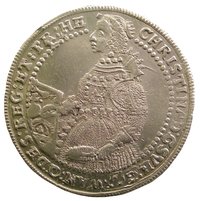
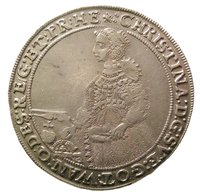
Obverse
Description:
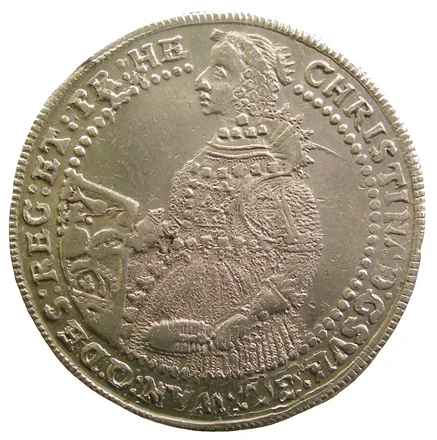
Bust of Queen Christina facing left within a circular inscription.
Inscription:
CHRISTIN:D.G:SVE:GOT·WAN:Q.DES:REG:ET:PR:HE
Script: Latin
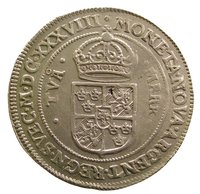
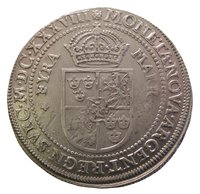
Reverse
Description:
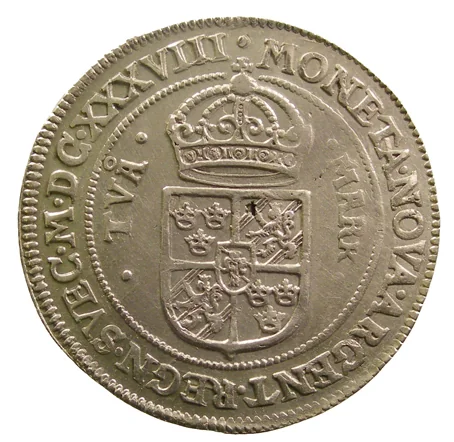
Shield with Swedish arms divides value within circular legend.
Inscription:
MONETA·NOVA·ARGENT·REGN·SVEC·M·DC·XXXVIII·
· TVÅ · · MARK ·
· TVÅ · · MARK ·
Script: Latin
Edge
Mints
| Name | Mark |
|---|---|
| Stockholm | — |
Mintings
| Year | Mint Mark | Mintage | Quality | Collection |
|---|---|---|---|---|
| 1638 | — | — |
Historical background
In 1638, Sweden operated under a complex and strained monetary system, a direct consequence of its ongoing participation in the Thirty Years' War (1618-1648). The war effort, led by King Gustavus Adolphus and continued after his death in 1632 by Chancellor Axel Oxenstierna, demanded enormous financial resources. To fund its armies on the continent, the Swedish crown heavily debased the currency, notably the silver daler. The government's Stockholm Mint (Myntet) produced vast quantities of lower-quality copper and billon (base metal with some silver) coins, while much of the nation's high-quality silver was exported to pay for troops and supplies. This created a classic situation of bad money driving out good, as Gresham's Law took hold.
The primary currency in circulation was the copper daler, established by a 1624 ordinance that aimed to base the currency on Sweden's rich copper reserves from the Falun Mine. However, the intrinsic value of the copper in these large, cumbersome plate coins (plåtmynt) often fluctuated wildly against their face value, leading to instability. Alongside these, a confusing array of older Swedish coins and numerous foreign currencies—especially German, Dutch, and Polish coins—circulated freely, as Sweden was deeply integrated into Baltic and North Sea trade networks. The state's chronic need for cash also led to the expansion of a credit system and the use of tax vouchers, creating a multi-layered and often unreliable monetary environment.
For the New Sweden colony, established in 1638 along the Delaware River, this monetary situation meant that formal Swedish coinage was scarce to non-existent in the settlement. Trade with the local Lenape people was conducted through barter (e.g., beaver pelts, cloth, and tools), while transactions within the small colony likely relied on a mix of credit, commodity values, and whatever foreign coins—such as Dutch guilders or Spanish pieces of eight—entered through trade with other European colonies. Thus, the financial reality in New Sweden was a distant, practical reflection of the strained and complex fiscal policies emanating from the wartime treasury in Stockholm.
The primary currency in circulation was the copper daler, established by a 1624 ordinance that aimed to base the currency on Sweden's rich copper reserves from the Falun Mine. However, the intrinsic value of the copper in these large, cumbersome plate coins (plåtmynt) often fluctuated wildly against their face value, leading to instability. Alongside these, a confusing array of older Swedish coins and numerous foreign currencies—especially German, Dutch, and Polish coins—circulated freely, as Sweden was deeply integrated into Baltic and North Sea trade networks. The state's chronic need for cash also led to the expansion of a credit system and the use of tax vouchers, creating a multi-layered and often unreliable monetary environment.
For the New Sweden colony, established in 1638 along the Delaware River, this monetary situation meant that formal Swedish coinage was scarce to non-existent in the settlement. Trade with the local Lenape people was conducted through barter (e.g., beaver pelts, cloth, and tools), while transactions within the small colony likely relied on a mix of credit, commodity values, and whatever foreign coins—such as Dutch guilders or Spanish pieces of eight—entered through trade with other European colonies. Thus, the financial reality in New Sweden was a distant, practical reflection of the strained and complex fiscal policies emanating from the wartime treasury in Stockholm.
✨ Legendary