

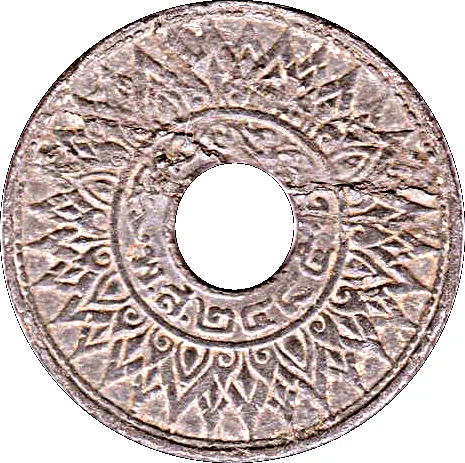
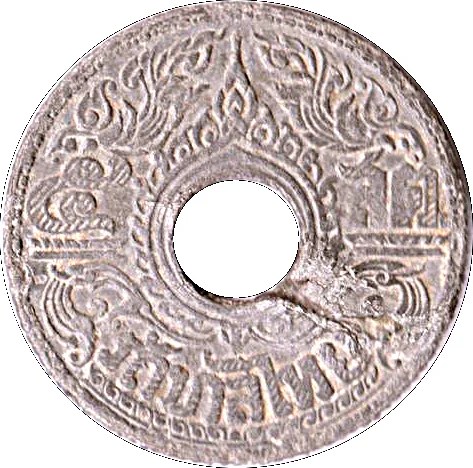
5 Satangs – Thailand
Thailand
Context
Year: 1942
Thai Year: 2485
Issuer: Thailand 
Ruler: Ananda Mahidol
Currency:
(since 1897)
Demonetized: Yes
Total mintage: 2,472,000
Material
Diameter: 17.5 mm
Weight: 3 g
Shape: Round with a round hole
Composition: Tin
Magnetic: No
Technique: Milled
Alignment: Coin alignment
flip
References
Y: #Click to copy to clipboard58
Numista: #12233
Value
Exchange value: 0.05 THB = $0.00
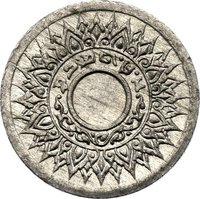
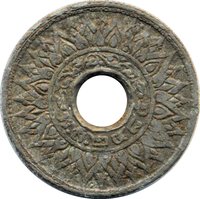
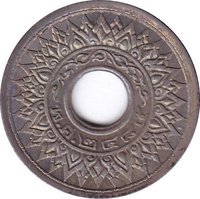
Obverse
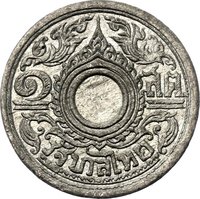
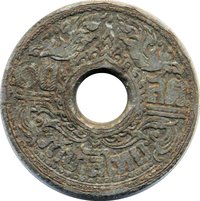
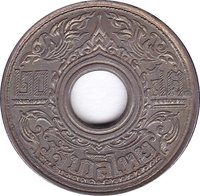
Reverse
Edge
Mintings
| Year | Mint Mark | Mintage | Quality | Collection |
|---|---|---|---|---|
| 1942 | — | 2,472,000 |
Historical background
In 1942, Thailand's currency situation was defined by its precarious wartime position under the Phibun Songkhram government, which had formally allied with Japan following the latter's invasion in December 1941. To finance the Japanese military campaign in Southeast Asia, the occupying forces compelled the Bank of Thailand to grant massive "special yen" loans. This was facilitated through a series of forced, unequal agreements, where Japan paid for goods, services, and infrastructure using these yen credits, which were essentially IOUs with no convertible value outside the Japanese economic sphere. This system caused a rapid and uncontrolled expansion of the money supply within Thailand.
The influx of this Japanese military scrip, alongside the increased issuance of Thai baht to cover domestic war expenditures and the loans, triggered severe inflation. Prices for essential commodities, particularly rice, began a sharp upward spiral as goods were diverted to supply the Japanese army, creating scarcity. The Thai government attempted to impose price controls and rationing, but these measures were largely ineffective against the fundamental pressure of too much money chasing too few goods. The economic distortion was exacerbated by a thriving black market, which further undermined the official value and stability of the currency.
Consequently, the Thai baht, which had been on a sterling exchange standard prior to the war, became effectively pegged to the non-convertible Japanese yen at an artificially set rate. This period severed Thailand's pre-war financial links and integrated its economy into Japan's "Greater East Asia Co-Prosperity Sphere," leading to significant economic hardship for the population. The legacy was a severely weakened financial system, depleted foreign reserves, and a burdensome postwar obligation, as the "special yen" debt became a major point of contention and negotiation during the peace settlements after Japan's defeat.
The influx of this Japanese military scrip, alongside the increased issuance of Thai baht to cover domestic war expenditures and the loans, triggered severe inflation. Prices for essential commodities, particularly rice, began a sharp upward spiral as goods were diverted to supply the Japanese army, creating scarcity. The Thai government attempted to impose price controls and rationing, but these measures were largely ineffective against the fundamental pressure of too much money chasing too few goods. The economic distortion was exacerbated by a thriving black market, which further undermined the official value and stability of the currency.
Consequently, the Thai baht, which had been on a sterling exchange standard prior to the war, became effectively pegged to the non-convertible Japanese yen at an artificially set rate. This period severed Thailand's pre-war financial links and integrated its economy into Japan's "Greater East Asia Co-Prosperity Sphere," leading to significant economic hardship for the population. The legacy was a severely weakened financial system, depleted foreign reserves, and a burdensome postwar obligation, as the "special yen" debt became a major point of contention and negotiation during the peace settlements after Japan's defeat.
Series: 1942 Thailand circulation coins
🌟 Uncommon