

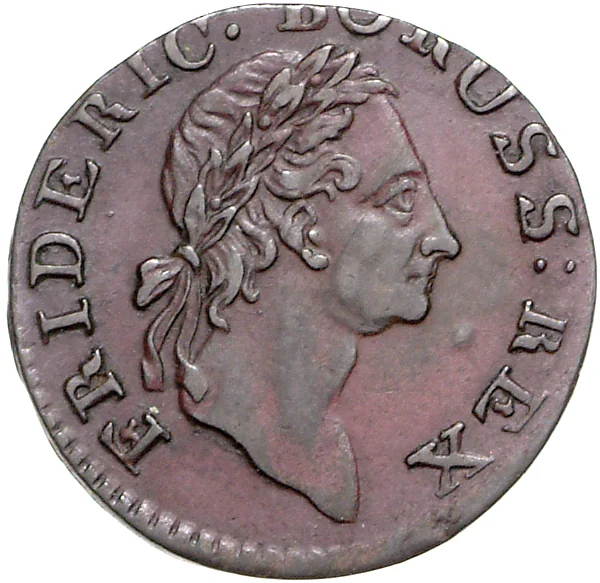
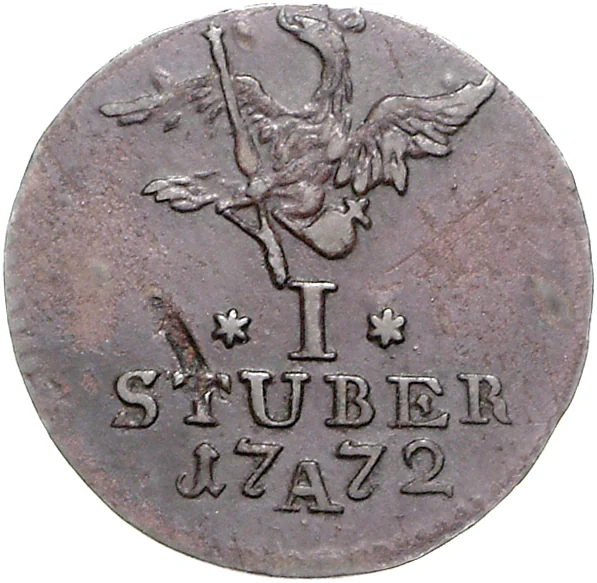
1 stüber – East Frisia
Add to wishlist
Germany
Context
Years: 1771–1783
Country: Germany
Issuer: East Frisia
Ruler: Frederick II
Currency:
Demonetized: Yes
Material
References
KM: #
Numista: #17487
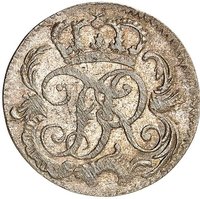
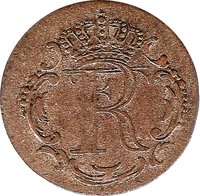
Obverse
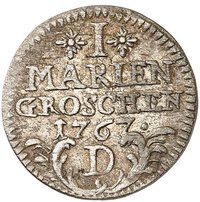
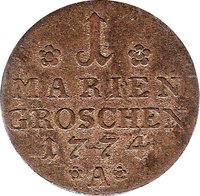
Reverse
Edge
Plain
Mintings
| Year | Mint Mark | Mintage | Quality | Collection |
|---|---|---|---|---|
| 1771 | A | — | ||
| 1772 | A | — | ||
| 1775 | A | — | ||
| 1776 | A | — | ||
| 1777 | A | — | ||
| 1781 | A | — | ||
| 1783 | A | — |
Historical background
In 1771, East Frisia was a fragmented territory under the rule of the Prussian King Frederick the Great, who had annexed it in 1744. The currency situation was complex and problematic, characterized by a chaotic coexistence of multiple circulating mediums. The official Prussian Reichsthaler was the standard, but in practice, a multitude of older local coins, Dutch guilders, and various German state thalers from neighboring regions all circulated simultaneously. This created a confusing and inefficient monetary environment for daily trade and administration.
The core of the problem lay in the persistent use of the "East Frisian Rixdollar" (Ostfriesischer Reichstaler), a coin officially minted until the Prussian takeover but now fixed at an artificial and outdated exchange rate. Prussia had decreed that one East Frisian Rixdollar was equal to one Prussian Reichsthaler, but its intrinsic silver content was significantly lower. This discrepancy led to Gresham's Law in action: "bad money drives out good." People hoarded the full-value Prussian coins and used the debased local coins for payments, causing a chronic shortage of sound currency and undermining economic stability.
By 1771, Prussian authorities were actively seeking to streamline and control this monetary anarchy as part of broader efforts to integrate East Frisia into the Prussian fiscal system. Plans were likely underway to demonetize the old local coinage and enforce the exclusive use of Prussian currency, a move typical of centralizing states in the 18th century. Thus, the currency situation of that year represented a tense transitional period, caught between a legacy of regional monetary identity and the imposition of a standardized, state-controlled monetary system from Berlin.
The core of the problem lay in the persistent use of the "East Frisian Rixdollar" (Ostfriesischer Reichstaler), a coin officially minted until the Prussian takeover but now fixed at an artificial and outdated exchange rate. Prussia had decreed that one East Frisian Rixdollar was equal to one Prussian Reichsthaler, but its intrinsic silver content was significantly lower. This discrepancy led to Gresham's Law in action: "bad money drives out good." People hoarded the full-value Prussian coins and used the debased local coins for payments, causing a chronic shortage of sound currency and undermining economic stability.
By 1771, Prussian authorities were actively seeking to streamline and control this monetary anarchy as part of broader efforts to integrate East Frisia into the Prussian fiscal system. Plans were likely underway to demonetize the old local coinage and enforce the exclusive use of Prussian currency, a move typical of centralizing states in the 18th century. Thus, the currency situation of that year represented a tense transitional period, caught between a legacy of regional monetary identity and the imposition of a standardized, state-controlled monetary system from Berlin.
⭐ Rare