

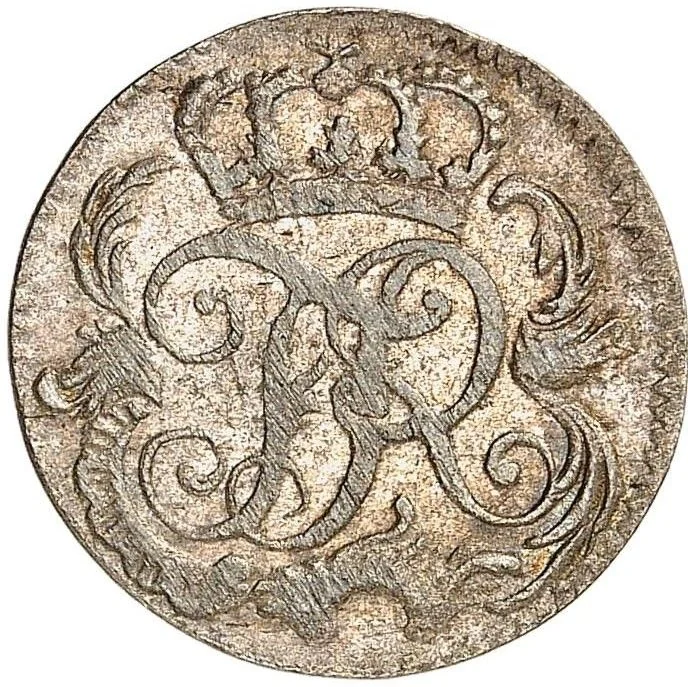
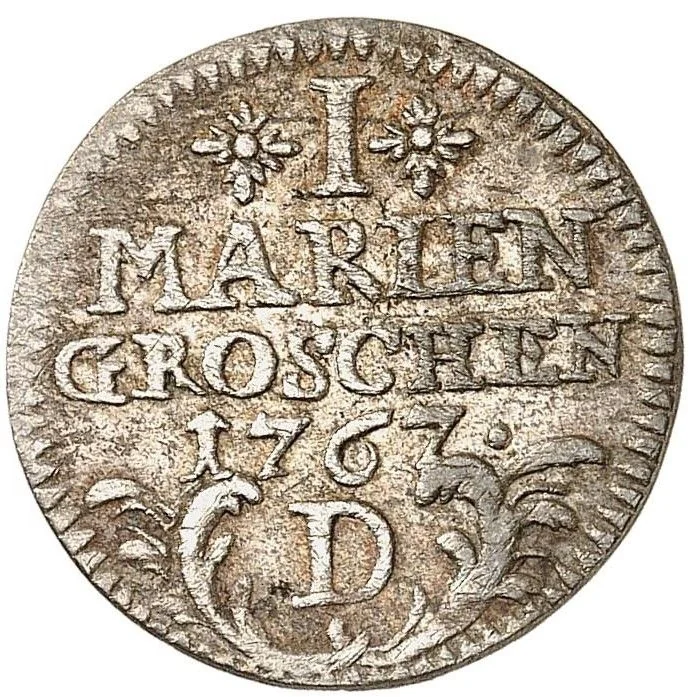
1 mariengroschen – East Frisia
Add to wishlist
Germany
Context
Years: 1767–1768
Country: Germany
Issuer: East Frisia
Ruler: Frederick II
Currency:
Demonetized: Yes
Total mintage: 1,221,000
Material
References
KM: #
Numista: #315409
Value
Bullion value: $4.17
Obverse
Reverse
Edge
Mints
| Name | Mark |
|---|---|
| Aurich | D |
Historical background
In 1767, the currency situation in East Frisia was complex and fragmented, a direct legacy of its political history. The region was not a unified monetary zone but a patchwork of different circulating coins and accounting systems. This was because East Frisia, though a county within the Holy Roman Empire, had been divided since 1744: the western part was under Prussian administration following the Emden Convention, while the eastern Herrlichkeit of Kniphausen remained under the control of the local ruling family, the von Inn- und Knyphausens. Each authority minted or sanctioned its own currency, leading to a coexistence of Prussian and local East Frisian issues.
The primary unit of account was the Reichsthaler, divided into 72 Grote, each of 5 Schwaren. However, a plethora of physical coins from neighbouring states, such as Dutch guilders, Hamburg marks, and various German Klippe and Scheidemünzen (small change), circulated alongside the official issues. This created significant practical difficulties for trade and daily life, as merchants and citizens constantly had to calculate exchange rates and assess the often-debased silver content of coins from different mints. The problem was particularly acute with small change, where shortages and inferior alloys were common.
The Prussian administration, seeking to impose order and integrate East Frisia into its economic sphere, was actively working to standardize the currency. They promoted the use of Prussian coinage and aimed to suppress irregular issues. However, in 1767, this process was still incomplete. The year falls within a transitional period where the old, chaotic multiplicity of currencies persisted on the ground, even as the centralizing pressure from Berlin steadily grew, aiming to replace East Frisia's monetary patchwork with the more uniform Prussian system.
The primary unit of account was the Reichsthaler, divided into 72 Grote, each of 5 Schwaren. However, a plethora of physical coins from neighbouring states, such as Dutch guilders, Hamburg marks, and various German Klippe and Scheidemünzen (small change), circulated alongside the official issues. This created significant practical difficulties for trade and daily life, as merchants and citizens constantly had to calculate exchange rates and assess the often-debased silver content of coins from different mints. The problem was particularly acute with small change, where shortages and inferior alloys were common.
The Prussian administration, seeking to impose order and integrate East Frisia into its economic sphere, was actively working to standardize the currency. They promoted the use of Prussian coinage and aimed to suppress irregular issues. However, in 1767, this process was still incomplete. The year falls within a transitional period where the old, chaotic multiplicity of currencies persisted on the ground, even as the centralizing pressure from Berlin steadily grew, aiming to replace East Frisia's monetary patchwork with the more uniform Prussian system.
✨ Legendary