

6 Hellers – Landgraviate of Hesse-Cassel
Context
Years: 1733–1750
Issuer: Landgraviate of Hesse-Cassel
Ruler: Frederick I
Currency:
Demonetized: Yes
Total mintage: 912,000
References
KM: #Click to copy to clipboard415
Numista: #173705
Obverse
Description:
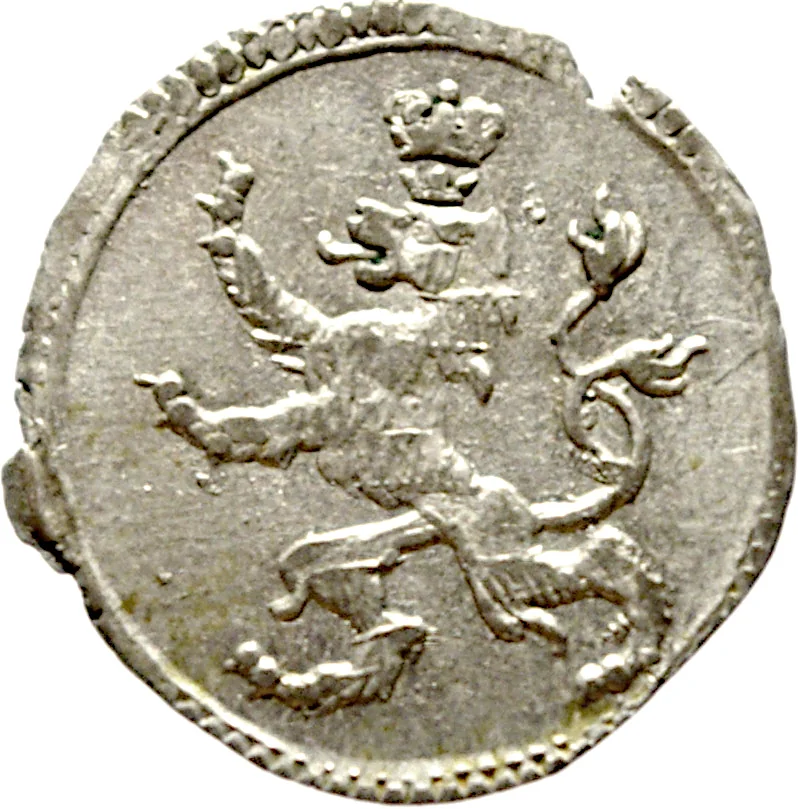
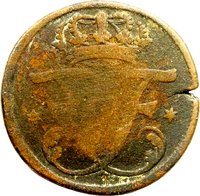
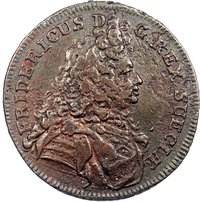
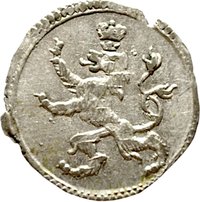
Crowned rampant lion left-facing with forked tail.
Reverse
Description:
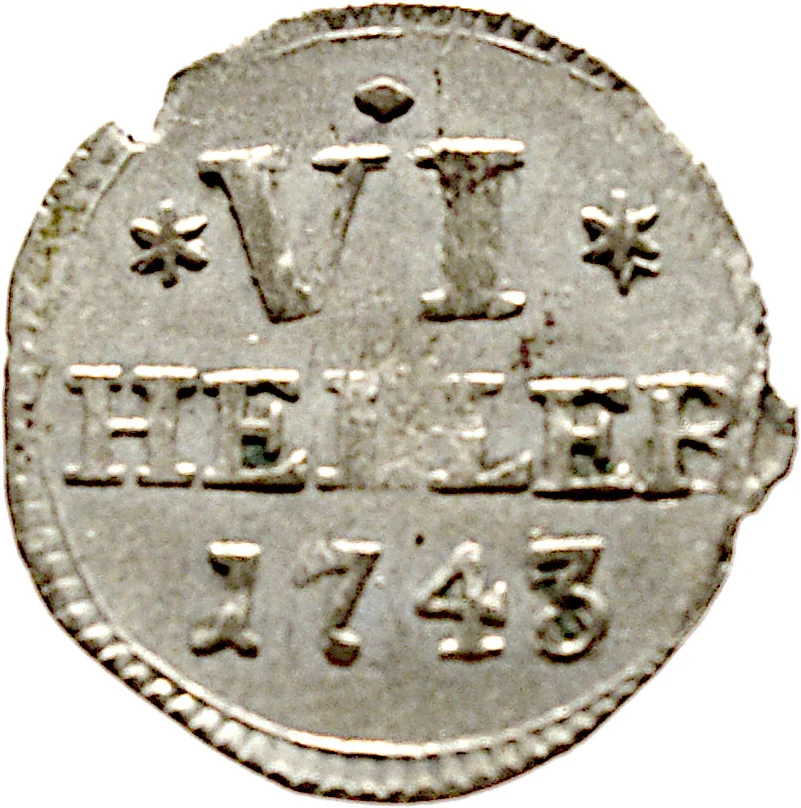
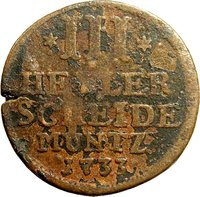
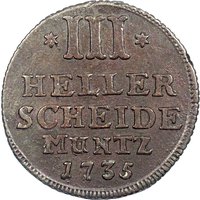
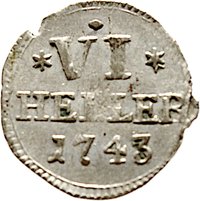
Denomination and date flanked by stars, with a diamond above the "VI."
Inscription:
VI
HELLER
1743
HELLER
1743
Script: Latin
Edge
Mintings
| Year | Mint Mark | Mintage | Quality | Collection |
|---|---|---|---|---|
| 1733 | — | 134,000 | ||
| 1736 | — | 374,000 | ||
| 1737 | — | 263,000 | ||
| 1738 | — | 141,000 | ||
| 1743 | — | — | ||
| 1745 | — | — | ||
| 1746 | — | — | ||
| 1750 | — | — |
Historical background
In 1733, the currency situation in the Landgraviate of Hesse-Cassel was one of profound complexity and instability, a legacy of the region's strategic importance and the financial policies of its rulers. The landgraviate was a key transit territory within the Holy Roman Empire, and its economy was heavily influenced by the passage of trade and troops, particularly due to its practice of Soldatenhandel (renting out soldiers to foreign powers). This generated significant foreign revenue, often in stable silver thalers, but also flooded the domestic market with various foreign coins, creating a chaotic monetary environment.
The core of the problem lay in the coexistence of multiple accounting systems and a proliferation of debased coinage. Officially, accounts were kept in the Reichsthaler (Imperial Thaler), but everyday transactions used a confusing array of actual physical coins, including Gute Groschen, Albuses, and Heller, each with fluctuating values. Successive landgraves, including the current ruler Landgrave Karl I, had frequently engaged in currency manipulation—devaluing coinage to fund state expenditures, especially for their lavish courts and military ventures. This resulted in a severe loss of public trust, as the intrinsic silver content of coins often fell far below their face value.
Consequently, the year 1733 represented a point of mounting pressure for reform. The monetary chaos hindered commerce, created uncertainty for all economic classes, and undermined the state's own financial administration. While a comprehensive standardization would not be fully achieved until later in the century, the dire situation in 1733 set the stage for future attempts, under Landgrave Friedrich II, to establish a stable, unified currency aligned with the Reichsthaler standard, aiming to restore confidence and facilitate the landgraviate's sophisticated fiscal-military state model.
The core of the problem lay in the coexistence of multiple accounting systems and a proliferation of debased coinage. Officially, accounts were kept in the Reichsthaler (Imperial Thaler), but everyday transactions used a confusing array of actual physical coins, including Gute Groschen, Albuses, and Heller, each with fluctuating values. Successive landgraves, including the current ruler Landgrave Karl I, had frequently engaged in currency manipulation—devaluing coinage to fund state expenditures, especially for their lavish courts and military ventures. This resulted in a severe loss of public trust, as the intrinsic silver content of coins often fell far below their face value.
Consequently, the year 1733 represented a point of mounting pressure for reform. The monetary chaos hindered commerce, created uncertainty for all economic classes, and undermined the state's own financial administration. While a comprehensive standardization would not be fully achieved until later in the century, the dire situation in 1733 set the stage for future attempts, under Landgrave Friedrich II, to establish a stable, unified currency aligned with the Reichsthaler standard, aiming to restore confidence and facilitate the landgraviate's sophisticated fiscal-military state model.
✨ Legendary