


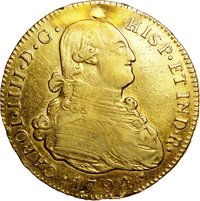
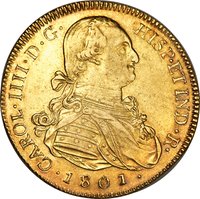
Obverse
Description:
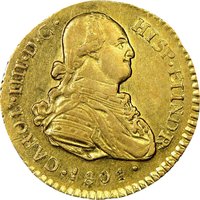
Armored bust right, legend around, date below.
Inscription:
CAROL · IIII · D · G · HISP · ET IND · R ·
· 1794 ·
· 1794 ·
Script: Latin
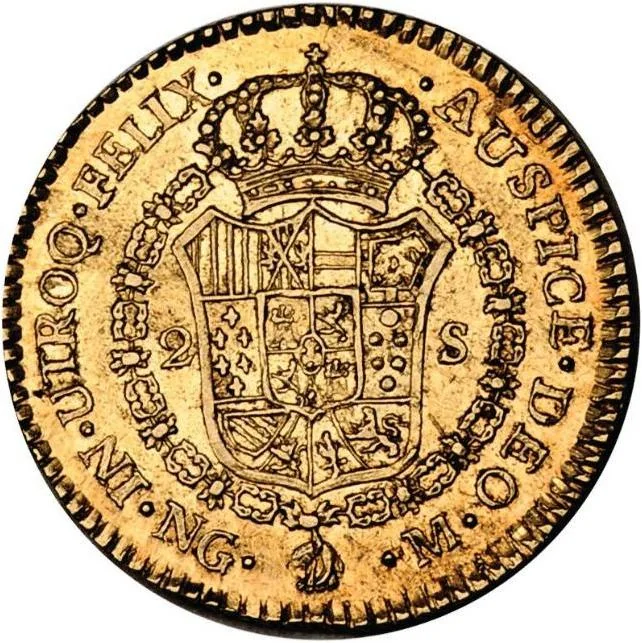
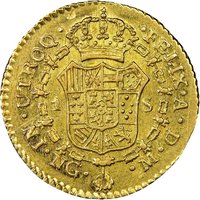
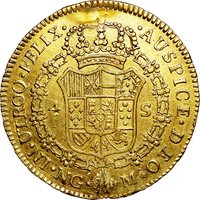
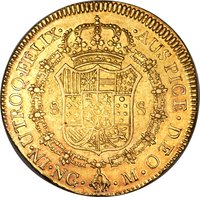
Reverse
Description:
Shield with crown, flanked by value, within chain and legend. Mint mark below.
Inscription:
IN · UTROQ · FELIX · · AUSPICE · DEO
2 S
· NG · · M ·
2 S
· NG · · M ·
Script: Latin
Edge
Categories
| Symbols> Coat of Arms |
| Person> Monarch |
Mints
| Name | Mark |
|---|---|
| Casa de Moneda de Guatemala | NG |
Historical background
In 1794, Guatemala, as the Captaincy General of Guatemala within the Spanish Empire, operated under a complex and often strained monetary system. The official currency was the Spanish colonial real, with eight reales equaling one peso, also known as a "piece of eight." However, the economy suffered from a chronic and severe shortage of official coinage. The vast administrative region, stretching from Chiapas to Costa Rica, relied heavily on trade with its agricultural exports (indigo, cochineal, cacao), but much of the silver and gold produced in the broader Spanish Americas was extracted and sent directly to Spain, leaving the local economy starved for circulating medium.
This scarcity led to the widespread use of substitute currencies, creating a chaotic monetary environment. The most common solution was the use of macacos or tlacos—token coins made of copper or base metals, often issued irregularly by local municipalities, merchants, and even hacienda owners. Their value was highly localized and unstable, leading to confusion and friction in commerce. Furthermore, foreign coins, particularly those from other Spanish colonies and even illicit Portuguese or English pieces, circulated freely, their value determined more by their metal content and local trust than by royal decree.
The Spanish Crown was aware of these problems but was largely ineffective in resolving them from afar. In 1794, authorities in Guatemala City were likely engaged in ongoing appeals to the Crown for a formal mint (Casa de Moneda), a request that would not be granted until 1733 under King Philip V and only became operational decades later. Therefore, the currency situation in 1794 was defined by this duality: an official royal standard that was honored in accounting but scarce in practice, and a practical, disorderly system of tokens and foreign coins that facilitated daily trade but reflected the administrative and economic constraints of a distant colony.
This scarcity led to the widespread use of substitute currencies, creating a chaotic monetary environment. The most common solution was the use of macacos or tlacos—token coins made of copper or base metals, often issued irregularly by local municipalities, merchants, and even hacienda owners. Their value was highly localized and unstable, leading to confusion and friction in commerce. Furthermore, foreign coins, particularly those from other Spanish colonies and even illicit Portuguese or English pieces, circulated freely, their value determined more by their metal content and local trust than by royal decree.
The Spanish Crown was aware of these problems but was largely ineffective in resolving them from afar. In 1794, authorities in Guatemala City were likely engaged in ongoing appeals to the Crown for a formal mint (Casa de Moneda), a request that would not be granted until 1733 under King Philip V and only became operational decades later. Therefore, the currency situation in 1794 was defined by this duality: an official royal standard that was honored in accounting but scarce in practice, and a practical, disorderly system of tokens and foreign coins that facilitated daily trade but reflected the administrative and economic constraints of a distant colony.
Series: 1794 Guatemala circulation coins

✨ Legendary