

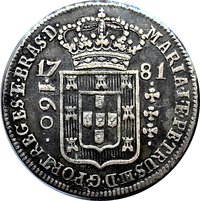
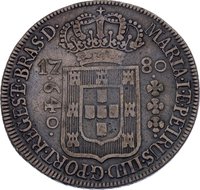
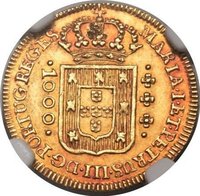
Obverse
Description:
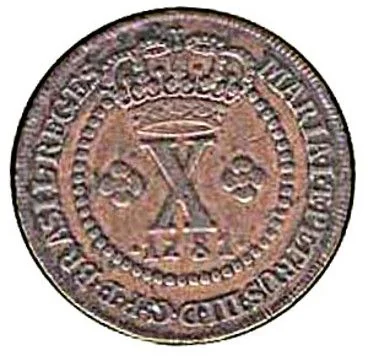
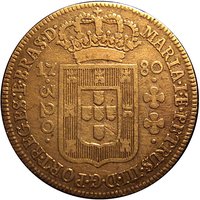
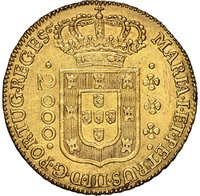
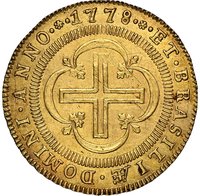
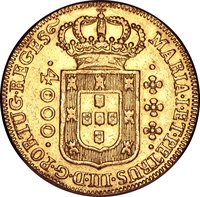
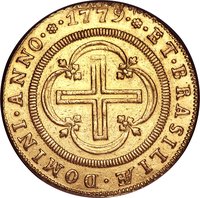
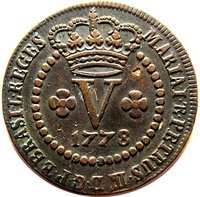
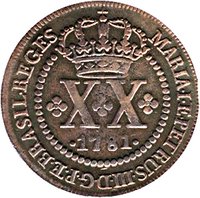
Flowers and date flanking value X, encircled by pearls and crowned.
Inscription:
MARIA·I·ET·PETRUS·III·D·G·P·ET·BRASIL·REGES
X
1781
X
1781
Script: Latin
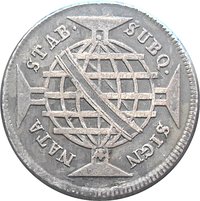
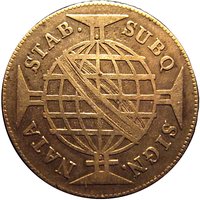
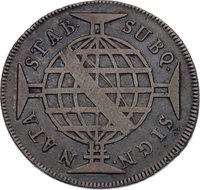
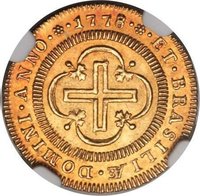
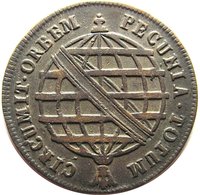
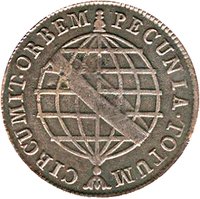
Reverse
Edge
Plain
Mints
| Name | Mark |
|---|---|
| Imprensa Nacional - Casa da Moeda | — |
Mintings
| Year | Mint Mark | Mintage | Quality | Collection |
|---|---|---|---|---|
| 1778 | — | 767,000 | ||
| 1781 | — | 312,000 | ||
| 1782 | — | 295,000 | ||
| 1784 | — | 189,000 | ||
| 1785 | — | 405,000 |
Historical background
In 1778, Brazil, as a colony of the Portuguese Empire, operated under a complex and often strained monetary system. The official currency was the Portuguese real (plural: réis), but the colony suffered from a chronic shortage of specie (coined money). This scarcity was a direct result of mercantilist policies, which drained gold and silver to the metropole, and trade imbalances, particularly with England. Most large-scale commerce and government transactions were therefore conducted through a cumbersome system of credit, bills of exchange, and ledger entries, creating an economy heavily reliant on trust and paper promises.
To alleviate the shortage, a wide variety of foreign coins, especially Spanish-American pesos (often called "patacas" or "pesos fuertes"), circulated unofficially but widely. These coins were valued by their weight and fineness of metal, not by their face value, leading to constant local valuation disputes. Furthermore, due to the lack of small change for everyday transactions, shopkeepers and municipal authorities often issued their own low-value tokens, known as moeda de troco or sinetes. This created a fragmented and localized monetary landscape where the actual medium of exchange could vary significantly from one town to another.
The situation was further complicated by the legacy of gold production. Although the peak of the Minas Gerais gold rush had passed by 1778, gold dust and small, informally minted gold coins still played a role in internal trade, particularly in the southeastern captaincies. The Portuguese Crown, seeking control and profit, had established mints in Bahia and Rio de Janeiro, but their output was insufficient. Consequently, the monetary reality of Brazil in 1778 was one of improvisation: an official currency framework existed on paper, but in practice, the economy functioned on a patchwork of foreign coins, private tokens, credit instruments, and commodity money, reflecting both its colonial subordination and the pragmatic ingenuity of its inhabitants.
To alleviate the shortage, a wide variety of foreign coins, especially Spanish-American pesos (often called "patacas" or "pesos fuertes"), circulated unofficially but widely. These coins were valued by their weight and fineness of metal, not by their face value, leading to constant local valuation disputes. Furthermore, due to the lack of small change for everyday transactions, shopkeepers and municipal authorities often issued their own low-value tokens, known as moeda de troco or sinetes. This created a fragmented and localized monetary landscape where the actual medium of exchange could vary significantly from one town to another.
The situation was further complicated by the legacy of gold production. Although the peak of the Minas Gerais gold rush had passed by 1778, gold dust and small, informally minted gold coins still played a role in internal trade, particularly in the southeastern captaincies. The Portuguese Crown, seeking control and profit, had established mints in Bahia and Rio de Janeiro, but their output was insufficient. Consequently, the monetary reality of Brazil in 1778 was one of improvisation: an official currency framework existed on paper, but in practice, the economy functioned on a patchwork of foreign coins, private tokens, credit instruments, and commodity money, reflecting both its colonial subordination and the pragmatic ingenuity of its inhabitants.
Series: 1778 Brazil circulation coins
💎 Very Rare