

1⁄12 thaler – ERR: County of Stolberg-StolbergandCounty of Stolberg-Rossla
Add to wishlist
Context
Year: 1796
Currency:
Demonetized: Yes
References
KM: #
Numista: #168163
Obverse
Description:
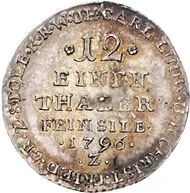
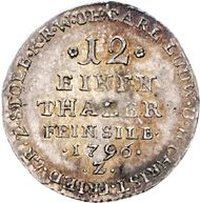
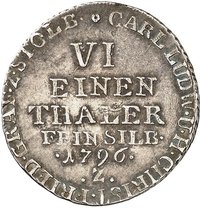
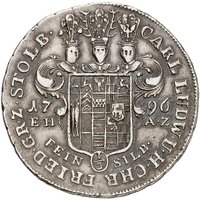
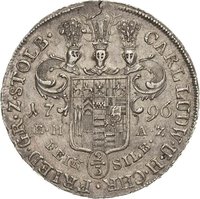
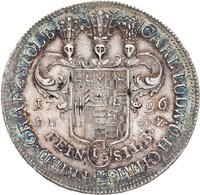
Inscription in four lines, date and mintmaster's initial below.
Inscription:
CARL. LUDW. U. H. CHRIST. FRIED. GR. Z. STOLB. K. R. W. U. H.
12
EINEN
THALER
FEIN SILB.
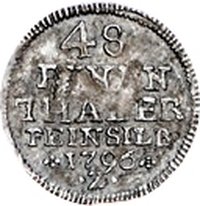
12
EINEN
THALER
FEIN SILB.
Script: Latin
Reverse
Script: Latin
Edge
Mints
| Name | Mark |
|---|---|
| Stolberg, Harz | — |
Mintings
| Year | Mint Mark | Mintage | Quality | Collection |
|---|---|---|---|---|
| 1796 | — | — |
Historical background
In 1796, the currency situation in the County of Stolberg-Stolberg and the County of Stolberg-Rossla was complex and fragmented, reflecting the broader monetary disarray of the Holy Roman Empire. Both counties, though ruled by separate branches of the House of Stolberg, operated within an economic sphere dominated by the larger regional powers, particularly the Electorate of Saxony and the Kingdom of Prussia. Consequently, a multitude of coins circulated simultaneously, including Saxon Thalers and Groschen, Prussian Friedrich d’or and Thalers, and various Reichsthalers and Kreuzers from other German states. This proliferation created a chaotic marketplace where exchange rates fluctuated and calculations for trade were cumbersome.
The lack of a unified, sovereign coinage issued by the Stolberg counts themselves underscored their limited political autonomy. While they possessed the right of minting (Münzregal), it was often exercised intermittently or leased to external parties, meaning locally struck coins were not the primary medium of exchange. The actual monetary landscape was therefore defined by the inflow of coins from trade and the currencies used by neighbouring military forces, a significant factor given the ongoing upheaval of the French Revolutionary Wars. This period saw increased financial strain, with the risk of debased coins and inflationary pressures as various states manipulated their currency to fund military expenditures.
For merchants and residents in Stolberg and Rossla, daily transactions required practical expertise in assessing the weight, metal content, and legitimacy of numerous coins. The situation demanded constant reference to published exchange tables (Wechselkurse) and the services of money changers. Ultimately, the currency chaos of 1796 highlighted the counties' embeddedness within a decaying imperial structure and their vulnerability to external economic forces, a reality that would soon be overtaken by the territorial reorganizations of the Napoleonic era.
The lack of a unified, sovereign coinage issued by the Stolberg counts themselves underscored their limited political autonomy. While they possessed the right of minting (Münzregal), it was often exercised intermittently or leased to external parties, meaning locally struck coins were not the primary medium of exchange. The actual monetary landscape was therefore defined by the inflow of coins from trade and the currencies used by neighbouring military forces, a significant factor given the ongoing upheaval of the French Revolutionary Wars. This period saw increased financial strain, with the risk of debased coins and inflationary pressures as various states manipulated their currency to fund military expenditures.
For merchants and residents in Stolberg and Rossla, daily transactions required practical expertise in assessing the weight, metal content, and legitimacy of numerous coins. The situation demanded constant reference to published exchange tables (Wechselkurse) and the services of money changers. Ultimately, the currency chaos of 1796 highlighted the counties' embeddedness within a decaying imperial structure and their vulnerability to external economic forces, a reality that would soon be overtaken by the territorial reorganizations of the Napoleonic era.

✨ Legendary