

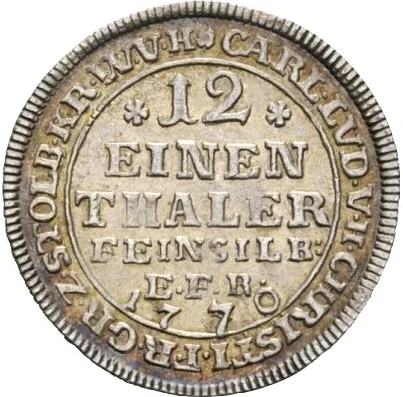
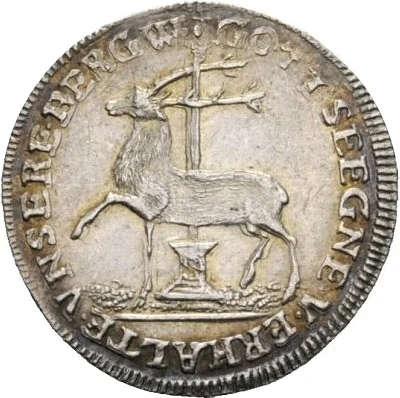
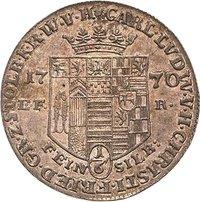
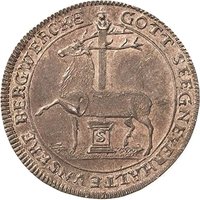
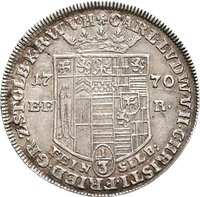
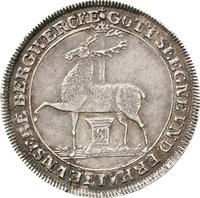
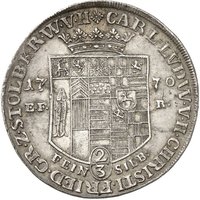
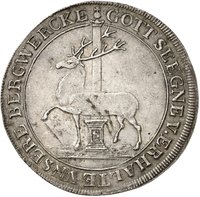
1⁄12 thaler – ERR: County of Stolberg-StolbergandCounty of Stolberg-Rossla
Add to wishlist
Context
Years: 1768–1770
Currency:
Demonetized: Yes
References
KM: #
Numista: #168162
Obverse
Reverse
Edge
Mints
| Name | Mark |
|---|---|
| Stolberg, Harz | — |
Mintings
| Year | Mint Mark | Mintage | Quality | Collection |
|---|---|---|---|---|
| 1768 | — | — | ||
| 1770 | — | — |
Historical background
In 1768, the currency situation in the County of Stolberg-Stolberg and the County of Stolberg-Rossla was complex, rooted in their political fragmentation and economic dependencies. These two counties were part of a broader patchwork of Thuringian states that had emerged from repeated divisions of the original Stolberg inheritance. Crucially, neither county possessed Münzregal (the sovereign right of coinage), a privilege held by their feudal overlord, the Electorate of Saxony. Consequently, they could not issue their own official currency, forcing them to rely on the circulation of externally minted coins.
The monetary landscape was therefore dominated by Saxon currency, particularly the Reichsthaler and Groschen of the Saxon monetary system, which served as the primary standard for larger transactions and accounting. However, due to the region's position at a crossroads of trade routes, a multitude of other currencies also circulated, including coins from neighboring Brunswick, Prussian thalers, and even smaller regional issues. This proliferation led to chronic challenges with exchange rates, valuation, and the presence of debased or foreign coins, complicating daily commerce and financial administration for the county governments and merchants alike.
For the counts and their administrations, managing public finances required meticulous accounting to navigate this heterogeneous system. Revenue from their limited domains (forestry, mining shares, and small industries) and expenditures for the court and infrastructure had to be reconciled across different coinages. The lack of monetary sovereignty was a tangible marker of their limited autonomy within the Holy Roman Empire, binding their economic life tightly to Saxon policy while simultaneously dealing with the practical chaos of a multi-currency environment common to the German states of the period.
The monetary landscape was therefore dominated by Saxon currency, particularly the Reichsthaler and Groschen of the Saxon monetary system, which served as the primary standard for larger transactions and accounting. However, due to the region's position at a crossroads of trade routes, a multitude of other currencies also circulated, including coins from neighboring Brunswick, Prussian thalers, and even smaller regional issues. This proliferation led to chronic challenges with exchange rates, valuation, and the presence of debased or foreign coins, complicating daily commerce and financial administration for the county governments and merchants alike.
For the counts and their administrations, managing public finances required meticulous accounting to navigate this heterogeneous system. Revenue from their limited domains (forestry, mining shares, and small industries) and expenditures for the court and infrastructure had to be reconciled across different coinages. The lack of monetary sovereignty was a tangible marker of their limited autonomy within the Holy Roman Empire, binding their economic life tightly to Saxon policy while simultaneously dealing with the practical chaos of a multi-currency environment common to the German states of the period.
✨ Legendary