Logo Title
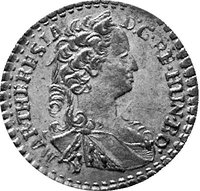
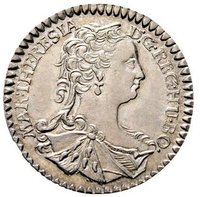
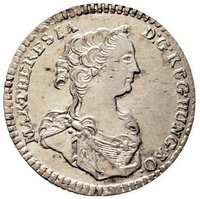
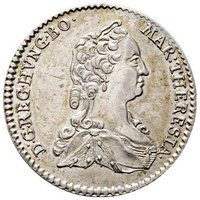
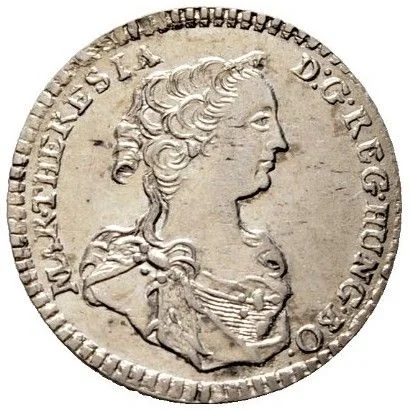
obverse
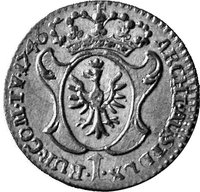
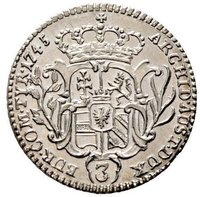
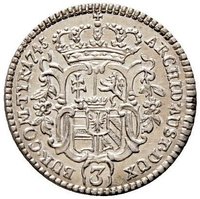
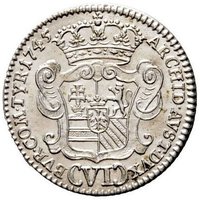
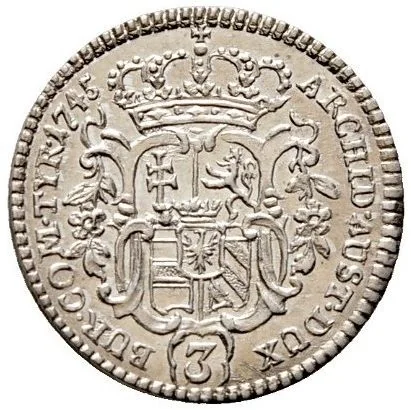
reverse
H. D. Rauch
Context
Year: 1745
Country: Austria Country flag
Currency:
Demonetized: Yes
Material
Diameter: 21 mm
Weight: 1.68 g
Shape: Round
Composition: Billon (35.9% Silver)
References
KM: #Click to copy to clipboard1721
Numista: #167963

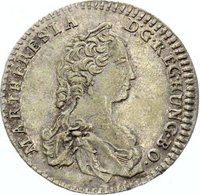
Obverse

Description:
Portrait orientation.
Inscription:
MAR THERESIA D G REG HUNG BO
Script: Latin

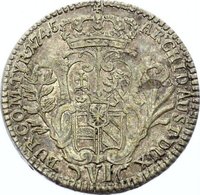
Reverse

Description:
Flowers frame the arms; value below.
Inscription:
ARCHID AUST DUX BUR COM TYR

(3)
Script: Latin

Edge

Plain

Mints

NameMark
Hall

Mintings

YearMint MarkMintageQualityCollection
1745

Historical background

In 1745, the County of Tyrol, a crown land of the Habsburg Monarchy, was navigating a complex and challenging currency landscape typical of the mid-18th century Holy Roman Empire. The primary unit of account was the Tyrolean guilder (Gulden), which was subdivided into 60 kreuzer. However, the monetary system was far from unified. Tyrol itself minted its own coins, most notably the silver Tyroler Gulden and smaller kreuzer pieces, at the historic mint in Hall. Yet, these circulated alongside a plethora of foreign coins from neighboring German states, Italian territories, and other Habsburg lands, each with varying metallic content and value, leading to chronic confusion in trade and daily transactions.

The period was marked by the pressures of the War of the Austrian Succession (1740-1748), which placed severe financial strain on the Habsburg treasury. A common method of raising funds for war was the debasement of coinage—reducing the precious metal content in coins while maintaining their face value. While the Habsburg authorities sought to maintain standards, the temptation to generate seigniorage revenue was strong. This practice, whether enacted in Vienna or suspected locally, eroded public trust in currency, spurred inflation, and encouraged hoarding of older, full-weight coins (Gresham's Law), thereby exacerbating the scarcity of reliable money.

Consequently, the economic environment in Tyrol in 1745 was one of instability and pragmatic adaptation. Merchants and officials had to constantly refer to published exchange lists (Münztafeln) to navigate the dizzying array of circulating specie. The intrinsic value of a coin often mattered more than its stamped denomination, complicating taxation, savings, and commercial contracts. This fragmented system highlighted the tension between Tyrol's semi-autonomous traditions and the centralizing fiscal demands of the Habsburg state, a situation that would persist until more sweeping reforms were implemented under Empress Maria Theresa later in the century.

Series: 1745 County of Tyrol circulation coins

1 Kreuzer obverse
1 Kreuzer reverse
1 Kreuzer
1745-1747
3 Kreuzers obverse
3 Kreuzers reverse
3 Kreuzers
1745
3 Kreuzers obverse
3 Kreuzers reverse
3 Kreuzers
1745
6 Kreuzers obverse
6 Kreuzers reverse
6 Kreuzers
1745
6 Kreuzers obverse
6 Kreuzers reverse
6 Kreuzers
1745
Legendary