Logo Title
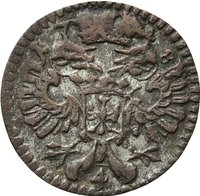
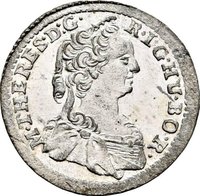
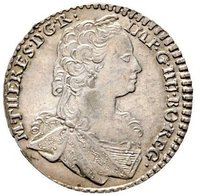
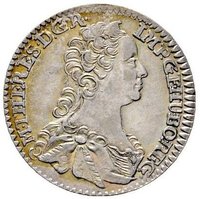
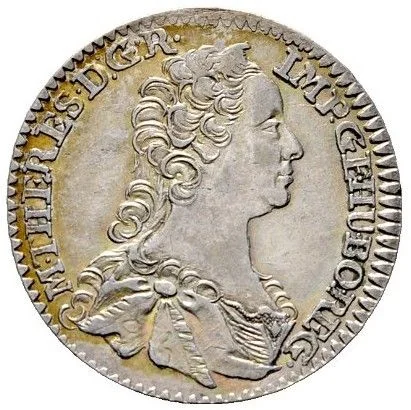
obverse
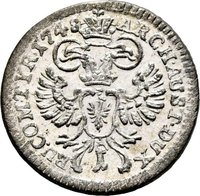
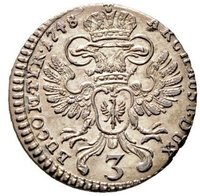
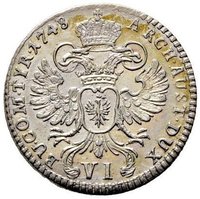
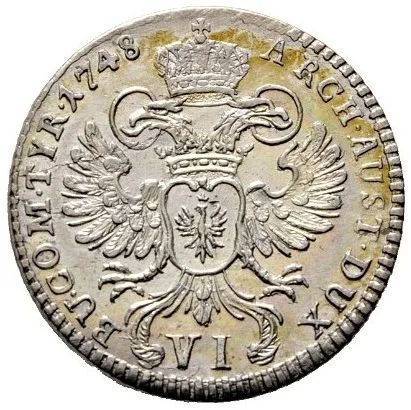
reverse
H. D. Rauch
Context
Years: 1748–1750
Country: Austria Country flag
Currency:
Demonetized: Yes
Material
Diameter: 25 mm
Weight: 2.8 g
Shape: Round
Composition: Billon (43.7% Silver)
References
KM: #Click to copy to clipboard1763
Numista: #167951

Obverse

Description:
Portrait, legend at 8 o'clock.
Inscription:
M THERESIA D G R IMP GE HU BO REG
Script: Latin

Reverse

Description:
Imperial eagle with Tyrol shield, value in roman numerals below.
Inscription:
ARCH AUST DUX BU COM TYR 1748

VI
Script: Latin

Edge

Mints

NameMark
Hall

Mintings

YearMint MarkMintageQualityCollection
1748
1750

Historical background

In 1748, the County of Tyrol, a crown land of the Habsburg Monarchy, was navigating a complex and challenging monetary landscape typical of the mid-18th century Holy Roman Empire. The region did not have a single, unified currency but operated within a system of multiple, concurrently circulating coins. These included older Tyrolean issues, such as the Kreuzer and Gulden, alongside a flood of foreign coins from neighboring German states, Italy, and the wider Habsburg realms. This proliferation created chronic confusion in trade, as the intrinsic silver content and exchange rates between these coins constantly fluctuated, leading to instability and facilitating debasement.

The situation was directly managed by the Habsburg state, which held the right of coinage (Münzregal). In 1748, the reigning monarch was Empress Maria Theresa, whose government was actively engaged in centralizing and reforming the monetary system across her dominions in the wake of the War of the Austrian Succession. While the major imperial currency reform, the Konventionsmünzfuß of 1753, was still a few years away, the groundwork was being laid. The state aimed to standardize the silver content of coins like the Conventionsthaler and the Gulden to streamline finance and taxation, a critical concern for funding the monarchy's military and administrative needs.

For the Tyrolean populace, this pre-reform environment meant daily economic life was fraught with uncertainty. Merchants, farmers, and tradespeople had to be acutely aware of the varying values of different coins, a knowledge gap often exploited by money changers. The instability discouraged long-term investment and complicated simple transactions. Thus, in 1748, Tyrol was in a transitional period, caught between the old era of fragmented regional coinage and the impending imposition of a more standardized, Vienna-directed monetary system designed to strengthen central Habsburg authority and economic cohesion.

Series: 1748 County of Tyrol circulation coins

¼ Kreuzer obverse
¼ Kreuzer reverse
¼ Kreuzer
1748-1749
1 Kreuzer obverse
1 Kreuzer reverse
1 Kreuzer
1748-1757
3 Kreuzers obverse
3 Kreuzers reverse
3 Kreuzers
1748-1750
6 Kreuzers obverse
6 Kreuzers reverse
6 Kreuzers
1748-1750
½ Thaler obverse
½ Thaler reverse
½ Thaler
1748-1750
Legendary