

5 ducats – Austrian Empire
Add to wishlist
Austria
Context
Year: 1745
Country: Austria
Issuer: Austrian Empire
Ruler: Maria Theresa
Currency:
(1520—1754)
Demonetized: Yes
Material
References
KM: #
Numista: #166774
Value
Bullion value: $2641.02
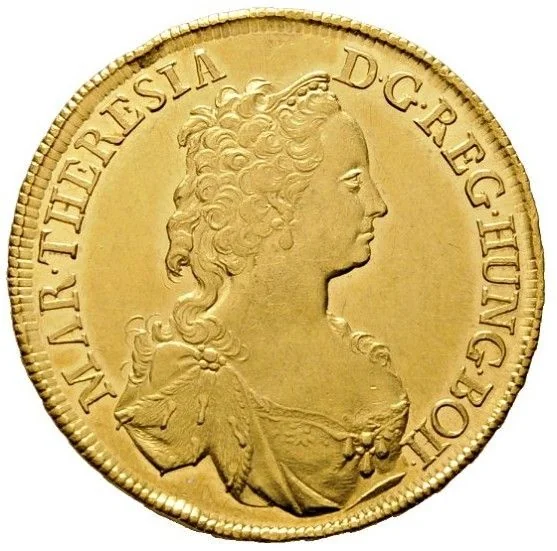
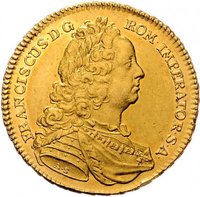
Obverse
Description:
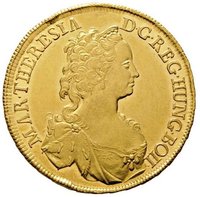
Right-facing bust, truncation at rim, legend begins at 8 o'clock.
Inscription:
MAR THERESIA // D G REG HUNG BOH
Script: Latin
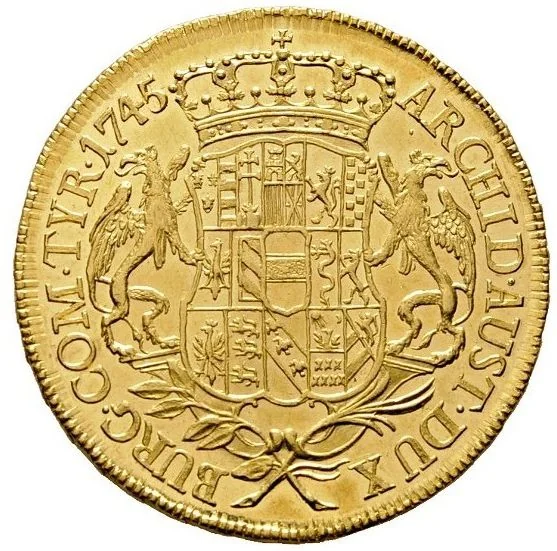
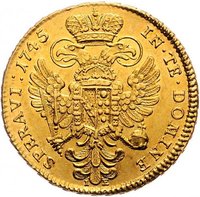
Reverse
Description:
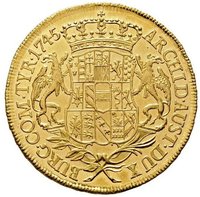
Crowned arms with central Austrian shield, supported by griffons.
Inscription:
ARCHID AUST DUX // BURG COM TYR 1745
Script: Latin
Edge
Mints
| Name | Mark |
|---|---|
| Münze Österreich | — |
Mintings
| Year | Mint Mark | Mintage | Quality | Collection |
|---|---|---|---|---|
| 1745 | — | — |
Historical background
In 1745, the currency system of the Habsburg Monarchy, often referred to as the Austrian Empire, was in a state of profound instability and crisis, a direct legacy of the expensive wars of the previous decades, particularly the War of the Austrian Succession (1740-1748). The state's relentless need to finance massive military campaigns led to a chronic fiscal shortfall. This deficit was primarily addressed not through efficient taxation but through the debasement of the coinage. The state mint, under the direction of the Court Chamber, repeatedly reduced the silver content in large denomination coins (like the Konventionstaler) and especially in the small, everyday kreuzer coins, while officially maintaining their face value. This practice, effectively a form of inflation, eroded public trust and disrupted commerce.
The result was a chaotic monetary landscape with a wide gap between the official Banco money of account (used for large transactions and state finance) and the depreciated current coinage used in daily life. Furthermore, the empire was not a unified economic zone; various constituent lands, such as Hungary and the Austrian Netherlands, often operated with their own monetary conventions and minted coins, complicating trade across the monarchy. The flood of underweight, debased coins also drove older, full-weight coins out of circulation (Gresham's Law), worsening the scarcity of reliable currency. Prices rose sharply, causing hardship for soldiers, civil servants on fixed pay, and the poor, while benefiting some debtors and speculators.
Recognizing the crisis, the state had begun attempts at reform. The pivotal year of 1745 saw the foundation of the Wiener Stadtbanco, a government-backed bank in Vienna, which began issuing paper Bancozettel. These were not yet true banknotes for public circulation but rather interest-bearing bonds that could be used as a more stable transfer and accounting medium for large transactions, laying a crucial foundation for future financial stability. However, a comprehensive recoinage and standardization of the metallic currency would only be achieved later with the major monetary reforms of Empress Maria Theresa, particularly the Conventionsfuß of 1753, which established a stable silver standard across much of the empire. Thus, 1745 represents a low point of monetary disorder, but also the beginning of a structured, state-led effort to restore financial credibility.
The result was a chaotic monetary landscape with a wide gap between the official Banco money of account (used for large transactions and state finance) and the depreciated current coinage used in daily life. Furthermore, the empire was not a unified economic zone; various constituent lands, such as Hungary and the Austrian Netherlands, often operated with their own monetary conventions and minted coins, complicating trade across the monarchy. The flood of underweight, debased coins also drove older, full-weight coins out of circulation (Gresham's Law), worsening the scarcity of reliable currency. Prices rose sharply, causing hardship for soldiers, civil servants on fixed pay, and the poor, while benefiting some debtors and speculators.
Recognizing the crisis, the state had begun attempts at reform. The pivotal year of 1745 saw the foundation of the Wiener Stadtbanco, a government-backed bank in Vienna, which began issuing paper Bancozettel. These were not yet true banknotes for public circulation but rather interest-bearing bonds that could be used as a more stable transfer and accounting medium for large transactions, laying a crucial foundation for future financial stability. However, a comprehensive recoinage and standardization of the metallic currency would only be achieved later with the major monetary reforms of Empress Maria Theresa, particularly the Conventionsfuß of 1753, which established a stable silver standard across much of the empire. Thus, 1745 represents a low point of monetary disorder, but also the beginning of a structured, state-led effort to restore financial credibility.
✨ Legendary