

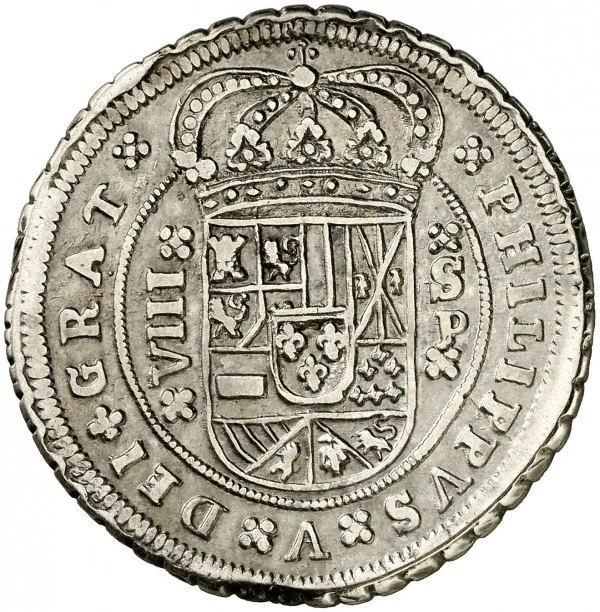
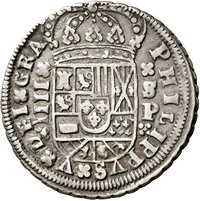
Obverse
Description:
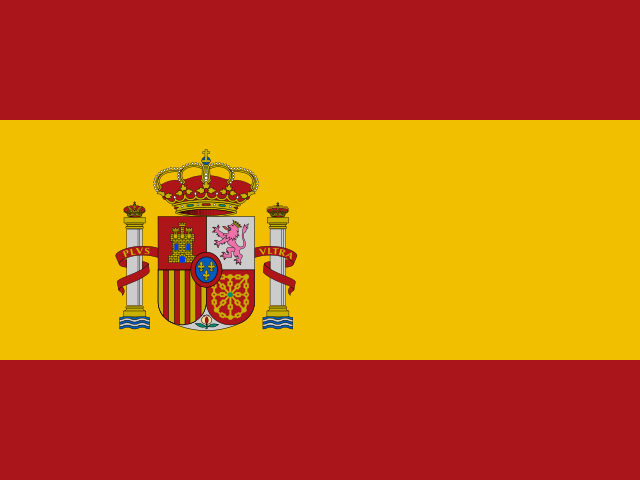
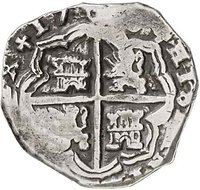
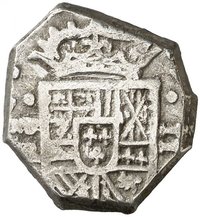
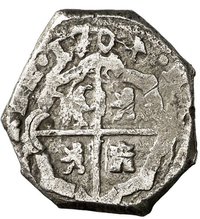
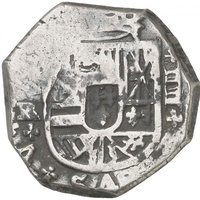
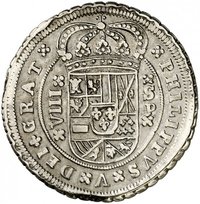
Spanish coat of arms in dotted circle.
Inscription:
✤ PHILIPPVS ✤ V ✤ DEI ✤ GRAT ✤
✤ VIII ✤
✤ S P ✤
✤ VIII ✤
✤ S P ✤
Script: Latin
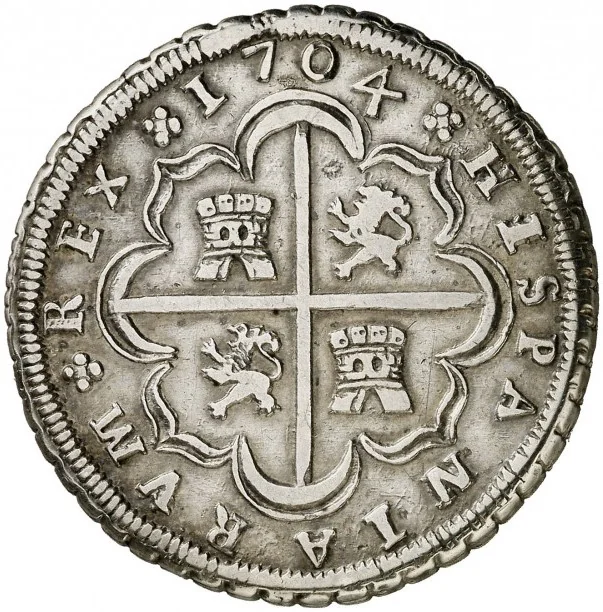
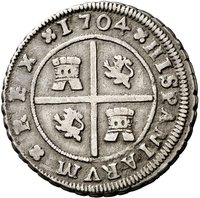
Reverse
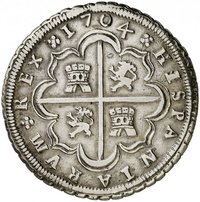
Description:
Castile and León's coat of arms in an octolobe.
Inscription:
✤ 1704 ✤ HISPANIARVM ✤ REX
Script: Latin
Edge
Embossed pattern
Categories
| Symbols> Coat of Arms |
Mints
| Name | Mark |
|---|---|
| Royal Mint of Seville | (S) |
Mintings
| Year | Mint Mark | Mintage | Quality | Collection |
|---|---|---|---|---|
| 1704 | SP | — | ||
| 1705 | SP | — | ||
| 1706 | SP | — | ||
| 1707 | SM | — | ||
| 1708 | SM | — | ||
| 1709 | SM | — | ||
| 1711 | SM | — | ||
| 1713 | SM | — |
Historical background
In 1704, Spain found itself in the midst of the War of the Spanish Succession (1701-1714), a conflict that was fundamentally a financial and monetary crisis as much as a dynastic and military one. The war, fought over the contested throne of the childless King Charles II, pitted the Bourbon claimant Philip V (supported by France) against the Habsburg claimant Archduke Charles (supported by the Grand Alliance of England, the Dutch Republic, and Austria). The immense cost of mobilizing and supplying armies across the peninsula and Europe placed an unbearable strain on the Spanish treasury, which had been in a state of chronic weakness for over a century.
This fiscal emergency directly dictated the currency situation. To finance the war, the regime of Philip V, following a practice long used by his Habsburg predecessors, resorted to severe currency debasement. The principal silver coin, the real, and the ubiquitous vellón (a crude coin of copper or billon) were systematically reduced in their precious metal content. The crown would call in existing coins, melt them down, and reissue them with a higher face value but less intrinsic worth, a process known as enhancement. This created a rapid and confusing proliferation of coin types with different values, severely disrupting trade and market confidence.
The immediate consequence was rampant inflation, a collapse in public credit, and widespread economic hardship. Prices soared as the value of money fell, causing shortages and social unrest. Furthermore, the competing authorities in different regions—as parts of Catalonia, Valencia, and Aragon supported the Habsburg claimant—sometimes issued their own emergency coinage, adding to the monetary chaos. Thus, in 1704, Spain’s currency was not a tool of stable commerce but an instrument of war finance, reflecting a kingdom in the painful process of being torn apart and its economy pushed to the brink.
This fiscal emergency directly dictated the currency situation. To finance the war, the regime of Philip V, following a practice long used by his Habsburg predecessors, resorted to severe currency debasement. The principal silver coin, the real, and the ubiquitous vellón (a crude coin of copper or billon) were systematically reduced in their precious metal content. The crown would call in existing coins, melt them down, and reissue them with a higher face value but less intrinsic worth, a process known as enhancement. This created a rapid and confusing proliferation of coin types with different values, severely disrupting trade and market confidence.
The immediate consequence was rampant inflation, a collapse in public credit, and widespread economic hardship. Prices soared as the value of money fell, causing shortages and social unrest. Furthermore, the competing authorities in different regions—as parts of Catalonia, Valencia, and Aragon supported the Habsburg claimant—sometimes issued their own emergency coinage, adding to the monetary chaos. Thus, in 1704, Spain’s currency was not a tool of stable commerce but an instrument of war finance, reflecting a kingdom in the painful process of being torn apart and its economy pushed to the brink.
Series: 1704 Spain circulation coins
✨ Legendary