

12 Florins – Hungary
Hungary

Obverse
Description:
Right-facing laureate bust with curls, necklace, and Golden Fleece ring; behind neck, crowned double Hungarian shield; on right, Madonna on crescent.
Inscription:
FERDINAND D · G · RO · I · S · AVG · GER · HVN BOH · REX
Reverse
Description:
Imperial double-headed eagle with sword and scepter, holding a quartered shield (Árpád stripes, Bohemian lion twice, Árpád stripes) with an inescutcheon of Austrian and Burgundian arms. Mintmark below.
Inscription:
ARCHIDVX · AVS · DVX · BVR · MAR · MOR · CO · TYR · 1636 ·
K B
K B
Edge
Plain
Mints
| Name | Mark |
|---|---|
| Kremnica | KB |
Mintings
| Year | Mint Mark | Mintage | Quality | Collection |
|---|---|---|---|---|
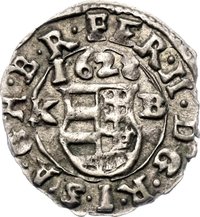
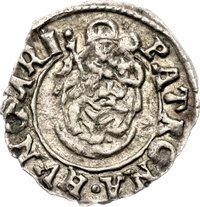
| 1626 | K-B | — |
Historical background
In 1626, Hungary existed as a divided and war-torn kingdom, a reality that fundamentally shaped its chaotic currency situation. The realm was split three ways: Royal Hungary under Habsburg rule in the west and north, the Ottoman-occupied central plains, and the semi-independent Principality of Transylvania in the east. This political fragmentation meant there was no unified monetary authority. Instead, the circulation was a jumble of domestic and foreign coins, including the Habsburg thalers and kreutzers from the north, Turkish akçes and gold sultani from the occupied territories, and Transylvanian denars, all competing at fluctuating exchange rates.
The primary source of monetary instability, however, was the rampant debasement of the silver-based denar coinage, orchestrated by the Habsburg government in Vienna. Facing immense costs from the ongoing Thirty Years' War (1618-1648), the Habsburgs systematically reduced the silver content of coins minted for Hungary, particularly at the mining town of Körmöcbánya (present-day Kremnica, Slovakia). This practice, while providing short-term revenue for the imperial war chest, led to severe inflation and a classic "bad money drives out good" (Gresham's Law) scenario within Royal Hungary. Older, purer coins were hoarded or exported, leaving the populace with ever-worsening currency.
This economic turmoil had profound social consequences, exacerbating the hardships of a population already suffering from warfare, Ottoman raids, and religious conflict. The debasement effectively acted as a hidden tax, eroding savings, disrupting trade, and fueling widespread discontent, particularly among the nobility and soldiers who were paid in the devalued coins. Thus, the currency crisis of 1626 was not merely a financial issue but a key factor in the growing political tensions between the Hungarian estates and their Habsburg monarchs, foreshadowing the period of further strife and rebellion that would mark the rest of the 17th century.
The primary source of monetary instability, however, was the rampant debasement of the silver-based denar coinage, orchestrated by the Habsburg government in Vienna. Facing immense costs from the ongoing Thirty Years' War (1618-1648), the Habsburgs systematically reduced the silver content of coins minted for Hungary, particularly at the mining town of Körmöcbánya (present-day Kremnica, Slovakia). This practice, while providing short-term revenue for the imperial war chest, led to severe inflation and a classic "bad money drives out good" (Gresham's Law) scenario within Royal Hungary. Older, purer coins were hoarded or exported, leaving the populace with ever-worsening currency.
This economic turmoil had profound social consequences, exacerbating the hardships of a population already suffering from warfare, Ottoman raids, and religious conflict. The debasement effectively acted as a hidden tax, eroding savings, disrupting trade, and fueling widespread discontent, particularly among the nobility and soldiers who were paid in the devalued coins. Thus, the currency crisis of 1626 was not merely a financial issue but a key factor in the growing political tensions between the Hungarian estates and their Habsburg monarchs, foreshadowing the period of further strife and rebellion that would mark the rest of the 17th century.

✨ Legendary