

1 Florin – Hungary
Hungary

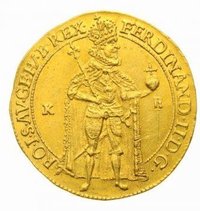
Obverse
Description:
King standing right in vestments, holding orb and scepter, sword at belt; mintmark divided within inner circle.
Inscription:
FER · II · D · G · R · I · S · · A · ¤ ·GE · HV · B · RE
K B
K B
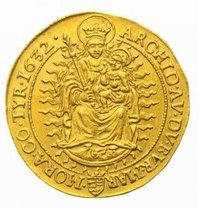
Reverse
Description:
Crowned Madonna seated on a cushion, holding the child and a scepter, above the crowned Hungarian coat of arms.
Inscription:
AR · AV · DVX · BVR · · COM · TY · 1632 ·
Edge
Plain
Mintings
| Year | Mint Mark | Mintage | Quality | Collection |
|---|---|---|---|---|
| 1632 | N-B | — |
Historical background
In 1632, Hungary existed as a fractured kingdom divided into three parts: Royal Hungary under Habsburg rule in the north and west, Ottoman-occupied central territories, and the semi-independent Principality of Transylvania in the east. This political fragmentation directly caused a chaotic and multi-layered currency situation. The Habsburgs, ruling from Vienna, minted and circulated imperial thalers and kreutzers in Royal Hungary, aiming to standardize the monetary system under their control. However, the ongoing Long Turkish War (1593-1606) and subsequent conflicts had drained royal coffers, leading to repeated debasements of these coins, which eroded public trust and their value.
Simultaneously, a vast quantity of underweight and poor-quality Turkish akçe coins circulated in the Ottoman-occupied regions, often entering Habsburg lands through trade and conflict, further complicating transactions. Most disruptive, however, was the flood of independently minted, debased coinage from the Principality of Transylvania. Rulers like Gabriel Bethlen (1613-1629) had aggressively minted lower-quality silver and copper coins, known as "counterfeit" or "light" money, to finance military campaigns against the Habsburgs. These coins poured across borders, driving out better-quality money through Gresham's Law.
Consequently, the Hungarian economy in 1632 suffered from severe monetary instability. Multiple coinages of varying intrinsic values and origins circulated simultaneously, causing confusion, price inflation, and widespread distrust in everyday commerce. This monetary disarray mirrored the kingdom's political disintegration, hindering economic recovery and creating a constant source of tension between the Habsburg monarchy, which sought fiscal control, and the estates and subjects who navigated a precarious and unreliable monetary environment.
Simultaneously, a vast quantity of underweight and poor-quality Turkish akçe coins circulated in the Ottoman-occupied regions, often entering Habsburg lands through trade and conflict, further complicating transactions. Most disruptive, however, was the flood of independently minted, debased coinage from the Principality of Transylvania. Rulers like Gabriel Bethlen (1613-1629) had aggressively minted lower-quality silver and copper coins, known as "counterfeit" or "light" money, to finance military campaigns against the Habsburgs. These coins poured across borders, driving out better-quality money through Gresham's Law.
Consequently, the Hungarian economy in 1632 suffered from severe monetary instability. Multiple coinages of varying intrinsic values and origins circulated simultaneously, causing confusion, price inflation, and widespread distrust in everyday commerce. This monetary disarray mirrored the kingdom's political disintegration, hindering economic recovery and creating a constant source of tension between the Habsburg monarchy, which sought fiscal control, and the estates and subjects who navigated a precarious and unreliable monetary environment.

✨ Legendary