

1 groschen – Hungary
Add to wishlist
Hungary
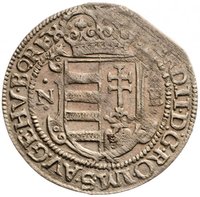
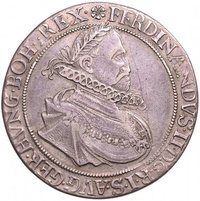
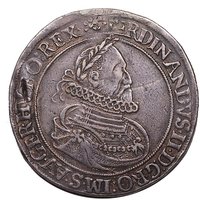
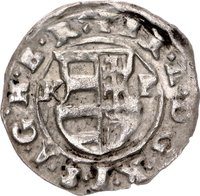
Obverse
Description:
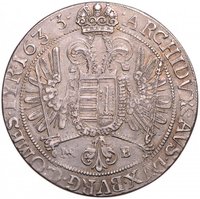
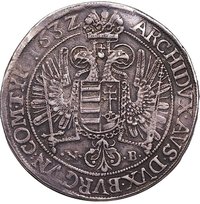
Twice-crowned Hungarian coat of arms divides the mint mark within an inner circle.
Inscription:
+ FERDINANDVS · II · D · G · R · I · S · AV · GE · HV · BO · REX
N B
N B
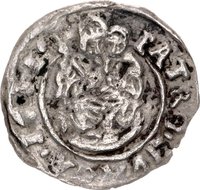
Reverse
Description:
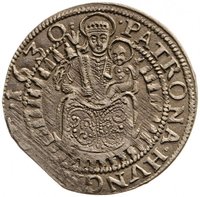
Radiant Madonna, crowned and holding child and scepter, on a crescent moon.
Inscription:
PATRONA · HVNGARIAE· 1630 ·
Edge
Plain
Mints
| Name | Mark |
|---|---|
| Baia Mare | NB |
Mintings
| Year | Mint Mark | Mintage | Quality | Collection |
|---|---|---|---|---|
| 1630 | N-B | — |
Historical background
In 1630, the Kingdom of Hungary was in a state of severe monetary crisis, a direct consequence of the ongoing Thirty Years' War (1618-1648) and its division between the Habsburg-ruled Royal Hungary in the west and north, the Ottoman-controlled central territories, and the semi-independent Principality of Transylvania in the east. The Habsburg monarchy, perpetually short of funds for its massive military expenditures, systematically debased the silver coinage minted for circulation in Hungary, notably the denarius (denar). This practice, which involved reducing the precious metal content while maintaining the face value, flooded the country with low-quality, "bad" money, causing rampant inflation and a loss of public trust in the currency.
The monetary landscape was chaotic, characterized by the simultaneous circulation of officially minted but debased coins, older higher-quality coins that were hoarded or exported, and a multitude of foreign currencies from neighboring states. This led to Gresham's Law in action, where "bad money drives out good." Peasants and merchants suffered greatly as prices for essential goods soared, while taxes and feudal dues owed to landlords, often fixed in nominal terms, became increasingly burdensome in real value. The Habsburg authorities' attempts to mandate the acceptance of the debased coinage only deepened economic distress and social unrest.
Furthermore, the fragmented political control of the Carpathian Basin exacerbated the problem. The Ottoman-occupied regions and Transylvania operated under different monetary systems and policies, creating complex exchange zones and hindering internal trade. The currency debasement was not merely an economic tool but also a form of war financing that extracted wealth from the Hungarian kingdom to support the Habsburgs' broader European conflicts, placing a disproportionate burden on the Hungarian population and contributing to the deepening economic and political grievances that would fuel future uprisings.
The monetary landscape was chaotic, characterized by the simultaneous circulation of officially minted but debased coins, older higher-quality coins that were hoarded or exported, and a multitude of foreign currencies from neighboring states. This led to Gresham's Law in action, where "bad money drives out good." Peasants and merchants suffered greatly as prices for essential goods soared, while taxes and feudal dues owed to landlords, often fixed in nominal terms, became increasingly burdensome in real value. The Habsburg authorities' attempts to mandate the acceptance of the debased coinage only deepened economic distress and social unrest.
Furthermore, the fragmented political control of the Carpathian Basin exacerbated the problem. The Ottoman-occupied regions and Transylvania operated under different monetary systems and policies, creating complex exchange zones and hindering internal trade. The currency debasement was not merely an economic tool but also a form of war financing that extracted wealth from the Hungarian kingdom to support the Habsburgs' broader European conflicts, placing a disproportionate burden on the Hungarian population and contributing to the deepening economic and political grievances that would fuel future uprisings.
Series: 1630 Hungary circulation coins

✨ Legendary