

2 Thalers – Hungary
Hungary

Obverse
Description:
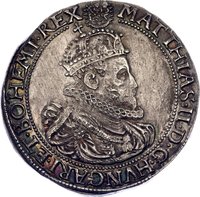
Matthias, armored and crowned, faces right with the Golden Fleece. The inner circle bears his royal titles, while above his crown, the Madonna and Child appear.
Inscription:
MATTHIAS · II · D · G · HVN · ET · BOHE · REX
Reverse
Description:
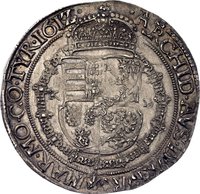
Crowned curved quartered shield (Árpád stripes, double cross, Bohemian lion, Dalmatian leopard heads, Moravian eagle) with an Austrian-Burgundian inescutcheon divides "KB" mintmark. Golden Fleece necklace inside inner circle, date in legend.
Inscription:
ARCHID · AV · DV · BV · MA · MO · CO · TY · 1610 ·
K B
K B
Edge
Plain
Mints
| Name | Mark |
|---|---|
| Kremnica | KB |
Mintings
| Year | Mint Mark | Mintage | Quality | Collection |
|---|---|---|---|---|
| 1612 | K-B | — |
Historical background
In 1612, Hungary existed as a fractured kingdom divided into three parts: Royal Hungary under Habsburg rule in the north and west, the Ottoman-occupied central territories, and the semi-independent Principality of Transylvania in the east. This political fragmentation directly caused a severe and chaotic monetary situation. Each power minted its own currency—the Habsburgs struck thalers and kreutzers in places like Kremnica, the Ottomans circulated Ottoman akçe, and Transylvania issued its own coins, notably the silver denarius. This resulted in a bewildering mix of coins of varying weights, purity, and value circulating simultaneously, undermining any unified economic system.
The core of the crisis was rampant currency debasement, a practice employed by all ruling entities to fund near-constant military expenditures against one another. By reducing the precious metal content in coins while maintaining their face value, authorities could create more money from the same silver reserves, effectively financing their armies through inflation. This led to a classic "bad money drives out good" (Gresham's Law) scenario, where older, purer coins were hoarded or melted down, leaving the economy flooded with unstable, weak currency. The value of money became highly unreliable, damaging trade and creating hardship for the common population.
Consequently, the monetary chaos of 1612 was not merely a financial issue but a symptom of Hungary's geopolitical disintegration. The competing currencies and relentless debasement crippled long-distance commerce, complicated tax collection, and eroded economic stability. This environment of financial uncertainty persisted throughout the 17th century, reflecting the ongoing struggle for control of the Hungarian heartland and hindering the kingdom's economic development during a period of intense political and military conflict.
The core of the crisis was rampant currency debasement, a practice employed by all ruling entities to fund near-constant military expenditures against one another. By reducing the precious metal content in coins while maintaining their face value, authorities could create more money from the same silver reserves, effectively financing their armies through inflation. This led to a classic "bad money drives out good" (Gresham's Law) scenario, where older, purer coins were hoarded or melted down, leaving the economy flooded with unstable, weak currency. The value of money became highly unreliable, damaging trade and creating hardship for the common population.
Consequently, the monetary chaos of 1612 was not merely a financial issue but a symptom of Hungary's geopolitical disintegration. The competing currencies and relentless debasement crippled long-distance commerce, complicated tax collection, and eroded economic stability. This environment of financial uncertainty persisted throughout the 17th century, reflecting the ongoing struggle for control of the Hungarian heartland and hindering the kingdom's economic development during a period of intense political and military conflict.
Series: 1612 Hungary circulation coins

✨ Legendary