

3 thalers – Hungary
Add to wishlist
Hungary
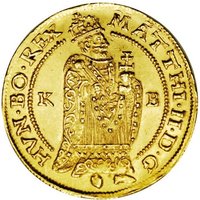
Obverse
Description:
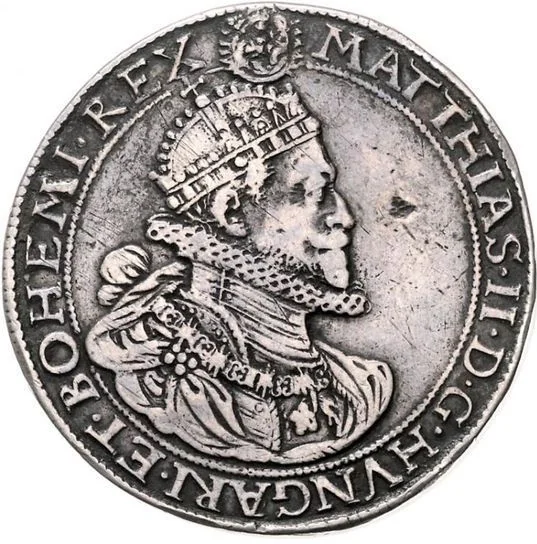
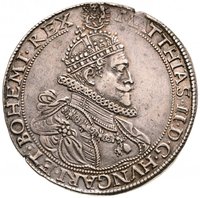
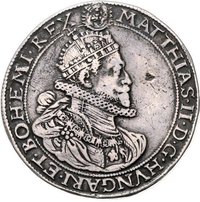
Matthias, armored and crowned, faces right with the Golden Fleece. The inner circle bears his royal titles, while above his crown, the Madonna and Child appear.
Inscription:
MATTHIAS·II·D·G·HVNGARI·ET·BOHEMI·REX
Script: Latin
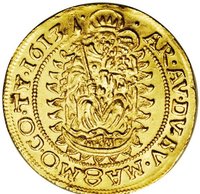
Reverse
Description:
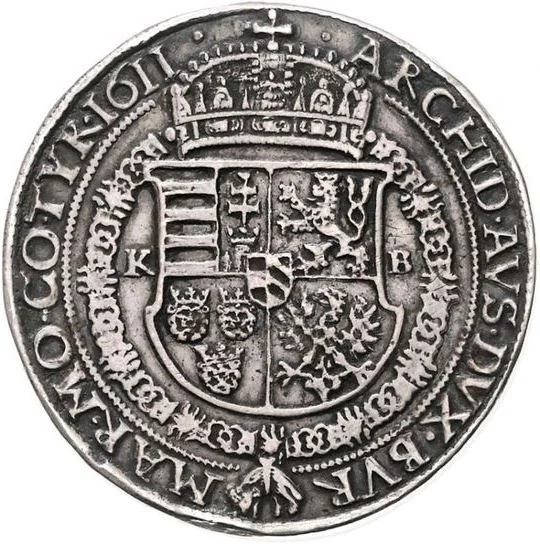
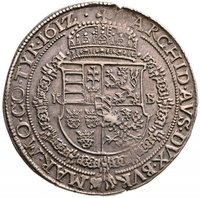
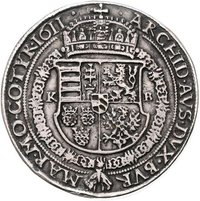
Crowned curved quartered shield (Árpád stripes, double cross, Bohemian lion, Dalmatian leopard heads, Moravian eagle) with an Austrian-Burgundian inescutcheon divides "KB" mintmark. Golden Fleece necklace inside inner circle, date in legend.
Inscription:
ARCHID·AVS·DVX·BVR· MAR·MO·CO·TYR·1612
Script: Latin
Edge
Plain
Categories
| Symbols> Coat of Arms |
Mints
| Name | Mark |
|---|---|
| Kremnica | KB |
Mintings
| Year | Mint Mark | Mintage | Quality | Collection |
|---|---|---|---|---|
| 1611 | K-B | — |
Historical background
In 1611, the Kingdom of Hungary was grappling with a severe and protracted currency crisis, a direct consequence of the ongoing Long Turkish War (1593-1606) and the internal strife of the Fifteen Years' War (1604-1608). The immense cost of these conflicts had drained the royal treasury, leading the Habsburg court in Vienna, which ruled Royal Hungary, to repeatedly debase the silver coinage. The primary currency, the denarius (or filler), was minted with ever-decreasing silver content, causing its intrinsic value to plummet and triggering rampant inflation. This practice, essentially a form of state bankruptcy, eroded public trust in the currency and devastated the economy, particularly harming soldiers paid in weak coins and peasants required to pay feudal dues in sound currency.
The monetary chaos was compounded by a bewildering circulation of various coins. Alongside the debased domestic issues, older, high-quality Hungarian silver thalers (or talér) from the early 16th century remained in use but were hoarded or exported, following Gresham's Law that "bad money drives out good." Furthermore, a flood of foreign coins, especially lightweight Polish and Transylvanian issues, along with Turkish akçe, circulated freely, creating a complex and unreliable monetary environment. This made trade difficult and prices unstable, as the value of coins was determined more by their uncertain metal content and weight than by their face value.
Attempts at reform, such as the 1604 Nagyszombat (Trnava) decree, had failed to stabilize the situation. By 1611, the Habsburg authorities, under Emperor Matthias, were still struggling to assert control. The crisis was not merely economic but also political, undermining the authority of the central government and exacerbating tensions with the Hungarian estates, who fiercely guarded their traditional rights, including control over taxation and local administration. Thus, the currency situation reflected the broader fragility of the realm, caught between Ottoman pressure, Habsburg fiscal demands, and domestic nobility's resistance.
The monetary chaos was compounded by a bewildering circulation of various coins. Alongside the debased domestic issues, older, high-quality Hungarian silver thalers (or talér) from the early 16th century remained in use but were hoarded or exported, following Gresham's Law that "bad money drives out good." Furthermore, a flood of foreign coins, especially lightweight Polish and Transylvanian issues, along with Turkish akçe, circulated freely, creating a complex and unreliable monetary environment. This made trade difficult and prices unstable, as the value of coins was determined more by their uncertain metal content and weight than by their face value.
Attempts at reform, such as the 1604 Nagyszombat (Trnava) decree, had failed to stabilize the situation. By 1611, the Habsburg authorities, under Emperor Matthias, were still struggling to assert control. The crisis was not merely economic but also political, undermining the authority of the central government and exacerbating tensions with the Hungarian estates, who fiercely guarded their traditional rights, including control over taxation and local administration. Thus, the currency situation reflected the broader fragility of the realm, caught between Ottoman pressure, Habsburg fiscal demands, and domestic nobility's resistance.
Series: 1611 Hungary circulation coins

✨ Legendary