

1 Thaler – Austrian Empire
Austria
Context
Year: 1657
Country: Austria 
Issuer: Austrian Empire
Ruler: Ferdinand III
Currency:
(1520—1754)
Demonetized: Yes
References
KM: #Click to copy to clipboard1003
Numista: #165675
Obverse
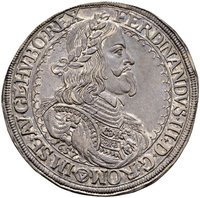
Description:
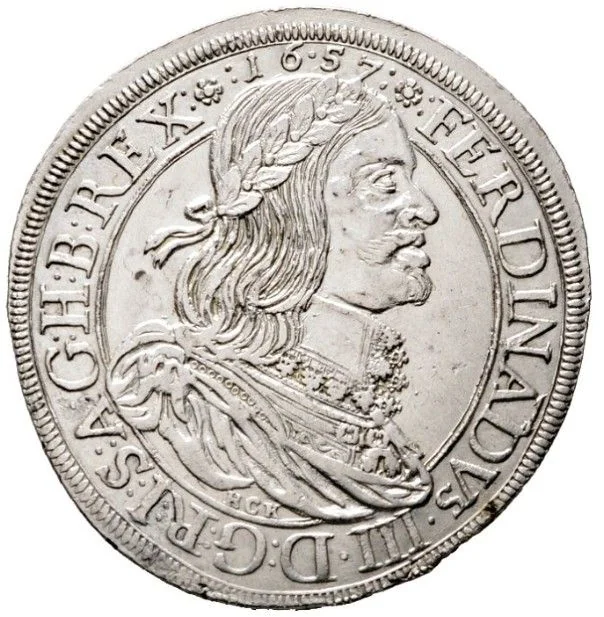
Right-facing portrait, mint letters below bust, small date above.
Inscription:
FERDINANDVS III D G R I S A G H B REX
HCK
HCK
Script: Latin
Engraver: H. Casp. Khendlmayer
Reverse
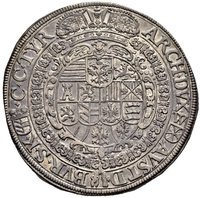
Description:
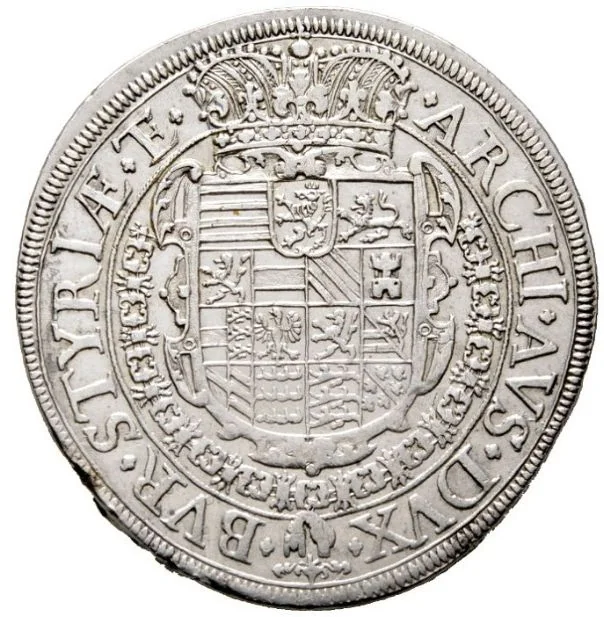
Arms in an oval shield, crowned and encircled by the Golden Fleece chain, with a small Styrian panther shield above. The crown breaks the surrounding circle and legend.
Inscription:
ARCHI AVS DVX // BVRG STYRIÆ ET
Script: Latin
Edge
Mints
| Name | Mark |
|---|---|
| Graz | — |
Mintings
| Year | Mint Mark | Mintage | Quality | Collection |
|---|---|---|---|---|
| 1657 | — | — |
Historical background
In 1657, the Austrian Habsburg monarchy was grappling with a severe and protracted currency crisis, primarily a legacy of the Thirty Years' War (1618-1648). To finance the enormous costs of the conflict, the state had resorted to repeated debasement of the coinage, notably the silver Reichsthaler and the smaller Kreuzer. By minting coins with progressively lower silver content while maintaining their face value, authorities created short-term revenue but triggered rampant inflation, a loss of public confidence, and economic instability. This period saw a chaotic circulation of both good, full-weight coins from earlier periods and new, "bad" debased coins, leading to Gresham's Law in practice, where "bad money drives out good."
The situation was exacerbated by a fragmented monetary system within the Empire's diverse territories, including Austria, Bohemia, and Hungary. While the Imperial Mint Ordinance (Reichsmünzordnung) of 1559 theoretically provided a standard, its authority had collapsed. Individual estates and cities often struck their own coins, further complicating trade and reducing the central government's control. The resulting monetary confusion stifled commerce, as merchants struggled with uncertain exchange rates and the risk of accepting worthless currency, while the population suffered from soaring prices for basic goods.
Recognizing the dire economic consequences, Emperor Leopold I's government initiated reforms. The pivotal response came in the following years, culminating in the landmark Münzpatent of 1659. This decree aimed to standardize the coinage, recall the debased money, and reintroduce a stable silver Reichsthaler. Thus, 1657 represents the crisis point that forced a decisive, if difficult, transition toward more stable monetary policy, setting the stage for the financial consolidation necessary for Austria's emergence as a major European power in the late 17th century.
The situation was exacerbated by a fragmented monetary system within the Empire's diverse territories, including Austria, Bohemia, and Hungary. While the Imperial Mint Ordinance (Reichsmünzordnung) of 1559 theoretically provided a standard, its authority had collapsed. Individual estates and cities often struck their own coins, further complicating trade and reducing the central government's control. The resulting monetary confusion stifled commerce, as merchants struggled with uncertain exchange rates and the risk of accepting worthless currency, while the population suffered from soaring prices for basic goods.
Recognizing the dire economic consequences, Emperor Leopold I's government initiated reforms. The pivotal response came in the following years, culminating in the landmark Münzpatent of 1659. This decree aimed to standardize the coinage, recall the debased money, and reintroduce a stable silver Reichsthaler. Thus, 1657 represents the crisis point that forced a decisive, if difficult, transition toward more stable monetary policy, setting the stage for the financial consolidation necessary for Austria's emergence as a major European power in the late 17th century.
✨ Legendary