

1 Thaler – Austrian Empire
Austria
Context
Years: 1631–1632
Country: Austria 
Issuer: Austrian Empire
Ruler: Ferdinand II
Currency:
(1520—1754)
Demonetized: Yes
References
KM: #Click to copy to clipboard749.3
Numista: #165602
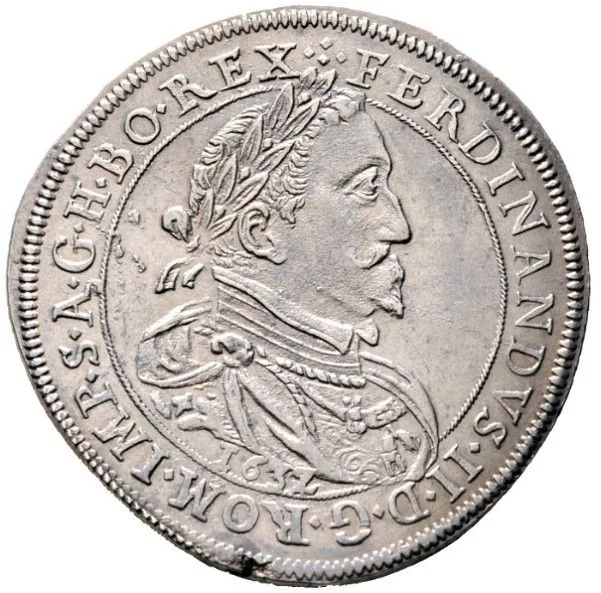
Obverse
Description:
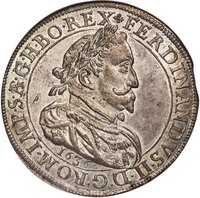
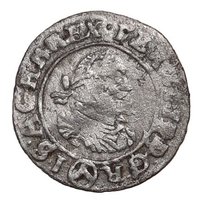
Laureate bust right in inner circle, date below.
Inscription:
FERDINANDVS II D G ROM IMP S A G H BO REX
Script: Latin
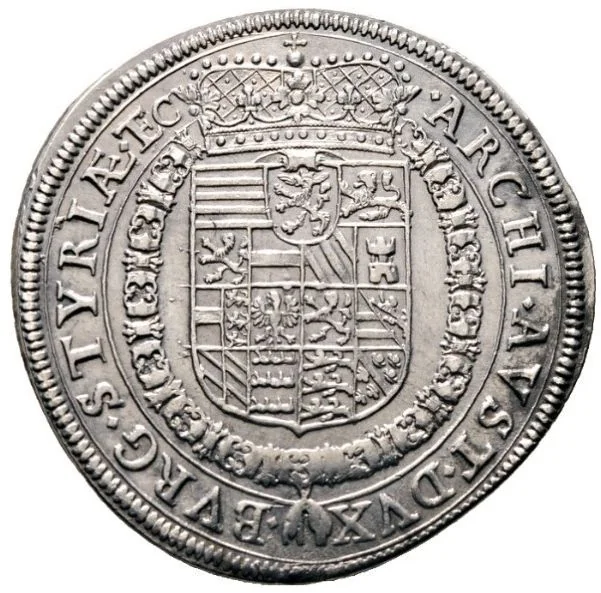
Reverse
Description:
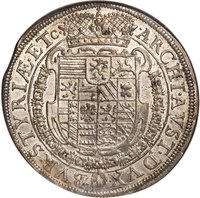
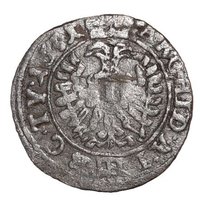
Crowned arms within a circle, encircled by the Order of the Golden Fleece's chain, with a small Styrian shield at the top.
Inscription:
ARCHI AVST DVX // BVRG STYRIÆ ETC
Script: Latin
Edge
Mints
| Name | Mark |
|---|---|
| Graz | — |
Mintings
| Year | Mint Mark | Mintage | Quality | Collection |
|---|---|---|---|---|
| 1631 | — | — | ||
| 1632 | — | — |
Historical background
In 1631, the Austrian Habsburg monarchy, a sprawling and diverse empire, was deeply embroiled in the Thirty Years' War (1618-1648). The financial demands of funding large imperial armies under commanders like Albrecht von Wallenstein were colossal and relentless. To meet these costs, the state resorted to heavy taxation, confiscations, and, most critically for the currency, the systematic debasement of coinage. Rulers granted minting concessions to private entrepreneurs who would remint existing coins with a lower precious metal content, pocketing the seigniorage profit and passing a share to the imperial treasury. This practice, while providing short-term liquidity, was eroding the very foundation of the monetary system.
The currency landscape was consequently chaotic and fragmented. While the official unit of account was the Gulden (florin), divided into 60 Kreuzer, the reality was a confusing circulation of hundreds of different coins from various imperial and territorial mints. The most common silver coin in daily use was the Kreuzer, but its silver content was unstable. The debasement created a vicious cycle: as new, inferior coins entered circulation, older coins with higher silver content were either hoarded (Gresham's Law) or melted down for profit, further accelerating the decline in the quality of money in active use. This led to price inflation, a loss of public trust, and economic distress, particularly for those on fixed incomes.
Furthermore, the Empire lacked a centralized monetary authority. Control over minting was dispersed among various Habsburg archduchies, crown lands, and even private entities, making a coherent monetary policy impossible. The result was a system in crisis by 1631. The value of money was uncertain, trade was hampered, and the fiscal desperation of the war effort was directly translating into monetary instability for the population. This period exemplifies the early modern "Kipper- und Wipperzeit" (a time of coin-clipping and swindling), where currency manipulation became a primary instrument of war finance at great long-term economic cost.
The currency landscape was consequently chaotic and fragmented. While the official unit of account was the Gulden (florin), divided into 60 Kreuzer, the reality was a confusing circulation of hundreds of different coins from various imperial and territorial mints. The most common silver coin in daily use was the Kreuzer, but its silver content was unstable. The debasement created a vicious cycle: as new, inferior coins entered circulation, older coins with higher silver content were either hoarded (Gresham's Law) or melted down for profit, further accelerating the decline in the quality of money in active use. This led to price inflation, a loss of public trust, and economic distress, particularly for those on fixed incomes.
Furthermore, the Empire lacked a centralized monetary authority. Control over minting was dispersed among various Habsburg archduchies, crown lands, and even private entities, making a coherent monetary policy impossible. The result was a system in crisis by 1631. The value of money was uncertain, trade was hampered, and the fiscal desperation of the war effort was directly translating into monetary instability for the population. This period exemplifies the early modern "Kipper- und Wipperzeit" (a time of coin-clipping and swindling), where currency manipulation became a primary instrument of war finance at great long-term economic cost.
✨ Legendary