

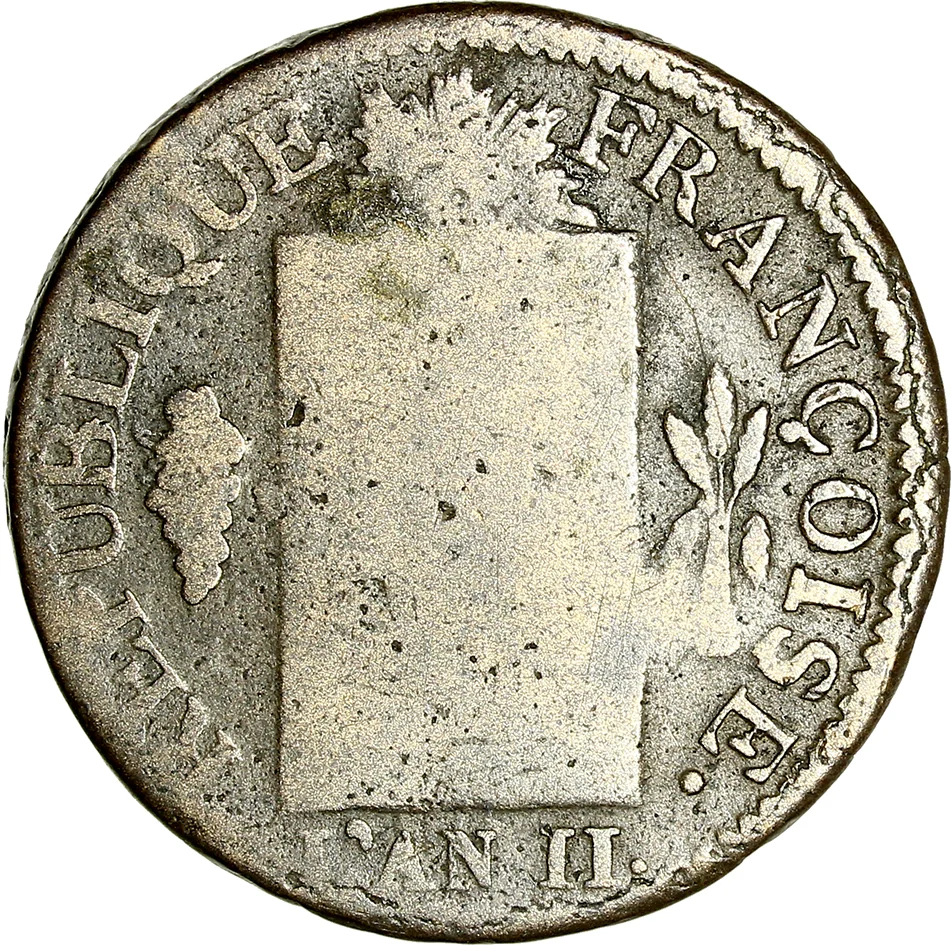
Obverse
Description:
Inscribed in rectangle
Inscription:
REPUBLIQUE FRANÇOISE.
LES
HOMMES
SONT
EGAUX
DEVANT
LA LOI
L'AN II.
LES
HOMMES
SONT
EGAUX
DEVANT
LA LOI
L'AN II.
Script: Latin
Engraver: Augustin Dupré
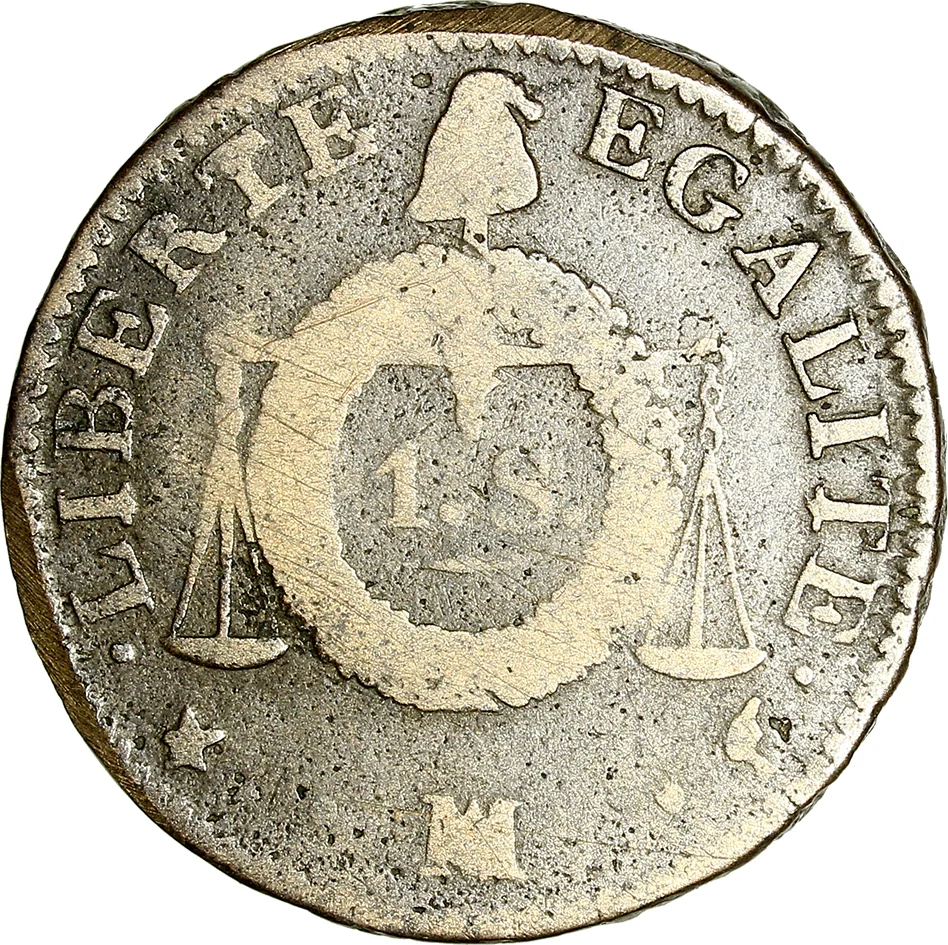
Reverse
Description:
Wreath encircling liberty cap on scales.
Inscription:
LIBERTE EGALITE
1 S
1 S
Script: Latin
Engraver: Augustin Dupré
Edge
Gross (striking without ferrule)
Categories
| Human rights |
| Symbol> Phrygian cap |
Mints
| Name | Mark |
|---|---|
| Metz | AA |
| Strasbourg | BB |
| Lyon | D |
| Limoges | I |
| Marseille | MA |
| Montpellier | N |
| Pau | Vache |
Mintings
Historical background
In 1794, France was in the throes of the radical phase of the Revolution, governed by the Committee of Public Safety during the Reign of Terror. The nation's currency, the assignat, was in a state of catastrophic collapse. Originally issued in 1789 as bonds backed by the value of confiscated Church lands, the assignats had evolved into a forced paper currency. To finance wars, social programs, and the general crisis, the revolutionary government resorted to massive, unchecked printing of these notes, utterly divorcing their value from the land assets that were supposed to guarantee them.
This hyperinflation rendered the assignat virtually worthless. By the spring of 1794, its value had plummeted to less than 1% of its face value. Prices for essential goods like bread and firewood skyrocketed, causing immense hardship for the urban poor and soldiers paid in the depreciating currency. While the Law of the Maximum (loi du maximum général) attempted to impose price controls and curb speculation, it was widely evaded, leading to black markets and severe shortages. The economic distress fueled social unrest, even as the political terror sought to suppress all dissent.
The currency crisis was a fundamental failure of revolutionary economic policy. It eroded public trust, undermined the war effort by making procurement difficult, and exacerbated the very social inequalities the Revolution sought to abolish. The situation in 1794 set the stage for the economic turmoil that would follow the Terror's end, ultimately leading to the abandonment of the assignat system in 1796 and a painful return to metallic currency under the Directory.
This hyperinflation rendered the assignat virtually worthless. By the spring of 1794, its value had plummeted to less than 1% of its face value. Prices for essential goods like bread and firewood skyrocketed, causing immense hardship for the urban poor and soldiers paid in the depreciating currency. While the Law of the Maximum (loi du maximum général) attempted to impose price controls and curb speculation, it was widely evaded, leading to black markets and severe shortages. The economic distress fueled social unrest, even as the political terror sought to suppress all dissent.
The currency crisis was a fundamental failure of revolutionary economic policy. It eroded public trust, undermined the war effort by making procurement difficult, and exacerbated the very social inequalities the Revolution sought to abolish. The situation in 1794 set the stage for the economic turmoil that would follow the Terror's end, ultimately leading to the abandonment of the assignat system in 1796 and a painful return to metallic currency under the Directory.
🌟 Limited