

1 Ducat – Austrian Empire
Austria
Context
Years: 1764–1765
Country: Austria 
Issuer: Austrian Empire
Ruler: Joseph II
Currency:
(1754—1857)
Demonetized: Yes
References
KM: #Click to copy to clipboard1844
Numista: #162014
Value
Bullion value: $575.39
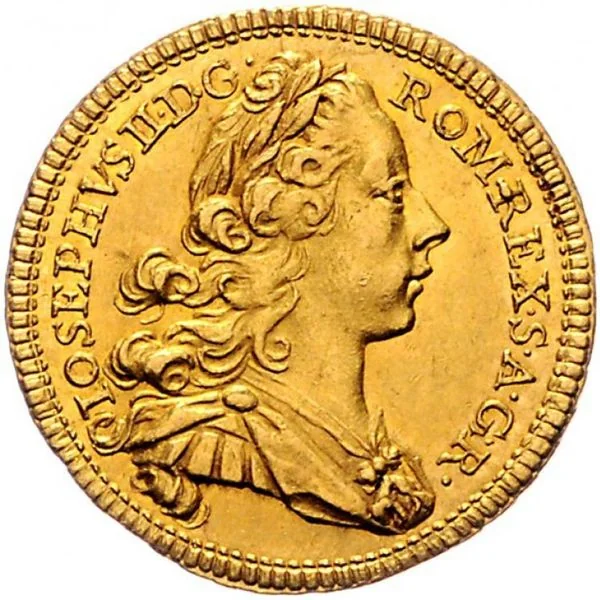
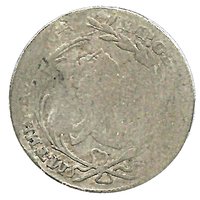
Obverse
Description:
Young right-facing portrait, titled King of the Romans. Legend begins at 8 o'clock. Two minor portrait variants.
Inscription:
IOSEPHVS II D G // ROM REX S A G R
Script: Latin
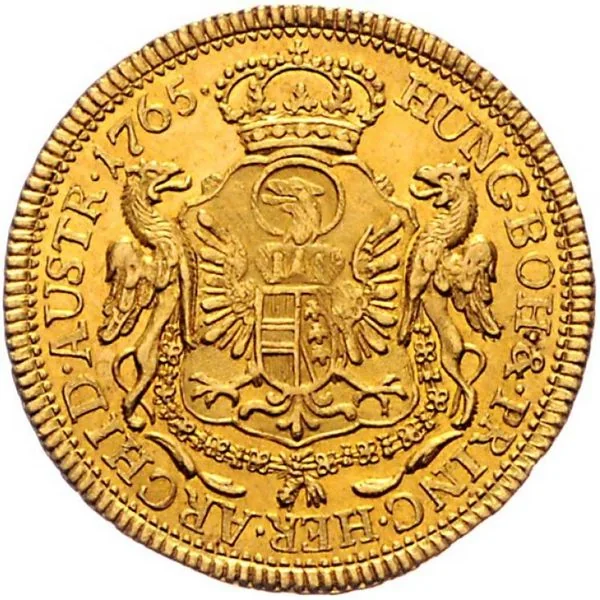
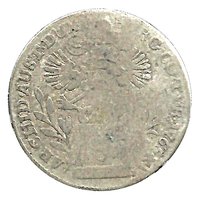
Reverse
Description:
Single-headed eagle in a baroque frame with Lorraine and Austria arms, griffin-supported. Legend begins at 1 o'clock.
Inscription:
HUNG BOH & PRINC HER ARCHID AUSTR 1765
Script: Latin
Edge
Mints
| Name | Mark |
|---|---|
| Münze Österreich | — |
Mintings
| Year | Mint Mark | Mintage | Quality | Collection |
|---|---|---|---|---|
| 1764 | — | — | ||
| 1765 | — | — |
Historical background
In 1764, the currency situation within the Habsburg Monarchy, often referred to as the Austrian Empire, was characterized by a fragile and complex system still recovering from the financial exhaustion of the Seven Years' War (1756-1763). The state treasury was deeply in debt, and the monetary landscape was a confusing patchwork of different coins and standards. The Empire lacked a unified, trusted silver currency, with various regions circulating their own subsidiary coins and a proliferation of debased, low-quality Scheidemünzen (small change). This created widespread uncertainty in trade and everyday transactions, undermining both public confidence and state revenue.
Recognizing this instability as a threat to economic recovery and state power, Empress Maria Theresa and her advisors, particularly Chancellor Wenzel Anton von Kaunitz, embarked on a major monetary reform. The cornerstone of this effort was the introduction of the Conventionstaler in 1753, but its full implementation and consolidation were ongoing in 1764. This new silver standard, agreed upon with Bavaria, established a stable, high-quality large silver coin (the Conventionstaler, containing roughly 23.39 grams of pure silver) that was intended to unify the currencies across the Habsburg hereditary lands and facilitate international trade.
Thus, the year 1764 falls within a critical period of transition. The government was actively working to suppress the circulation of old, debased coinage and promote the new Conventionstaler system. However, the process was gradual and faced practical challenges, including public reluctance to relinquish old coins and the logistical difficulty of reminting the entire currency supply. Consequently, while a framework for stability had been legislated, the actual monetary circulation in 1764 likely remained a mixture of the new Convention coins and the older, problematic currencies they were designed to replace.
Recognizing this instability as a threat to economic recovery and state power, Empress Maria Theresa and her advisors, particularly Chancellor Wenzel Anton von Kaunitz, embarked on a major monetary reform. The cornerstone of this effort was the introduction of the Conventionstaler in 1753, but its full implementation and consolidation were ongoing in 1764. This new silver standard, agreed upon with Bavaria, established a stable, high-quality large silver coin (the Conventionstaler, containing roughly 23.39 grams of pure silver) that was intended to unify the currencies across the Habsburg hereditary lands and facilitate international trade.
Thus, the year 1764 falls within a critical period of transition. The government was actively working to suppress the circulation of old, debased coinage and promote the new Conventionstaler system. However, the process was gradual and faced practical challenges, including public reluctance to relinquish old coins and the logistical difficulty of reminting the entire currency supply. Consequently, while a framework for stability had been legislated, the actual monetary circulation in 1764 likely remained a mixture of the new Convention coins and the older, problematic currencies they were designed to replace.
✨ Legendary