

⅙ Riksdaler – Sweden
Sweden
Context
Years: 1815–1817
Issuer: Sweden 
Ruler: Charles XIII
Currency:
(1798—1830)
Demonetized: Yes
Total mintage: 150,060
Material
References
KM: #Click to copy to clipboard589
Numista: #100289
Value
Bullion value: $12.24
Obverse
Description:
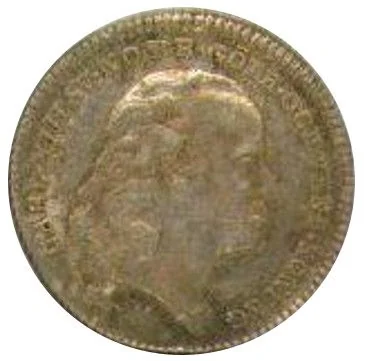
King Carl XIII facing right, with encircling legend.
Inscription:
CARL XIII SV • NORR • GÖTH • OCH VEND • KONUNG
Translation:
CARL XIII SWEDES' • NORWEGIANS' • GOTHS' • AND WENDS' • KING
Language: Swedish
Reverse
Description:
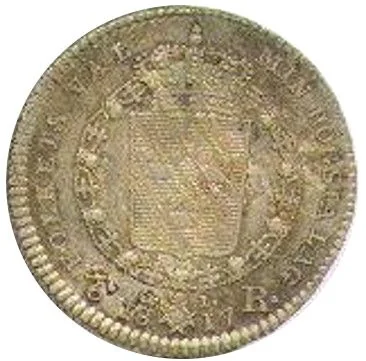
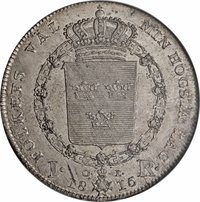
Shield with Three Crowns within Seraphim Chain. Chain divides value, date, and mintmark. King’s motto around rim.
Inscription:
FOLKES VÄL MIN HÖGSTA LAG
I/6. R.
O. L.
18 17
I/6. R.
O. L.
18 17
Translation:
The people's welfare my highest law
I/6. R.
O. L.
18 17
I/6. R.
O. L.
18 17
Language: Swedish
Edge
Mintings
| Year | Mint Mark | Mintage | Quality | Collection |
|---|---|---|---|---|
| 1815 | OL | 59,196 | ||
| 1817 | OL | 90,864 |
Historical background
In 1815, Sweden was navigating a complex and unstable monetary landscape following the Napoleonic Wars. The nation operated on a dual currency system, a legacy of the 18th century: the Riksdaler Riksmynt (the domestic currency used for everyday transactions) and the Riksdaler Specie (a higher-value currency tied to silver for international trade). However, years of war financing had led to severe inflation and a proliferation of paper money, primarily in the form of Riksgälds notes issued by the National Debt Office. These notes were not fully convertible to silver, causing their value to fluctuate and creating significant public distrust in the paper currency.
The fundamental problem was a severe shortage of silver coinage, which had been drained from the economy due to trade imbalances and the costs of war. This forced a heavy reliance on the depreciating paper notes for daily commerce, leading to a wide and unstable gap between the value of the silver Specie and the paper Riksmynt. Merchants and the public faced constant uncertainty, as exchange rates between coins and notes shifted, hampering trade and economic planning. The situation was a source of ongoing political debate, with factions divided between those advocating for a return to a strict silver standard and those recognizing the practical necessity of paper money.
Consequently, the currency situation in 1815 was one of transition and sought-for stability. The Riksdag (parliament) was actively seeking solutions, which would culminate in the major monetary reform of 1834. That reform formally established the Riksdaler Riksmynt as the sole unit of account and aimed to restore confidence by defining its value in relation to silver, though full convertibility remained a future goal. Thus, 1815 represents a critical juncture of post-war financial strain, public skepticism, and the early political efforts to unify and stabilize Sweden's monetary system.
The fundamental problem was a severe shortage of silver coinage, which had been drained from the economy due to trade imbalances and the costs of war. This forced a heavy reliance on the depreciating paper notes for daily commerce, leading to a wide and unstable gap between the value of the silver Specie and the paper Riksmynt. Merchants and the public faced constant uncertainty, as exchange rates between coins and notes shifted, hampering trade and economic planning. The situation was a source of ongoing political debate, with factions divided between those advocating for a return to a strict silver standard and those recognizing the practical necessity of paper money.
Consequently, the currency situation in 1815 was one of transition and sought-for stability. The Riksdag (parliament) was actively seeking solutions, which would culminate in the major monetary reform of 1834. That reform formally established the Riksdaler Riksmynt as the sole unit of account and aimed to restore confidence by defining its value in relation to silver, though full convertibility remained a future goal. Thus, 1815 represents a critical juncture of post-war financial strain, public skepticism, and the early political efforts to unify and stabilize Sweden's monetary system.
✨ Legendary