

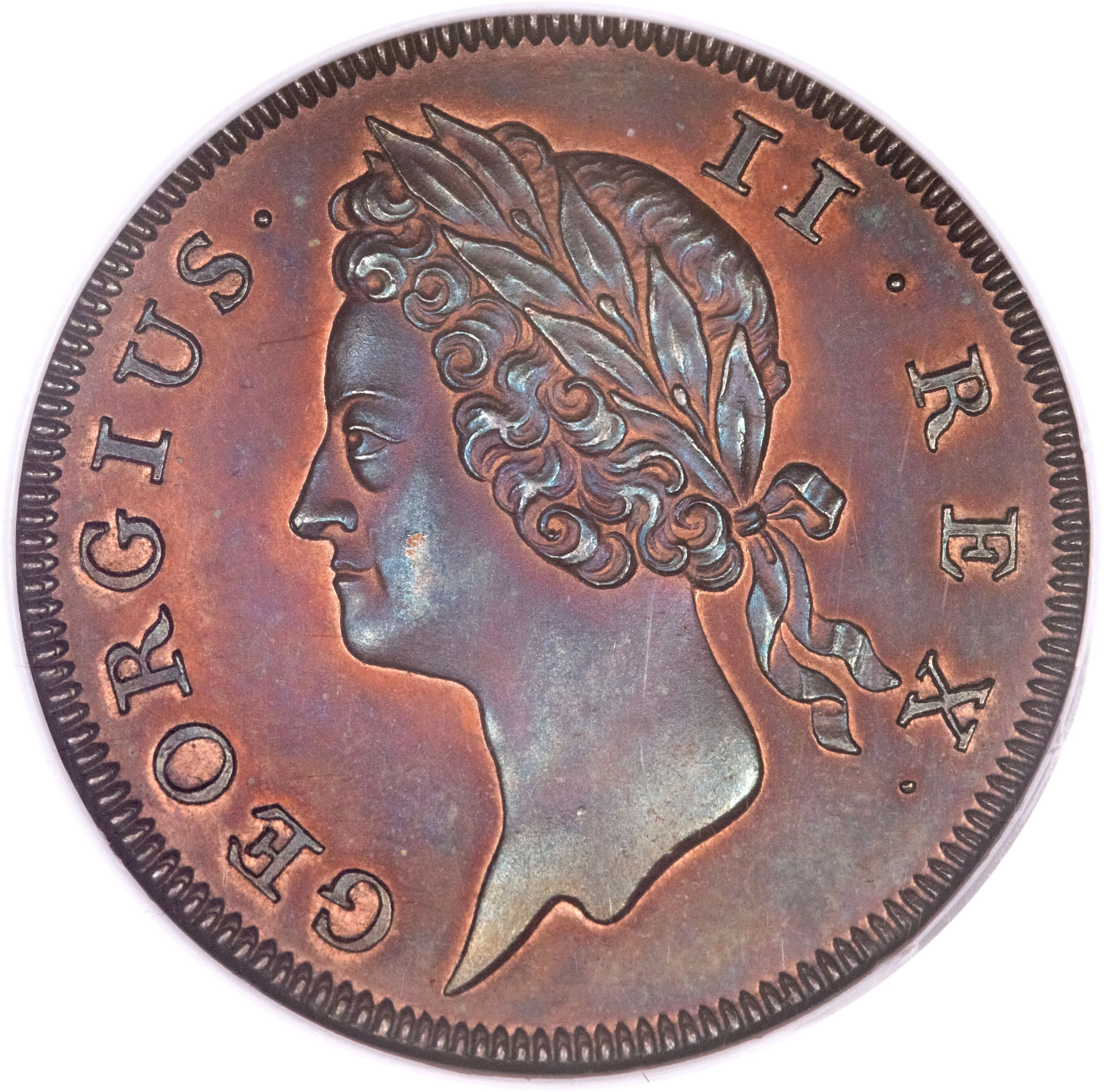
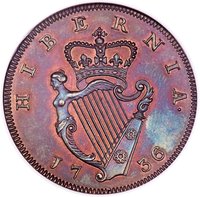
Obverse
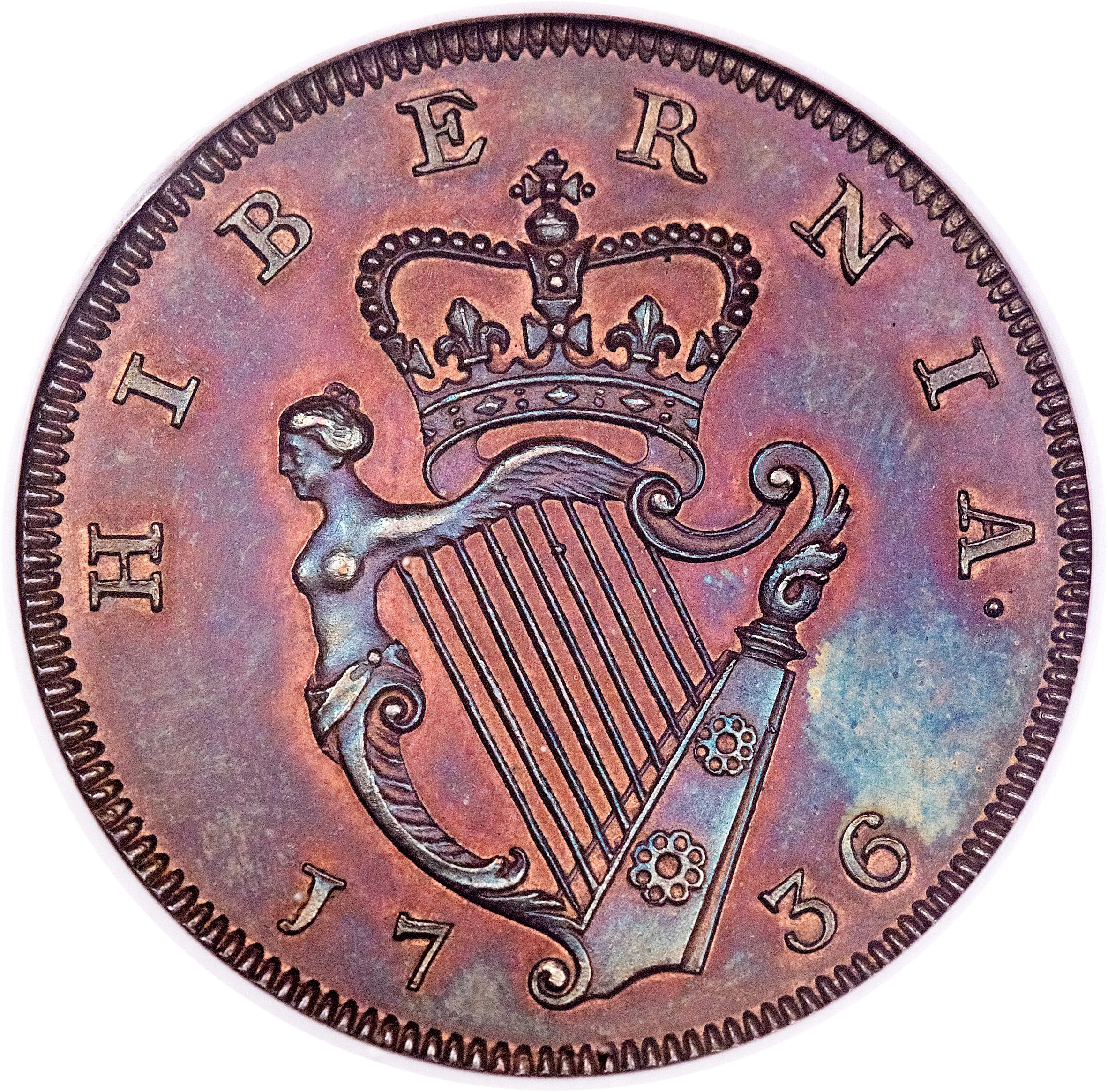
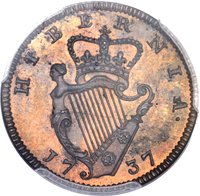
Reverse
Edge
Mintings
| Year | Mint Mark | Mintage | Quality | Collection |
|---|---|---|---|---|
| 1736 | — | — | ||
| 1736 | — | — | Proof | |
| 1737 | — | — | ||
| 1737 | — | — | Proof | |
| 1738 | — | — |
Historical background
In 1736, Ireland operated under a complex and restrictive monetary system largely dictated by its political and economic subordination to Great Britain. The official currency was sterling, but the physical supply of coinage was chronically insufficient for domestic needs. This scarcity was exacerbated by the fact that Ireland, as a net importer from England, saw its limited silver and gold coins constantly drained to settle trade imbalances, a problem known as a negative balance of payments. The result was a severe shortage of specie (coin), which stifled everyday commerce and economic activity.
To fill this void, a proliferation of makeshift currencies circulated. These included worn and clipped foreign coins (especially Spanish dollars and Portuguese johannes), private tokens issued by merchants and city corporations, and a heavy reliance on paper credit notes and bills of exchange. The most significant official paper currency was the "Bank of Ireland" note, issued not by a state bank but by a private syndicate granted a patent by the Irish Parliament. While these notes provided some liquidity, public trust in them was uneven, and their value could fluctuate, adding to the general monetary instability.
This unsatisfactory situation was a direct consequence of the mercantilist policies enshrined in laws like the 1695 Wool Acts, which deliberately suppressed Irish industry to benefit English competitors. The currency scarcity was a daily reminder of Ireland's dependent colonial status within the British Empire, hindering internal trade and development. It was within this context that figures like Dean Jonathan Swift wrote scathing critiques, such as his Drapier's Letters (1724-25), which had successfully defeated a previous controversial coinage scheme and left a lasting public wariness toward monetary solutions imposed from London. The year 1736 thus fell within a prolonged period of monetary frustration that would persist for decades.
To fill this void, a proliferation of makeshift currencies circulated. These included worn and clipped foreign coins (especially Spanish dollars and Portuguese johannes), private tokens issued by merchants and city corporations, and a heavy reliance on paper credit notes and bills of exchange. The most significant official paper currency was the "Bank of Ireland" note, issued not by a state bank but by a private syndicate granted a patent by the Irish Parliament. While these notes provided some liquidity, public trust in them was uneven, and their value could fluctuate, adding to the general monetary instability.
This unsatisfactory situation was a direct consequence of the mercantilist policies enshrined in laws like the 1695 Wool Acts, which deliberately suppressed Irish industry to benefit English competitors. The currency scarcity was a daily reminder of Ireland's dependent colonial status within the British Empire, hindering internal trade and development. It was within this context that figures like Dean Jonathan Swift wrote scathing critiques, such as his Drapier's Letters (1724-25), which had successfully defeated a previous controversial coinage scheme and left a lasting public wariness toward monetary solutions imposed from London. The year 1736 thus fell within a prolonged period of monetary frustration that would persist for decades.
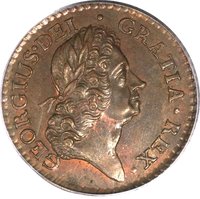
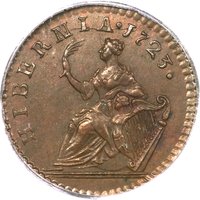
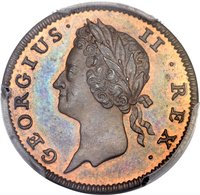
⭐ Rare