

½ Thaler – Austrian Empire
Austria
Context
Years: 1758–1765
Country: Austria 
Issuer: Austrian Empire
Ruler: Maria Theresa
Currency:
(1754—1857)
Demonetized: Yes
Material
References
KM: #Click to copy to clipboard1822
Numista: #159980
Value
Bullion value: $33.80
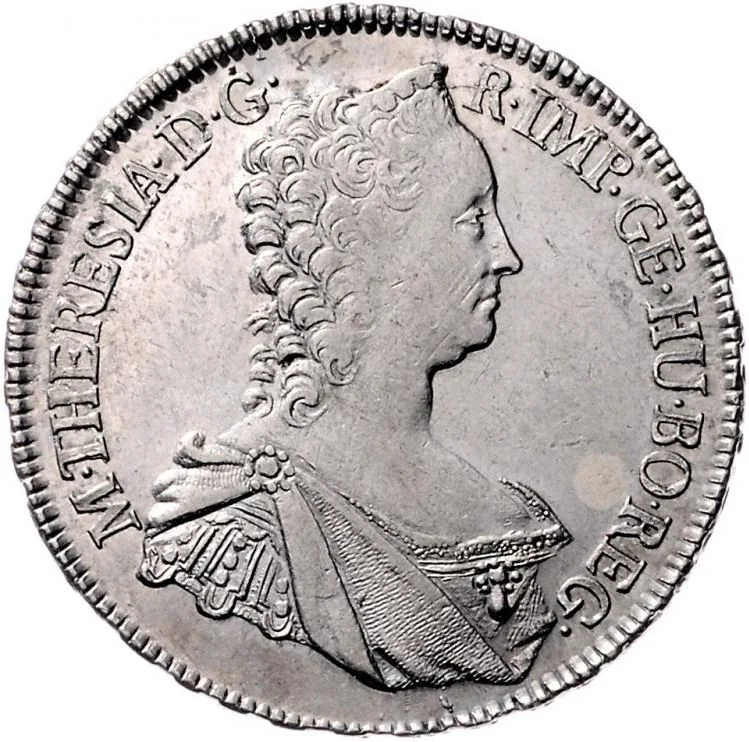
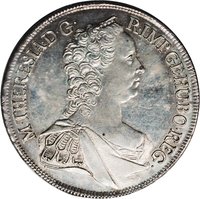
Obverse
Description:
Portrait in décolleté with shoulder armor.
Inscription:
M THERESIA D G // R IMP GE HU BO REG
Script: Latin
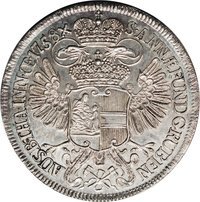
Reverse
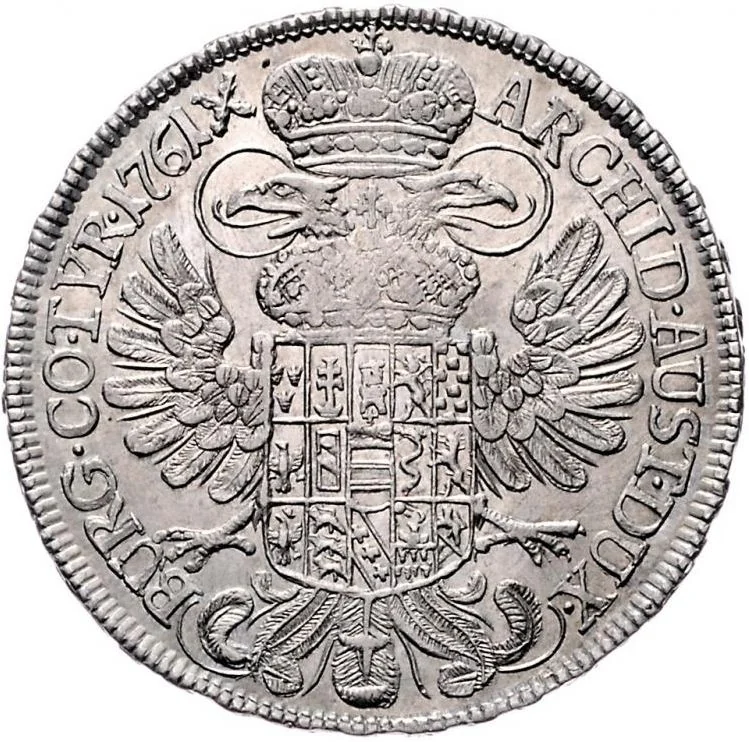
Description:
Imperial eagle with composite arms, centered on a small Vienna shield.
Inscription:
ARCHID AUST DUX // BURG CO TYR
Script: Latin
Edge
Mints
| Name | Mark |
|---|---|
| Münze Österreich | — |
Mintings
| Year | Mint Mark | Mintage | Quality | Collection |
|---|---|---|---|---|
| 1758 | — | — | ||
| 1759 | — | — | ||
| 1760 | — | — | ||
| 1761 | — | — | ||
| 1762 | — | — | ||
| 1763 | — | — | ||
| 1764 | — | — | ||
| 1765 | — | — |
Historical background
In 1758, the Austrian Empire, under the reign of Empress Maria Theresa, was embroiled in the costly global conflict of the Seven Years' War (1756-1763). The immense financial strain of funding large-scale military campaigns against Prussia and its allies placed the Habsburg state treasury under severe pressure. This dire need for revenue led the government to increasingly rely on the debasement of the coinage—reducing the precious metal content in coins while maintaining their face value—as a means of creating short-term funds to pay soldiers and suppliers. This practice, while providing immediate liquidity, was eroding the intrinsic value of the currency and sowing the seeds of inflation.
The monetary system itself was complex and fragmented. There was no single, unified currency; instead, the Empire operated on a bimetallic standard of silver and gold, with a plethora of different coins in circulation. These included the silver Conventionsthaler (or Konventionstaler), established by the Bavarian-Austrian monetary convention of 1753, and the gold ducat. The chronic budget deficits, however, led to the issuance of inferior-quality, lightweight coins and an increase in the production of paper money, known as Bancozettel, issued by the Vienna City Bank. While not yet rampant in 1758, these paper notes began to circulate beyond their original purpose as a credit instrument, adding another layer of instability to the monetary environment.
Consequently, the currency situation in 1758 was one of underlying tension and managed decline. The official exchange rates between gold, silver, and paper were artificially maintained by the state, but the gap between the face value and the real metallic value of coins was widening. This resulted in Gresham's Law in practice, where "bad money drives out good"—people hoarded older, full-weight coins and used the new debased ones for transactions, further disrupting commerce. Thus, while a full-blown financial crisis was still being staved off by state authority, the policies enacted during this wartime year were exacerbating structural weaknesses that would lead to significant monetary reform and instability in the decades to follow.
The monetary system itself was complex and fragmented. There was no single, unified currency; instead, the Empire operated on a bimetallic standard of silver and gold, with a plethora of different coins in circulation. These included the silver Conventionsthaler (or Konventionstaler), established by the Bavarian-Austrian monetary convention of 1753, and the gold ducat. The chronic budget deficits, however, led to the issuance of inferior-quality, lightweight coins and an increase in the production of paper money, known as Bancozettel, issued by the Vienna City Bank. While not yet rampant in 1758, these paper notes began to circulate beyond their original purpose as a credit instrument, adding another layer of instability to the monetary environment.
Consequently, the currency situation in 1758 was one of underlying tension and managed decline. The official exchange rates between gold, silver, and paper were artificially maintained by the state, but the gap between the face value and the real metallic value of coins was widening. This resulted in Gresham's Law in practice, where "bad money drives out good"—people hoarded older, full-weight coins and used the new debased ones for transactions, further disrupting commerce. Thus, while a full-blown financial crisis was still being staved off by state authority, the policies enacted during this wartime year were exacerbating structural weaknesses that would lead to significant monetary reform and instability in the decades to follow.
✨ Legendary