

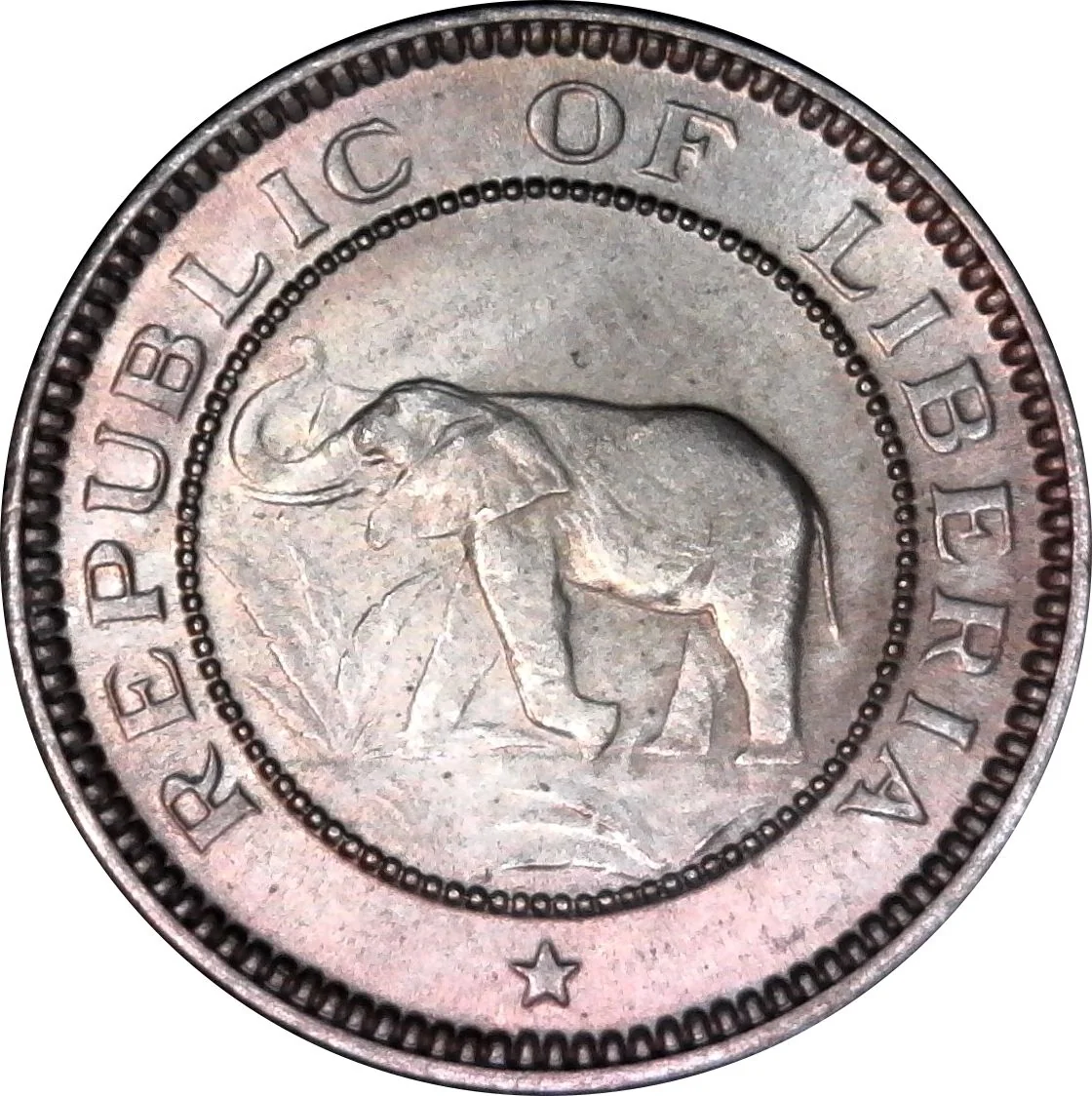
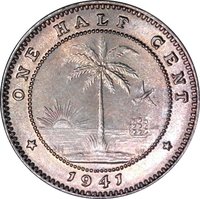
Obverse
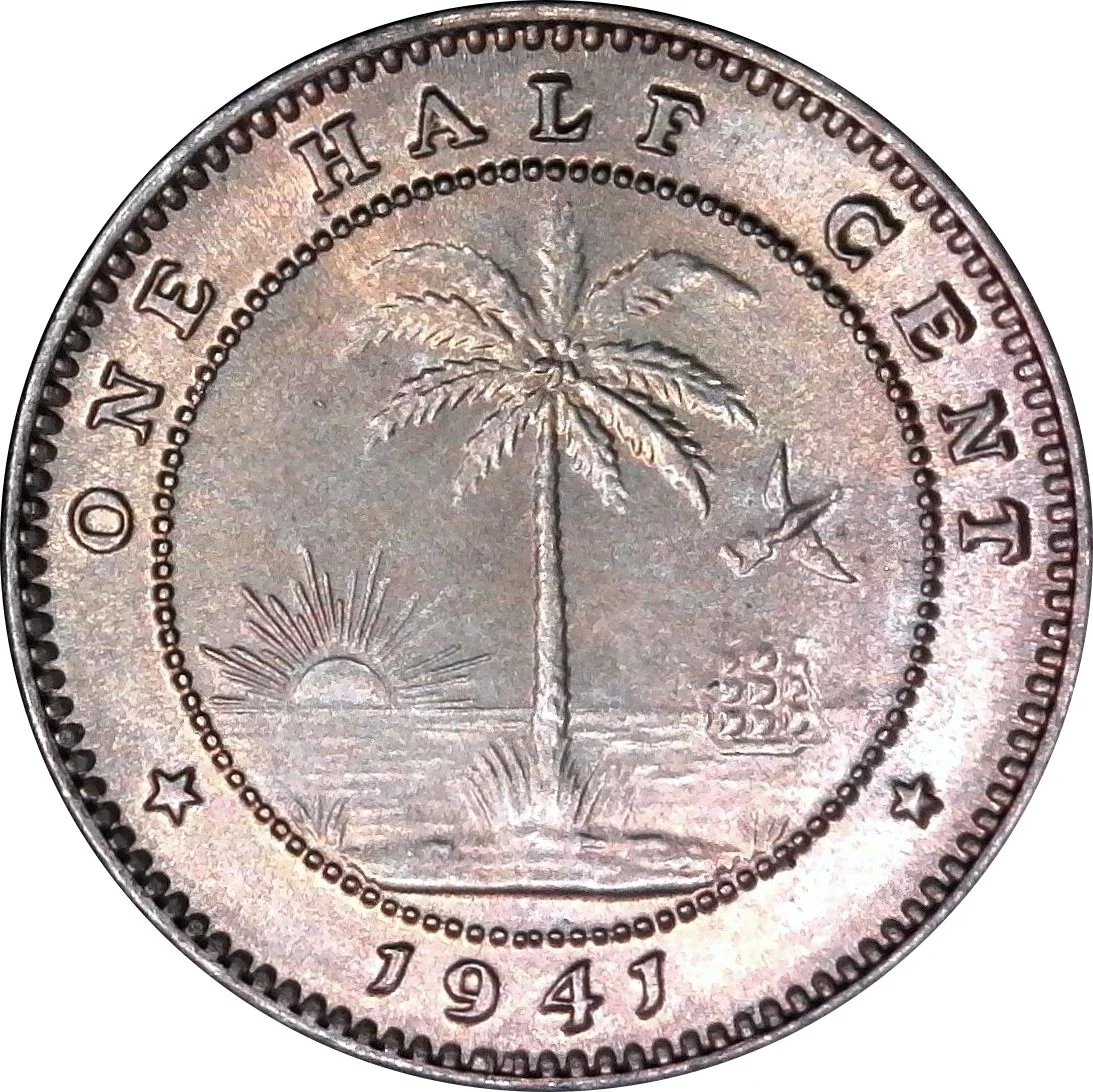
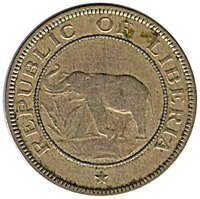
Reverse
Description:
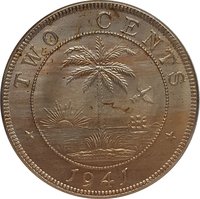
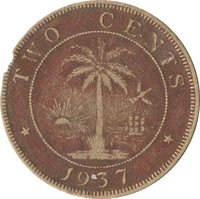
Palm tree separates ship and sun inside a circle, with stars above the date.
Inscription:
ONE HALF CENT
* 1941 *
* 1941 *
Script: Latin
Edge
Plain
Categories
| Animal> Bird |
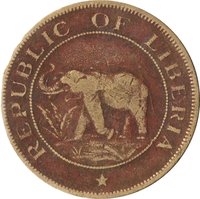
| Animal> Elephant |
| Plant> Tree |
| Transportation> Watercraft |
Mints
| Name | Mark |
|---|---|
| United States Mint of Philadelphia | — |
Mintings
| Year | Mint Mark | Mintage | Quality | Collection |
|---|---|---|---|---|
| 1941 | — | 250,000 |
Historical background
In 1941, Liberia’s currency situation was defined by a complex duality, operating under the monetary authority of the United States while maintaining its own national currency. The country was on a de facto dollar standard, as the Liberian dollar, first issued in 1847, was pegged at par with the U.S. dollar. However, U.S. currency and coins circulated widely and were often preferred in commerce, especially in coastal areas and for significant transactions, due to greater public confidence in their stability and wider international acceptance.
This monetary arrangement was a direct consequence of Liberia’s close economic and strategic ties with the United States, which were deepening in the context of World War II. In 1942, these ties would be formalized by a Defense Pact, but already in 1941, the U.S. was investing in Liberian infrastructure (like the port at Robertsfield) in exchange for military basing rights. The reliance on U.S. currency facilitated these growing financial interactions but also highlighted Liberia’s limited sovereign monetary control. The Liberian government’s own coinage was limited, and its paper money was not universally trusted domestically, leading to a persistent circulation of both currencies side-by-side.
Thus, the currency landscape reflected Liberia’s broader political and economic position: a formally independent nation heavily influenced by American capital and policy. The system provided stability by tethering the economy to a strong foreign reserve but came at the cost of an underdeveloped national banking system and a reliance on external monetary policy. This setup would persist largely unchanged until the 1980s, but in 1941, it served the needs of a wartime economy increasingly integrated with Allied interests.
This monetary arrangement was a direct consequence of Liberia’s close economic and strategic ties with the United States, which were deepening in the context of World War II. In 1942, these ties would be formalized by a Defense Pact, but already in 1941, the U.S. was investing in Liberian infrastructure (like the port at Robertsfield) in exchange for military basing rights. The reliance on U.S. currency facilitated these growing financial interactions but also highlighted Liberia’s limited sovereign monetary control. The Liberian government’s own coinage was limited, and its paper money was not universally trusted domestically, leading to a persistent circulation of both currencies side-by-side.
Thus, the currency landscape reflected Liberia’s broader political and economic position: a formally independent nation heavily influenced by American capital and policy. The system provided stability by tethering the economy to a strong foreign reserve but came at the cost of an underdeveloped national banking system and a reliance on external monetary policy. This setup would persist largely unchanged until the 1980s, but in 1941, it served the needs of a wartime economy increasingly integrated with Allied interests.
🌱 Common