

1 mazuna – Morocco
Add to wishlist
Morocco
Context
Year: 1772
Islamic (Hijri) Year:: 1185
Issuer: Morocco
Ruler: Sidi Muhammad III
Currency:
(1659—1882)
Demonetized: Yes
References
KM: #
Numista: #157502
Value
Bullion value: $1.85
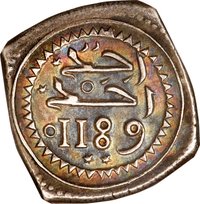
Obverse
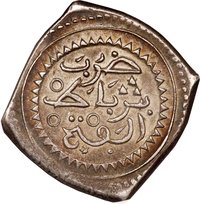
Reverse
Edge
Mintings
| Year | Mint Mark | Mintage | Quality | Collection |
|---|---|---|---|---|
| 1772 | — | — |
Historical background
In 1772, the currency situation in the Alaouite Sultanate of Morocco was characterized by a complex and often chaotic system, heavily influenced by both internal governance and intense foreign trade. The primary unit was the silver dirham, but its weight and purity were not consistently standardized across the realm, leading to significant regional variations. Concurrently, a gold currency, the benduqi (based on the Venetian ducat), circulated for larger transactions and foreign commerce, creating a bimetallic system vulnerable to shifts in the relative value of gold and silver. This period fell within the long and tumultuous reign of Sultan Sidi Mohammed III (1757-1790), who recognized the economic problems posed by this monetary disorder and was actively attempting reforms, including the establishment of a unified mint.
The chaos was exacerbated by the widespread circulation of a multitude of foreign coins, a testament to Morocco’s strategic position and vibrant trade. Spanish reales (pieces of eight), particularly the "ryal hassani," were so dominant in coastal and commercial centers that they became a de facto standard, often preferred over local issues. Portuguese, French, British, and Ottoman coins also flowed into the kingdom through trade, tribute, and piracy, further fragmenting the monetary landscape. This reliance on foreign specie not only complicated domestic transactions but also represented a drain on sovereignty, as control over the money supply was partially ceded to external entities.
Sultan Sidi Mohammed III’s response was a concerted, though only partially successful, effort at centralization and modernization. He sought to impose uniformity by minting new silver dirhams and gold benduqis with fixed weights and purities at the imperial mints in cities like Marrakech and Fes. His broader goal was to stabilize the economy, increase state revenue from seigniorage, and reduce dependence on foreign currency. However, these reforms faced immense practical challenges, including public distrust of new coinage, the entrenched use of foreign coins, and the difficulties of enforcing standards across a vast territory with powerful regional governors. Thus, in 1772, the monetary system remained in a transitional and unstable state, caught between traditional fragmentation and the Sultan’s push for a unified national currency.
The chaos was exacerbated by the widespread circulation of a multitude of foreign coins, a testament to Morocco’s strategic position and vibrant trade. Spanish reales (pieces of eight), particularly the "ryal hassani," were so dominant in coastal and commercial centers that they became a de facto standard, often preferred over local issues. Portuguese, French, British, and Ottoman coins also flowed into the kingdom through trade, tribute, and piracy, further fragmenting the monetary landscape. This reliance on foreign specie not only complicated domestic transactions but also represented a drain on sovereignty, as control over the money supply was partially ceded to external entities.
Sultan Sidi Mohammed III’s response was a concerted, though only partially successful, effort at centralization and modernization. He sought to impose uniformity by minting new silver dirhams and gold benduqis with fixed weights and purities at the imperial mints in cities like Marrakech and Fes. His broader goal was to stabilize the economy, increase state revenue from seigniorage, and reduce dependence on foreign currency. However, these reforms faced immense practical challenges, including public distrust of new coinage, the entrenched use of foreign coins, and the difficulties of enforcing standards across a vast territory with powerful regional governors. Thus, in 1772, the monetary system remained in a transitional and unstable state, caught between traditional fragmentation and the Sultan’s push for a unified national currency.

✨ Legendary