


Obverse
Description:
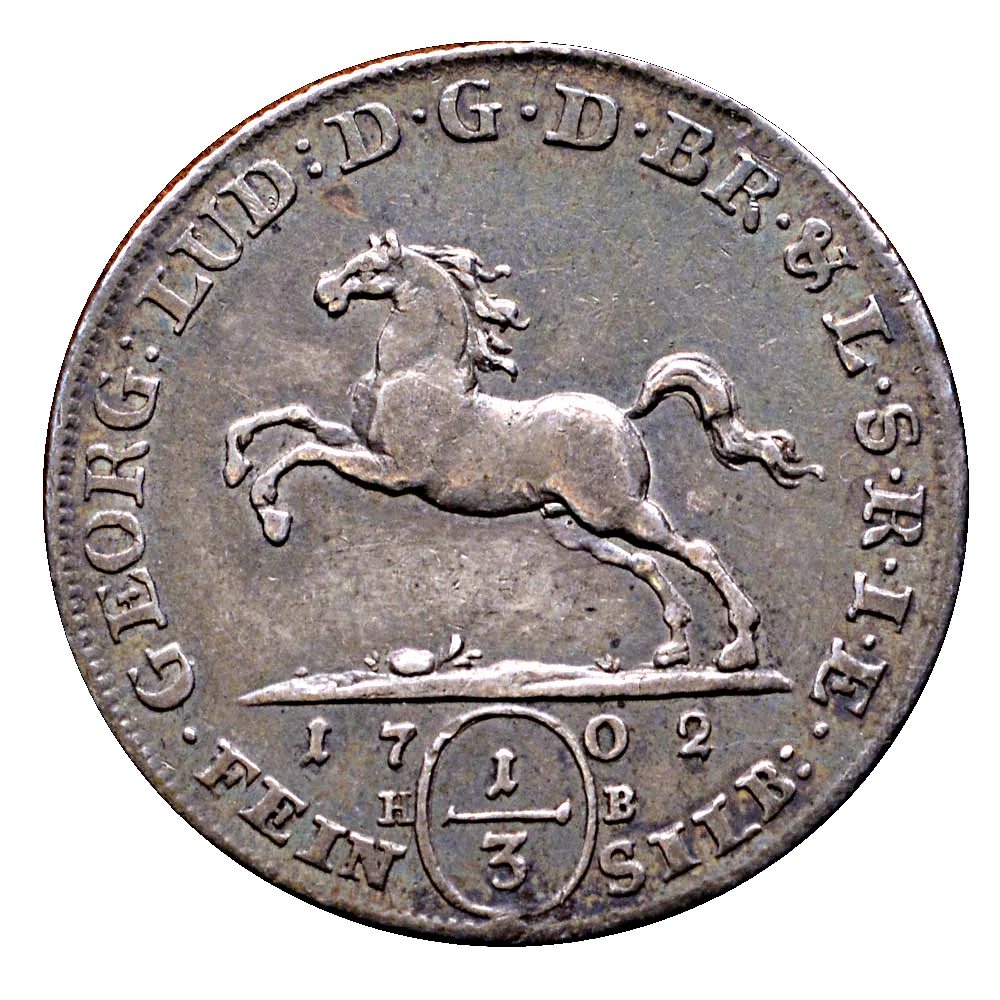
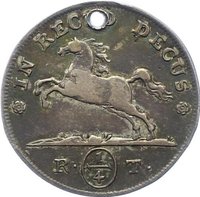
Galloping horse left, date and denomination in oval below.
Inscription:
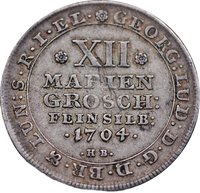
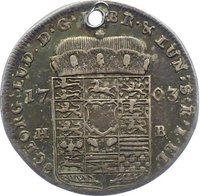
GEORG : LUD : D. G. D. BR. & L. S. R. I. E.
FEIN SILB
FEIN SILB
Script: Latin
Reverse
Edge
Mints
| Name | Mark |
|---|---|
| Clausthal | — |
Mintings
| Year | Mint Mark | Mintage | Quality | Collection |
|---|---|---|---|---|
| 1702 | — | — |
Historical background
In 1702, the currency situation in the Duchy of Brunswick-Lüneburg, specifically the Principality of Calenberg (with its capital in Hanover), was complex and fragmented, reflecting the broader political structure of the Holy Roman Empire. The territory was part of a web of competing monetary systems, with its own mint producing coins like the Thaler, Gute Groschen, and Mariengroschen. However, these circulated alongside a plethora of foreign coins from neighboring German states, the Dutch Republic, and beyond, leading to chronic confusion over exchange rates and intrinsic metal values. This monetary plurality was a significant hindrance to trade and state finance, as the value of money was not uniformly reliable.
The core of the problem lay in the disparity between the official Kurantgeld (currency money) and the lower-valued Reichstaler used for accounting. Furthermore, the frequent debasement of coinage by various mints, including Hanover's own, eroded public trust. Princes often reduced the silver content in coins to generate short-term profit from seigniorage, especially to fund military expenditures, as Elector George Louis (the future King George I of Great Britain) was deeply involved in the War of the Spanish Succession. This practice led to inflation, Gresham's Law (where "bad money drives out good"), and economic instability for merchants and peasants alike.
Despite these challenges, 1702 falls within a period of gradual reform. The Duchy was moving toward the Reichsmünzfuß (Imperial mint standard) decreed in the 1667 Zinnaische Münzvertrag and the 1690 Leipziger Münzfuß, which aimed to standardize thaler subdivisions across the Empire. Hanover's adherence to these standards was inconsistent but signaled a slow shift toward greater monetary stability. This precarious balance between wartime fiscal pressure, legacy fragmentation, and tentative standardization defined the currency background as Hanover stood on the cusp of its dynastic ascent to the British throne.
The core of the problem lay in the disparity between the official Kurantgeld (currency money) and the lower-valued Reichstaler used for accounting. Furthermore, the frequent debasement of coinage by various mints, including Hanover's own, eroded public trust. Princes often reduced the silver content in coins to generate short-term profit from seigniorage, especially to fund military expenditures, as Elector George Louis (the future King George I of Great Britain) was deeply involved in the War of the Spanish Succession. This practice led to inflation, Gresham's Law (where "bad money drives out good"), and economic instability for merchants and peasants alike.
Despite these challenges, 1702 falls within a period of gradual reform. The Duchy was moving toward the Reichsmünzfuß (Imperial mint standard) decreed in the 1667 Zinnaische Münzvertrag and the 1690 Leipziger Münzfuß, which aimed to standardize thaler subdivisions across the Empire. Hanover's adherence to these standards was inconsistent but signaled a slow shift toward greater monetary stability. This precarious balance between wartime fiscal pressure, legacy fragmentation, and tentative standardization defined the currency background as Hanover stood on the cusp of its dynastic ascent to the British throne.
✨ Legendary