

1 Florin – Hungary
Hungary

Obverse
Description:
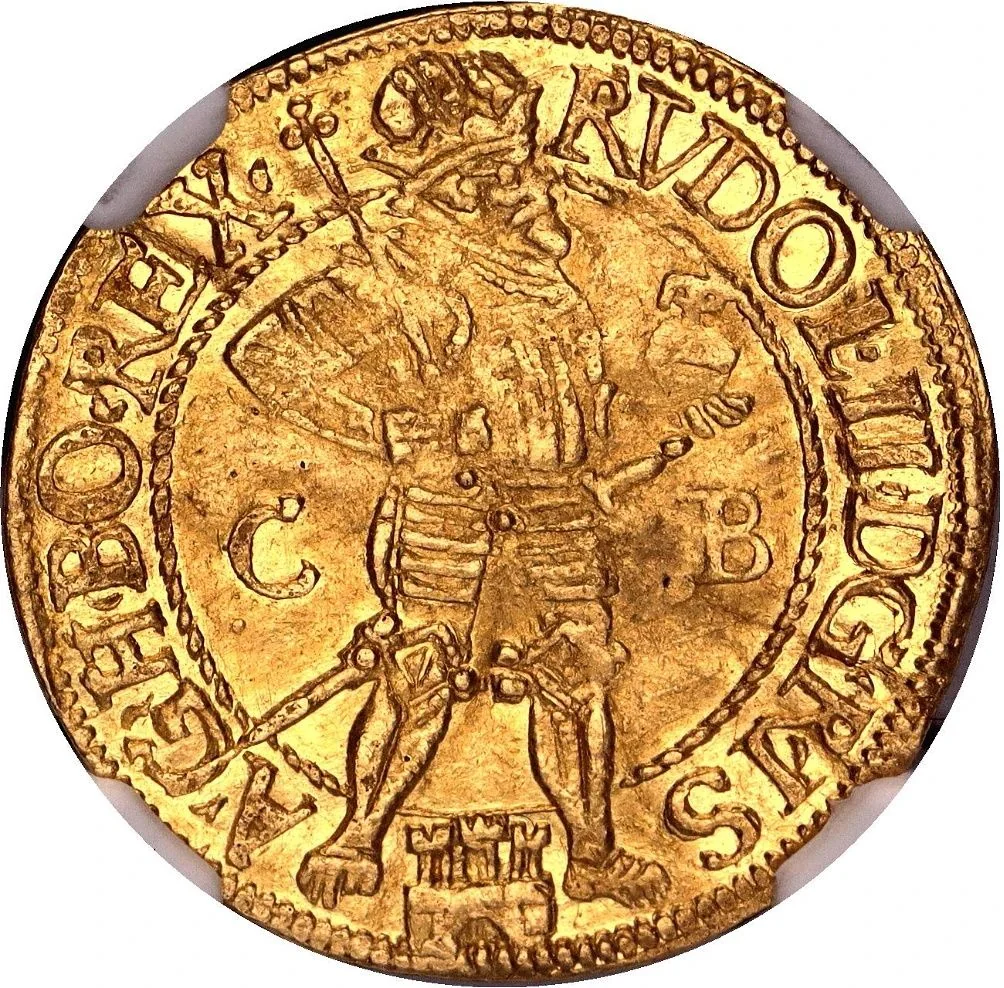
Crowned armored king facing right, holding a long sword and an orb. A castle between his legs (Klausenberg mintmark).
Inscription:
RVDOL · II · D · G · R I · S · A · G · H · BO · REX ·
C B
C B
Script: Latin
Reverse
Description:
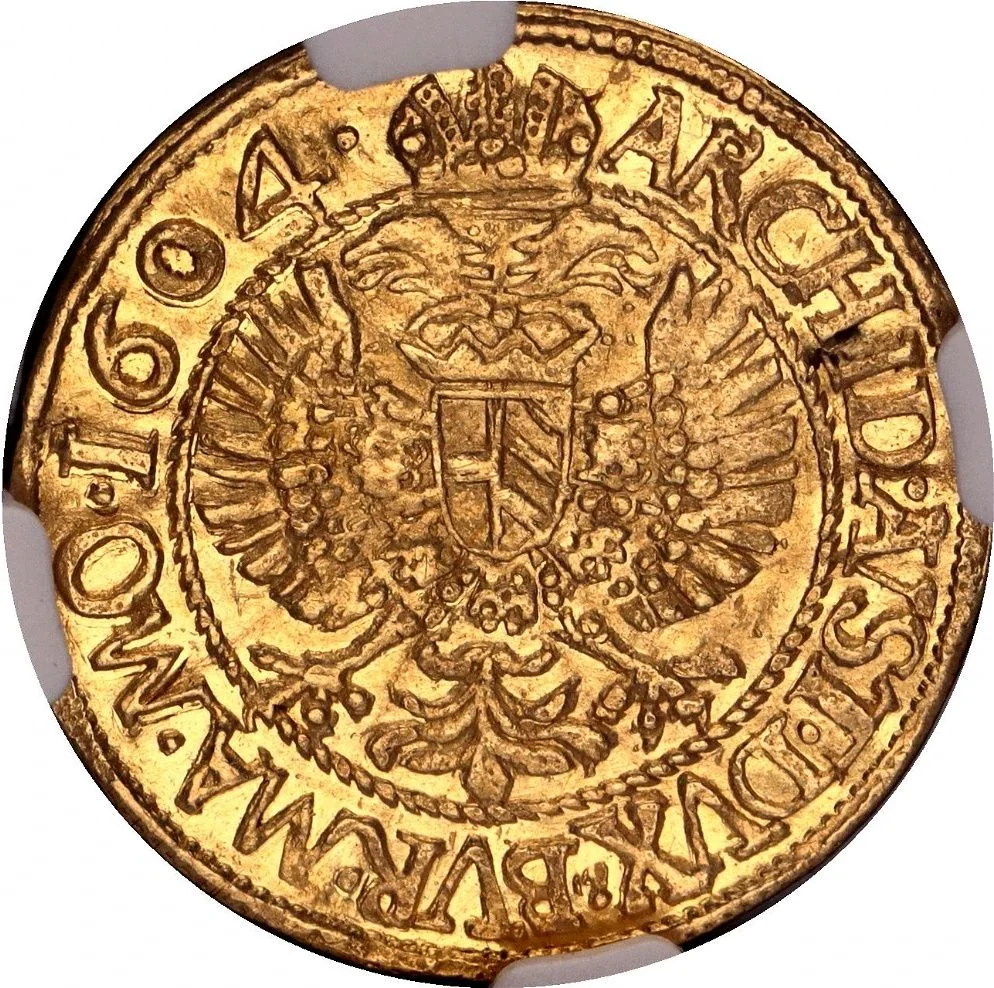
A double-headed eagle bearing the Austrian-Burgundian shield, crowned and adorned with the Golden Fleece.
Inscription:
ARCHID · AVST · DVX · BVR · MA · MO · 1604 ·
Script: Latin
Edge
Plain
Mints
| Name | Mark |
|---|---|
| Cluj-Napoca | CB |
Mintings
| Year | Mint Mark | Mintage | Quality | Collection |
|---|---|---|---|---|
| 1604 | C | — | ||
| 1605 | C | — |
Historical background
In 1604, Hungary existed as a fractured kingdom, divided into three parts: Royal Hungary under Habsburg rule, the Ottoman-occupied central territories, and the semi-independent Principality of Transylvania to the east. This political fragmentation directly caused a severe and chaotic monetary situation. The Habsburgs, controlling the minting rights for the kingdom, systematically debased the silver coinage, particularly the denarius (denar), to finance their ongoing wars against the Ottomans and to cover the immense costs of maintaining the Militärgrenze (Military Frontier). This resulted in a flood of low-quality, lightweight coins circulating in Royal Hungary, which drove older, full-value coins out of circulation (Gresham's Law) and caused rampant inflation, crippling trade and burdening the peasantry and lesser nobility.
The currency crisis became a central catalyst for the outbreak of the Bocskai Uprising in 1604. The Hungarian estates and frontier hajdú soldiers were already discontent with heavy taxation and centralizing Habsburg policies, but the devastating devaluation of their currency was a tangible and daily grievance. Stephen Bocskai, Prince of Transylvania, harnessed this economic anger, issuing his own high-quality silver coins (such as the Bocskai-tallér) from captured mints in Kassa (Košice). These coins served a dual purpose: they provided a stable currency to fund his rebellion and acted as powerful propaganda, symbolizing legitimate sovereignty and economic justice in direct contrast to the debased Habsburg money.
Thus, the currency situation of 1604 was not merely an economic issue but a potent political weapon and a symptom of deeper conflicts. The monetary chaos underscored the struggle between the Habsburg central authority and Hungarian estates' privileges, between the funding demands of perpetual warfare and economic stability. Bocskai’s successful monetary policy was instrumental in his military successes, forcing the Habsburgs to the negotiating table and ultimately securing the Treaty of Vienna (1606), which guaranteed religious freedom and restored some political autonomy to Hungary, temporarily alleviating the tensions that the currency crisis had so violently exposed.
The currency crisis became a central catalyst for the outbreak of the Bocskai Uprising in 1604. The Hungarian estates and frontier hajdú soldiers were already discontent with heavy taxation and centralizing Habsburg policies, but the devastating devaluation of their currency was a tangible and daily grievance. Stephen Bocskai, Prince of Transylvania, harnessed this economic anger, issuing his own high-quality silver coins (such as the Bocskai-tallér) from captured mints in Kassa (Košice). These coins served a dual purpose: they provided a stable currency to fund his rebellion and acted as powerful propaganda, symbolizing legitimate sovereignty and economic justice in direct contrast to the debased Habsburg money.
Thus, the currency situation of 1604 was not merely an economic issue but a potent political weapon and a symptom of deeper conflicts. The monetary chaos underscored the struggle between the Habsburg central authority and Hungarian estates' privileges, between the funding demands of perpetual warfare and economic stability. Bocskai’s successful monetary policy was instrumental in his military successes, forcing the Habsburgs to the negotiating table and ultimately securing the Treaty of Vienna (1606), which guaranteed religious freedom and restored some political autonomy to Hungary, temporarily alleviating the tensions that the currency crisis had so violently exposed.

✨ Legendary