

¼ Thaler – Kingdom of Bohemia
Context
Years: 1623–1638
Country: Bohemia
Issuer: Kingdom of Bohemia
Ruler: Ferdinand II
Currency:
(1520—1754)
Demonetized: Yes
References
KM: #Click to copy to clipboard344
Numista: #105751
Obverse
Description:
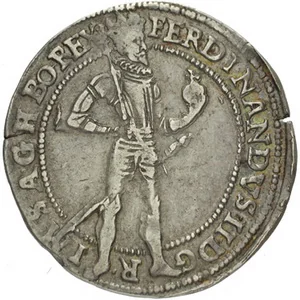
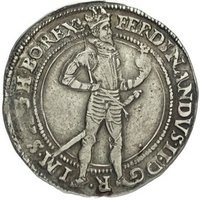
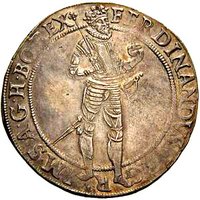
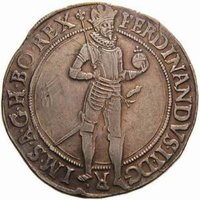
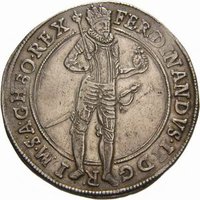
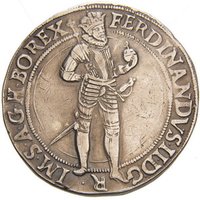
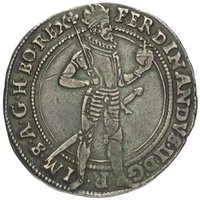
Laureate bust right, ruffled collar.
Inscription:
FERDINANDVS II D G R IM S A G H BO REX
Script: Latin
Reverse
Edge
Mints
| Name | Mark |
|---|---|
| Kuttenberg | — |
Mintings
| Year | Mint Mark | Mintage | Quality | Collection |
|---|---|---|---|---|
| 1623 | ee | — | ||
| 1624 | ee | — | ||
| 1625 | ee | — | ||
| 1626 | ee | — | ||
| 1627 | ee | — | ||
| 1628 | ee | — | ||
| 1629 | ee | — | ||
| 1630 | ee | — | ||
| 1631 | ee | — | ||
| 1632 | ee | — | ||
| 1633 | dd | — | ||
| 1633 | ff | — | ||
| 1634 | ff | — | ||
| 1637 | hh | — | ||
| 1638 | hh | — |
Historical background
In 1623, the Kingdom of Bohemia was in a state of profound financial and political crisis following the defeat of the Protestant estates at the Battle of the White Mountain in 1620. The victorious Habsburg Emperor Ferdinand II moved swiftly to consolidate power, executing rebel leaders, confiscating the lands of Protestant nobles, and enforcing Catholic recatholicization. This upheaval devastated the Bohemian economy, disrupting trade and agricultural production, while the massive property transfers to loyal Catholic allies created a climate of instability. The imperial authorities and the new landholding class faced urgent fiscal pressures to fund the ongoing military campaigns of the Thirty Years' War.
This dire situation led to a catastrophic monetary policy: the great currency debasement of 1622–1623. Emperor Ferdinand II granted a consortium of court financiers, led by Jacob Bassevi and Prince Karl I von Liechtenstein, the exclusive right to mint coinage. This consortium, known as the Münzverein, systematically collected existing silver coins, melted them down, and issued new ones with drastically reduced silver content. The most notorious was the Kipper krejcar, a small coin whose intrinsic value was a fraction of its face value. This process flooded the kingdom with unstable, poor-quality money.
The consequences were devastating hyperinflation and a collapse of public trust. Prices for basic necessities skyrocketed, wiping out savings and causing widespread pauperization. By early 1623, the currency had become virtually worthless, leading to a complete breakdown in market transactions. The experiment ended in disaster by the year's close, forcing the imperial government to step in, dissolve the consortium, and attempt a stabilization. The 1623 debasement left a lasting scar on Bohemia, symbolizing the economic ruin that accompanied the political and religious transformation of the kingdom in the early stages of the Thirty Years' War.
This dire situation led to a catastrophic monetary policy: the great currency debasement of 1622–1623. Emperor Ferdinand II granted a consortium of court financiers, led by Jacob Bassevi and Prince Karl I von Liechtenstein, the exclusive right to mint coinage. This consortium, known as the Münzverein, systematically collected existing silver coins, melted them down, and issued new ones with drastically reduced silver content. The most notorious was the Kipper krejcar, a small coin whose intrinsic value was a fraction of its face value. This process flooded the kingdom with unstable, poor-quality money.
The consequences were devastating hyperinflation and a collapse of public trust. Prices for basic necessities skyrocketed, wiping out savings and causing widespread pauperization. By early 1623, the currency had become virtually worthless, leading to a complete breakdown in market transactions. The experiment ended in disaster by the year's close, forcing the imperial government to step in, dissolve the consortium, and attempt a stabilization. The 1623 debasement left a lasting scar on Bohemia, symbolizing the economic ruin that accompanied the political and religious transformation of the kingdom in the early stages of the Thirty Years' War.
✨ Legendary