

gigot – Spanish Netherlands
Add to wishlist
Netherlands
Context
Years: 1681–1688
Country: Netherlands
Issuer: Spanish Netherlands
Ruler: Charles II
Currency:
(1506—1713)
Subdivision: gigot = ½ Liard
Demonetized: Yes
Material
Diameter: 22 mm
Weight: 1.91 g
Shape: Irregular round
Composition: Copper
Magnetic: No
Technique: Hammered
Alignment: Coin alignment
flip
References
KM: #
Numista: #105440
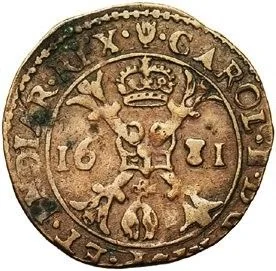
Obverse
Description:
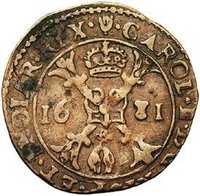
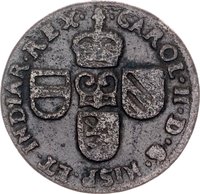
Burgundian cross with central firesteel frames date; Golden Fleece jewel below, mintmark above.
Inscription:
CAROL II D G HISP ET INDIAR REX
Script: Latin
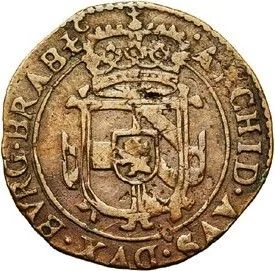
Reverse
Description:
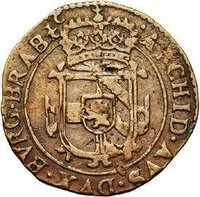
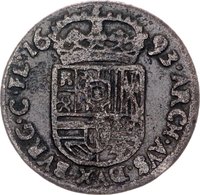
Austria-Burgundy crowned arms in inner circle.
Inscription:
ARCHID AVST DVX BVRG BRAB Z
Script: Latin
Edge
Mints
| Name | Mark |
|---|---|
| Antwerp | — |
| Royal Mint of Belgium | — |
Mintings
| Year | Mint Mark | Mintage | Quality | Collection |
|---|---|---|---|---|
| 1681 | — | — | ||
| 1685 | — | — | ||
| 1686 | — | — | ||
| 1688 | — | — |
Historical background
In 1681, the Spanish Netherlands found itself in a complex and deteriorating monetary crisis, a legacy of the long-running Franco-Dutch War (1672-1678) and the chronic fiscal strains of the Spanish Habsburg monarchy. The region's economy, a vital hub of European trade, was plagued by a severe shortage of high-value, full-weight coinage. This was due to both the export of good silver to pay for wartime expenses and the widespread practice of clipping and debasement, which eroded public trust in the coinage in circulation. Consequently, merchants and individuals hoarded any remaining sound money, exacerbating the shortage and disrupting daily commerce.
The monetary landscape was a chaotic patchwork. Alongside officially minted Patagons, Ducatons, and Patards, a vast array of worn, clipped, and counterfeit coins from neighboring states like France, the Dutch Republic, and the German principalities circulated at fluctuating and unreliable values. This confusion was actively exploited by money changers and speculators, who profited from the disorder at the expense of the general populace and legitimate trade. Local authorities attempted to legislate solutions by periodically issuing placards (ordinances) that set official exchange rates and banned certain foreign coins, but these measures were largely ineffective and frequently ignored.
This instability occurred under the governorship of the Duke of Parma, who ruled on behalf of King Charles II of Spain. The central government in Madrid, bankrupt and preoccupied with wider imperial concerns, provided little practical support. Therefore, the response was primarily local and reactive, failing to address the structural issues. The persistent currency chaos of 1681 weakened the economic fabric of the Spanish Netherlands, creating a backdrop of financial insecurity that would persist until more comprehensive reforms were attempted in the following decade.
The monetary landscape was a chaotic patchwork. Alongside officially minted Patagons, Ducatons, and Patards, a vast array of worn, clipped, and counterfeit coins from neighboring states like France, the Dutch Republic, and the German principalities circulated at fluctuating and unreliable values. This confusion was actively exploited by money changers and speculators, who profited from the disorder at the expense of the general populace and legitimate trade. Local authorities attempted to legislate solutions by periodically issuing placards (ordinances) that set official exchange rates and banned certain foreign coins, but these measures were largely ineffective and frequently ignored.
This instability occurred under the governorship of the Duke of Parma, who ruled on behalf of King Charles II of Spain. The central government in Madrid, bankrupt and preoccupied with wider imperial concerns, provided little practical support. Therefore, the response was primarily local and reactive, failing to address the structural issues. The persistent currency chaos of 1681 weakened the economic fabric of the Spanish Netherlands, creating a backdrop of financial insecurity that would persist until more comprehensive reforms were attempted in the following decade.
✨ Legendary