

1 Skilling – Denmark
Denmark
Context
References
KM: #Click to copy to clipboard29.2
Numista: #152595
Obverse
Description:
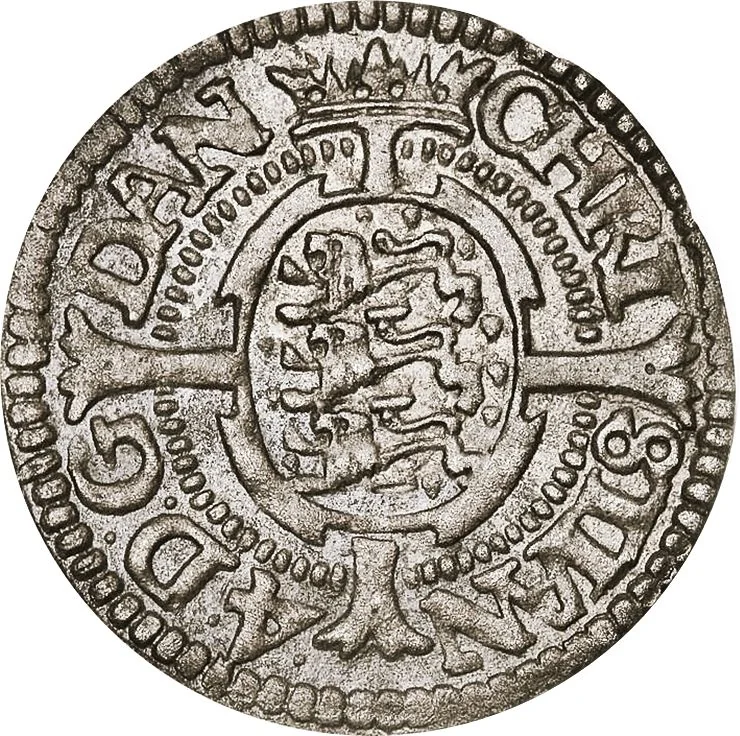
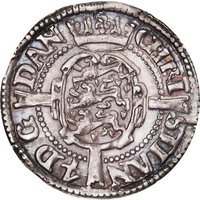
Crowned Danish shield on a cross, encircled by a beaded ring with a legend divided by the cross arms.
Inscription:
CHRI | STIAN | 4 · D:G · | DAN
Script: Latin
Reverse
Description:
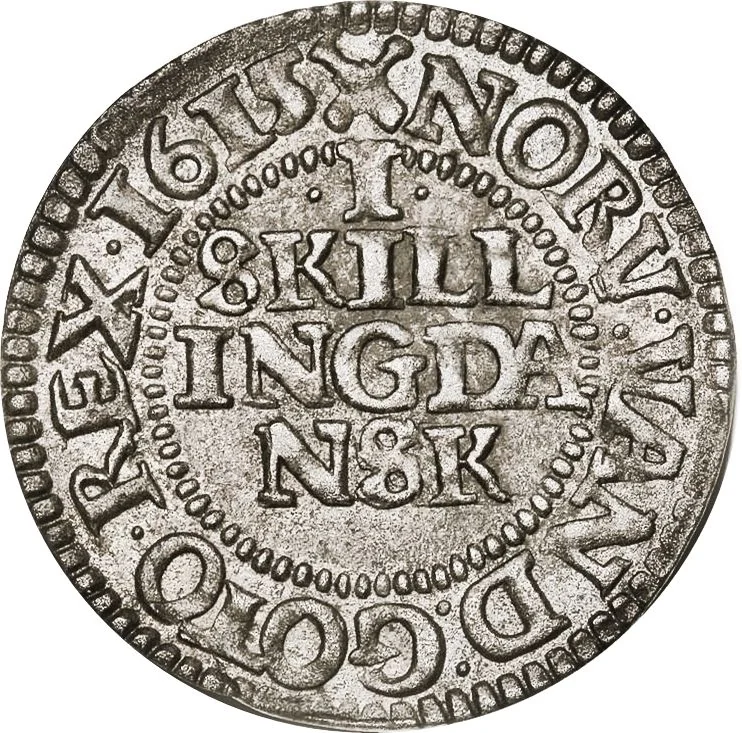
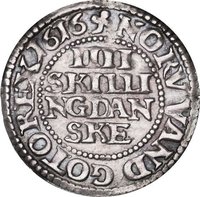
Pearled circle with four-line lettered value; legend encircles with date and mintmark.
Inscription:
I
SKILL
INGDAN
SK
NORV:VAND:GOTO:REX.1615
SKILL
INGDAN
SK
NORV:VAND:GOTO:REX.1615
Script: Latin
Edge
Mints
| Name | Mark |
|---|---|
| Copenhagen | ☘ |
Mintings
| Year | Mint Mark | Mintage | Quality | Collection |
|---|---|---|---|---|
| 1615 | c | — | ||
| 1617 | ☘ | — |
Historical background
In 1615, Denmark operated under a bimetallic monetary system, a legacy of the 1541 ordinance that established the Danish rigsdaler as the central unit of account. This system was theoretically based on both silver and gold, with the rigsdaler divided into marks and skilling. However, the reality was one of significant complexity and instability. A chronic shortage of official coinage, particularly small denominations for everyday trade, led to a chaotic circulation of hundreds of different foreign coins—primarily German, Dutch, and Swedish—each with fluctuating values. This proliferation of foreign currency, alongside the persistent practice of clipping and debasing coins, created a fragmented and unreliable monetary environment that hampered commerce and state finance.
The economic pressures of the Kalmar War (1611-1613) against Sweden heavily influenced the currency situation. The war had been financially draining, forcing the state to engage in expedients like extracting forced loans from the burgher class and manipulating currency values to meet expenses. While the war had ended with the Treaty of Knäred in 1613, its fiscal aftermath lingered into 1615. King Christian IV’s government was deeply in debt, and the temptation to generate revenue through seigniorage—the profit from minting coins with a face value higher than their metal content—remained strong, further threatening the currency's integrity.
Consequently, 1615 was a year of simmering crisis within a longer period of monetary disorder. The state's authority over the currency was weak, and the public's trust in the coinage was eroded. This unstable situation would ultimately compel a major, but only partially successful, monetary reform in 1619, which aimed to reassert royal control, standardize the coinage, and retire the multitude of foreign pieces. Thus, the background for 1615 is one of a strained post-war economy struggling with a dysfunctional monetary system in urgent need of the overhaul that would be attempted later in the decade.
The economic pressures of the Kalmar War (1611-1613) against Sweden heavily influenced the currency situation. The war had been financially draining, forcing the state to engage in expedients like extracting forced loans from the burgher class and manipulating currency values to meet expenses. While the war had ended with the Treaty of Knäred in 1613, its fiscal aftermath lingered into 1615. King Christian IV’s government was deeply in debt, and the temptation to generate revenue through seigniorage—the profit from minting coins with a face value higher than their metal content—remained strong, further threatening the currency's integrity.
Consequently, 1615 was a year of simmering crisis within a longer period of monetary disorder. The state's authority over the currency was weak, and the public's trust in the coinage was eroded. This unstable situation would ultimately compel a major, but only partially successful, monetary reform in 1619, which aimed to reassert royal control, standardize the coinage, and retire the multitude of foreign pieces. Thus, the background for 1615 is one of a strained post-war economy struggling with a dysfunctional monetary system in urgent need of the overhaul that would be attempted later in the decade.
✨ Legendary