

Obverse
Description:
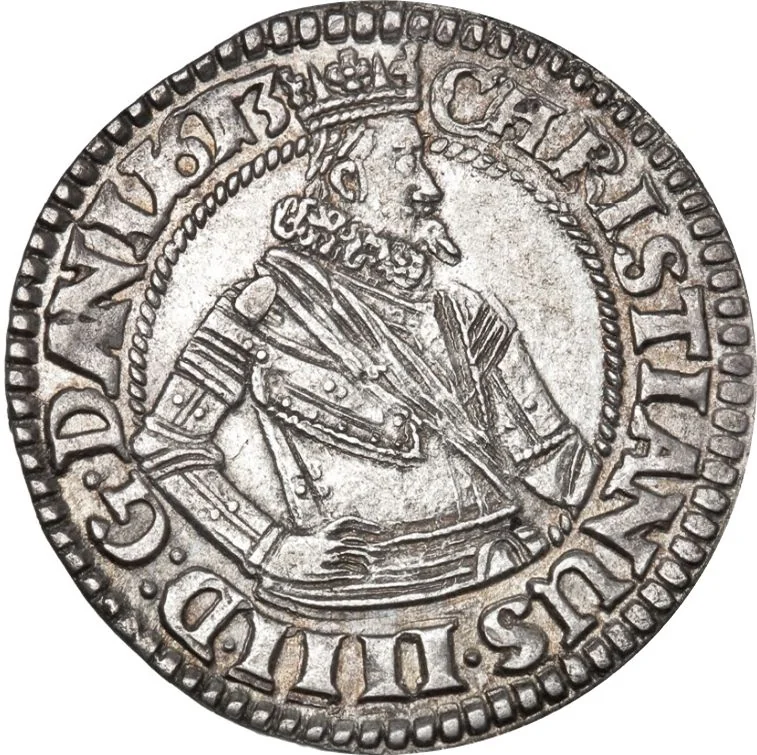
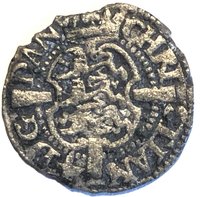
King Christian IV facing right in armor, sash, and ruff, his right hand on his hip. Within a partial beaded circle.
Inscription:
CHRISTIANUS · IIII · D : G · DANI 1613
Script: Latin
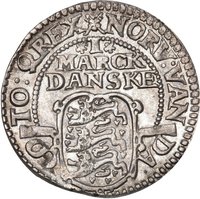
Reverse
Description:
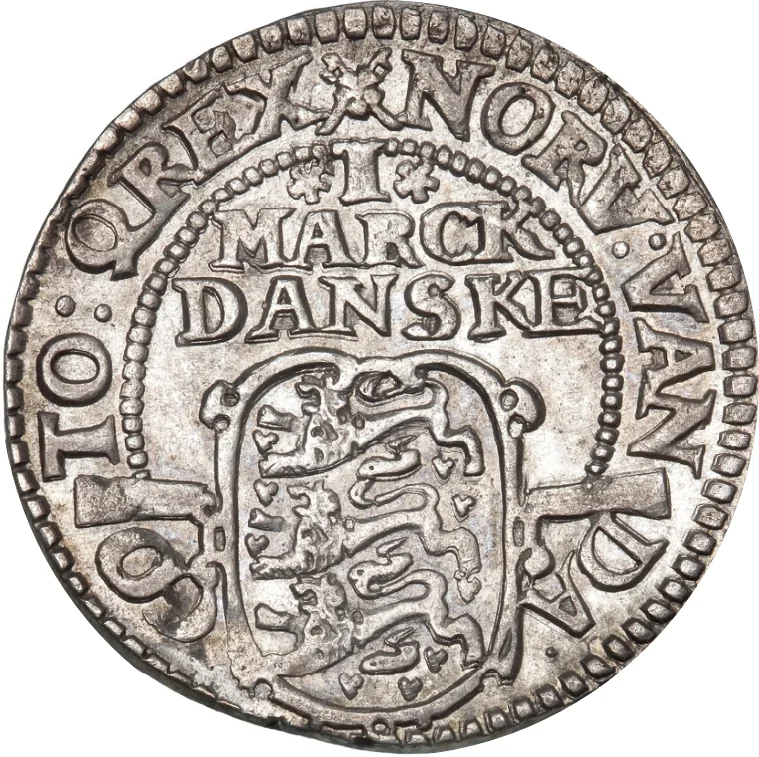
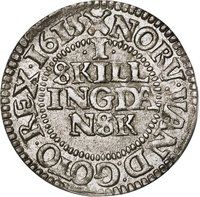
Three-line inscription. Danish coat of arms, cross optional below. Partial beaded border.
Inscription:
NORV : VAN DA · GO TO : Q REX
🞴 I 🞴
MARCK
DANSKE
🞴 I 🞴
MARCK
DANSKE
Script: Latin
Edge
Plain
Categories
| Person> Monarch |
| Symbols> Coat of Arms |
Mints
| Name | Mark |
|---|---|
| Copenhagen | ☘ |
Mintings
Historical background
In 1612, Denmark operated under a complex and strained monetary system, a legacy of the costly Kalmar War (1611-1613) against Sweden. The official currency was based on the silver rigsdaler, but the realm was plagued by a severe shortage of precious metals. This scarcity was exacerbated by decades of royal debasement, where kings like Christian IV's predecessors had reduced the silver content in coins to generate short-term revenue for state expenditures and wars, eroding public trust in the currency's intrinsic value.
Consequently, a chaotic multiplicity of coins circulated. Alongside debased domestic issues, a vast array of foreign coins—especially German, Dutch, and Baltic—were used in daily commerce, each valued by weight and perceived metal content rather than face value. This practice created a cumbersome and inefficient economy, requiring constant expert assessment and exchange. The state's attempt to fix official exchange rates (kurant) often diverged from market realities, leading to confusion and facilitating fraud.
Recognizing the crisis, 1612 fell within a period of attempted reform. In the previous year, Christian IV had established the Rentekammeret (Treasury) to better manage finances. The immediate pressures of war financing, however, limited decisive monetary overhaul. Thus, the situation remained fragile, characterized by a weak and heterogeneous coinage that hampered trade and state revenue, setting the stage for more structured reforms later in the century, such as the introduction of the Christian IV's kurantdaler in 1625.
Consequently, a chaotic multiplicity of coins circulated. Alongside debased domestic issues, a vast array of foreign coins—especially German, Dutch, and Baltic—were used in daily commerce, each valued by weight and perceived metal content rather than face value. This practice created a cumbersome and inefficient economy, requiring constant expert assessment and exchange. The state's attempt to fix official exchange rates (kurant) often diverged from market realities, leading to confusion and facilitating fraud.
Recognizing the crisis, 1612 fell within a period of attempted reform. In the previous year, Christian IV had established the Rentekammeret (Treasury) to better manage finances. The immediate pressures of war financing, however, limited decisive monetary overhaul. Thus, the situation remained fragile, characterized by a weak and heterogeneous coinage that hampered trade and state revenue, setting the stage for more structured reforms later in the century, such as the introduction of the Christian IV's kurantdaler in 1625.
💎 Very Rare