

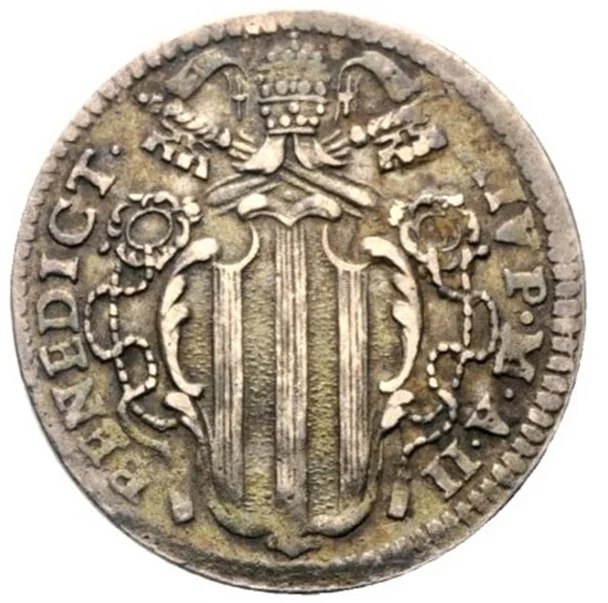

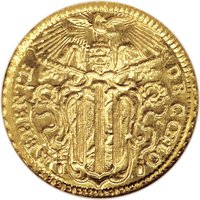
1 Grosso – Papal States
Vatican City
Context
Years: 1742–1743
Country: Vatican City 
Issuer: Papal States
Ruler: Benedict XIV
Currency:
(1534—1835)
Demonetized: Yes
Material

References
KM: #Click to copy to clipboard944
Numista: #152156
Value
Bullion value: $3.51
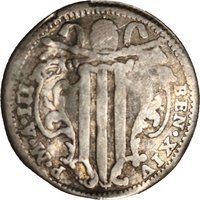
Obverse
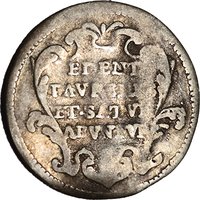
Reverse
Edge
Plain
Mintings
| Year | Mint Mark | Mintage | Quality | Collection |
|---|---|---|---|---|
| 1742 | — | — | ||
| 1743 | — | — |
Historical background
In 1742, the Papal States under Pope Benedict XIV faced a complex and strained monetary situation, typical of the fragmented Italian peninsula in the mid-18th century. The state lacked a unified, authoritative currency, leading to a chaotic circulation of diverse coins. Alongside the official papal issues from mints in Rome and Bologna, there was a flood of foreign silver and gold coins from Spain, France, Austria, and the various Italian states, each with fluctuating values. This proliferation of different currencies, combined with widespread clipping and counterfeiting, created a system rife with confusion and instability for daily commerce and state finances.
The core of the problem lay in the chronic debasement of the standard silver coin, the grosso or giulio. Over decades, successive popes had reduced its silver content to generate seigniorage revenue for the treasury, especially to meet the costs of administration, building projects, and diplomatic ventures. By 1742, this had led to a significant divergence between the face value of coins and their intrinsic metal worth, undermining public trust. Furthermore, the fixed exchange rate between the silver-based giulio and the gold-based scudo (valued at roughly 10 giulii) failed to reflect the volatile international market prices for precious metals, creating arbitrage opportunities that often drained full-weight coins from circulation, leaving only the poorer ones.
Pope Benedict XIV, recognizing these monetary disorders as a threat to economic health and papal authority, was already contemplating the comprehensive reform he would implement in 1746. Therefore, the situation in 1742 can be characterized as the tense culmination of long-standing decay, prompting serious study and setting the stage for decisive action. The papal administration grappled with the immediate challenges of budget shortfalls and commercial friction while laying the groundwork for a standardized, bimetallic system that would restore stability and confidence in the currency.
The core of the problem lay in the chronic debasement of the standard silver coin, the grosso or giulio. Over decades, successive popes had reduced its silver content to generate seigniorage revenue for the treasury, especially to meet the costs of administration, building projects, and diplomatic ventures. By 1742, this had led to a significant divergence between the face value of coins and their intrinsic metal worth, undermining public trust. Furthermore, the fixed exchange rate between the silver-based giulio and the gold-based scudo (valued at roughly 10 giulii) failed to reflect the volatile international market prices for precious metals, creating arbitrage opportunities that often drained full-weight coins from circulation, leaving only the poorer ones.
Pope Benedict XIV, recognizing these monetary disorders as a threat to economic health and papal authority, was already contemplating the comprehensive reform he would implement in 1746. Therefore, the situation in 1742 can be characterized as the tense culmination of long-standing decay, prompting serious study and setting the stage for decisive action. The papal administration grappled with the immediate challenges of budget shortfalls and commercial friction while laying the groundwork for a standardized, bimetallic system that would restore stability and confidence in the currency.
✨ Legendary