Logo Title
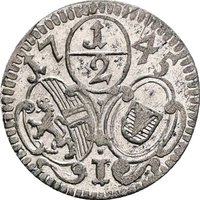
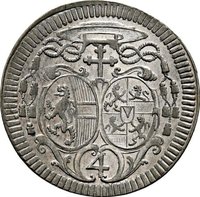
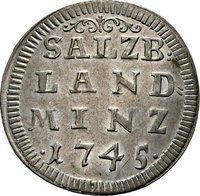
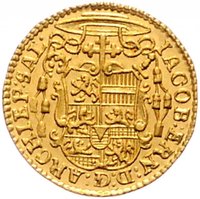
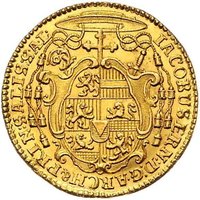
obverse
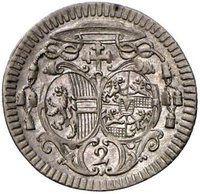
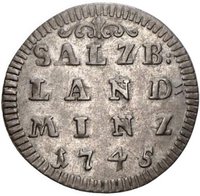
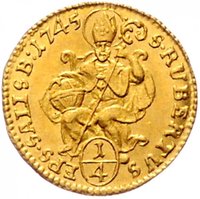
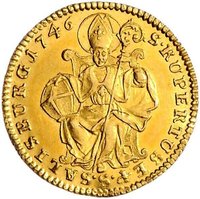
reverse
Auktionen Frühwald
Context
Year: 1745
Currency:
Demonetized: Yes
Material
Diameter: 40 mm
Weight: 29 g
Silver weight: 29.00 g
Shape: Round
Composition: Silver
Magnetic: No
References
KM: #Click to copy to clipboard345
Numista: #152151
Value
Bullion value: $82.03

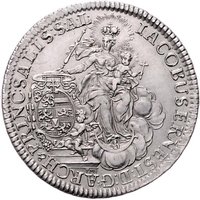
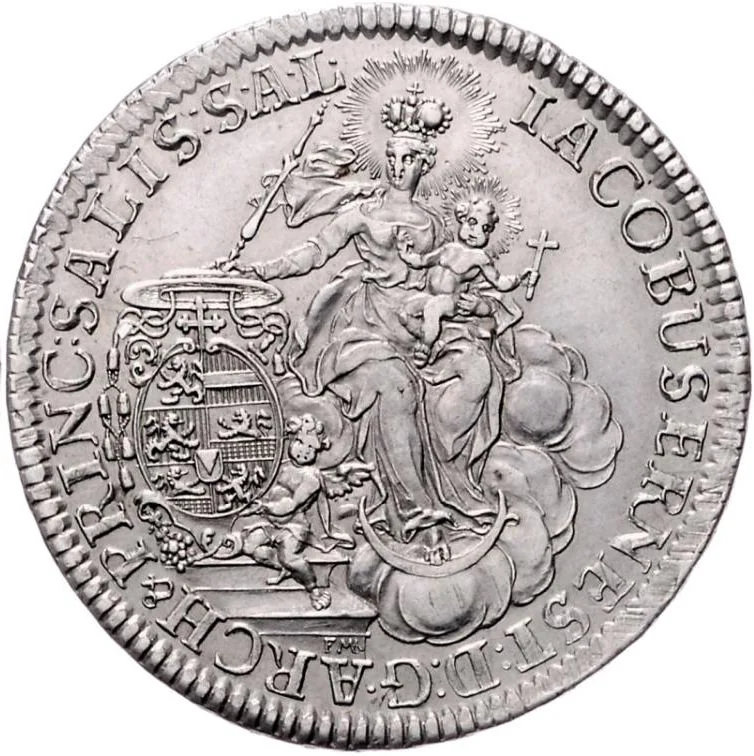
Obverse

Description:
Crowned Madonna and Child on a cloud, with an angel seated on a pedestal holding a shield under a Legate's hat.
Inscription:
IACOBUS ERNEST D G ARCH & PRINC SALIS S A L
Script: Latin

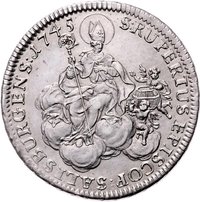
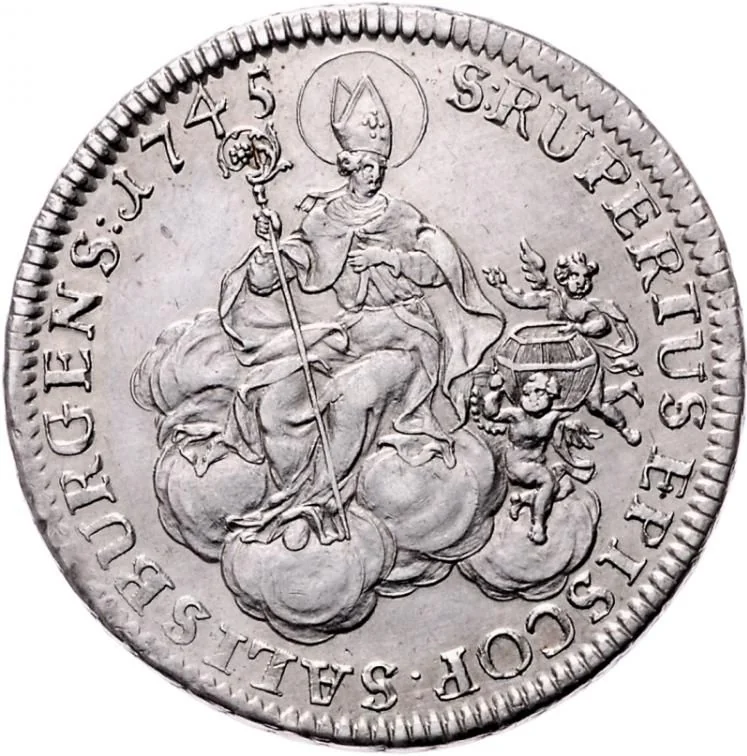
Reverse

Description:
St. Rupert enthroned on a cloud, holding his crozier and a salt barrel, with two angels to the right. Date in legend.
Inscription:
S RUPERTUS EPISCOP SALISBURG 1745
Script: Latin

Edge

Mintings

YearMint MarkMintageQualityCollection
1745
1745FMK

Historical background

In 1745, the Bishopric of Salzburg operated within the complex monetary landscape of the Holy Roman Empire, where currency issuance was not a unified state prerogative. The Prince-Archbishop, then Leopold Anton von Firmian (and from 1747, Jakob Ernst von Liechtenstein), minted his own coins, primarily silver Gulden and smaller Kreuzer, but their value and acceptance were heavily influenced by external forces. The region's economy was still recovering from the upheavals of the early 18th century, including the War of the Spanish Succession and the Bavarian uprising of 1705, which had disrupted trade and strained fiscal resources.

The currency situation was characterized by a proliferation of different coins in circulation, not only from Salzburg's own mint but also from neighboring states like Bavaria and Austria, as well as debased small change. This created persistent problems with exchange rates and valuation, complicating trade and taxation. The Bishopric's monetary policy was largely reactive, aiming to maintain the silver content of its own issues to ensure their credibility while competing with the often inflationary practices of other territories. The system was essentially one of "hard" silver coinage for larger transactions and unreliable small change for daily use, causing frequent friction between merchants, citizens, and the treasury.

Furthermore, Salzburg's currency was deeply entangled with the broader economic policies of the Habsburg Monarchy, to which it was politically and culturally aligned. The imperial attempts to standardize currency through the Reichsmünzfuß (Imperial minting standard) had limited practical success, leaving Salzburg to navigate a fragmented system. Thus, in 1745, the Bishopric's currency was not an instrument of sovereign economic power but a locally issued medium struggling for stability within a decentralized and competitive imperial monetary chaos.

Series: 1745 Bishopric of Salzburg circulation coins

½ Kreuzer obverse
½ Kreuzer reverse
½ Kreuzer
1745
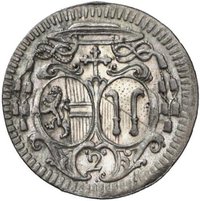
2 Kreuzers obverse
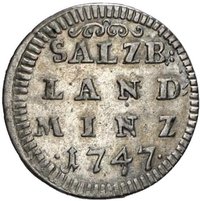
2 Kreuzers reverse
2 Kreuzers
1745-1747
4 Kreuzer obverse
4 Kreuzer reverse
4 Kreuzer
1745
1 Thaler - 1 Guldiner obverse
1 Thaler - 1 Guldiner reverse
1 Thaler - 1 Guldiner
1745
¼ Ducat obverse
¼ Ducat reverse
¼ Ducat
1745
1 Ducat obverse
1 Ducat reverse
1 Ducat
1745-1746
2 Kreuzers obverse
2 Kreuzers reverse
2 Kreuzers
1745-1747
Legendary