

8 skilling – Denmark
Add to wishlist
Denmark
Context
Material
Diameter: 21 mm
Weight: 3.06 g
Silver Weight:: 1.81 g
Shape: Round
Composition: 59.2% Silver
Standard: Gold tenth ounce
Magnetic: No
Alignment: Medal alignment
flip
References
KM: #
Numista: #150932
Value
Bullion value: $4.64
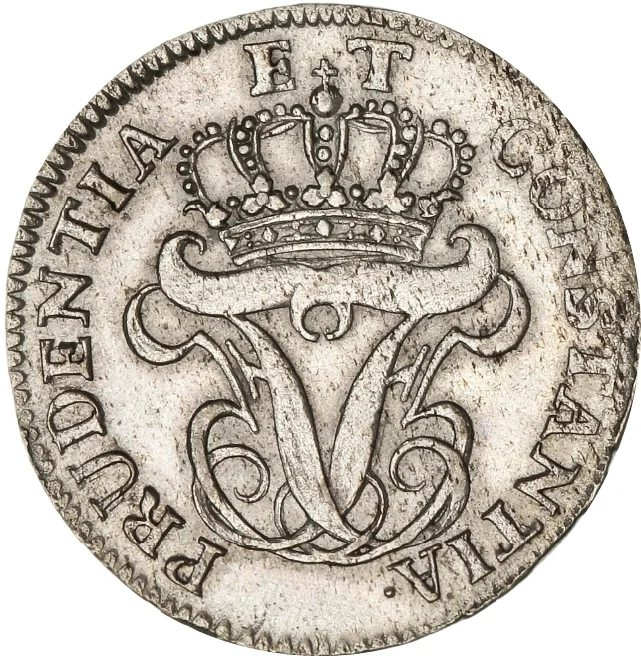
Obverse
Description:
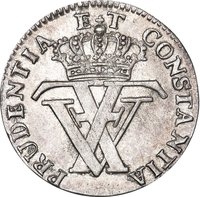
Crowned "F5" monogram encircled by the royal motto.
Inscription:
F55F
PRUDENTIA ET CONSTANTIA.
PRUDENTIA ET CONSTANTIA.
Script: Latin
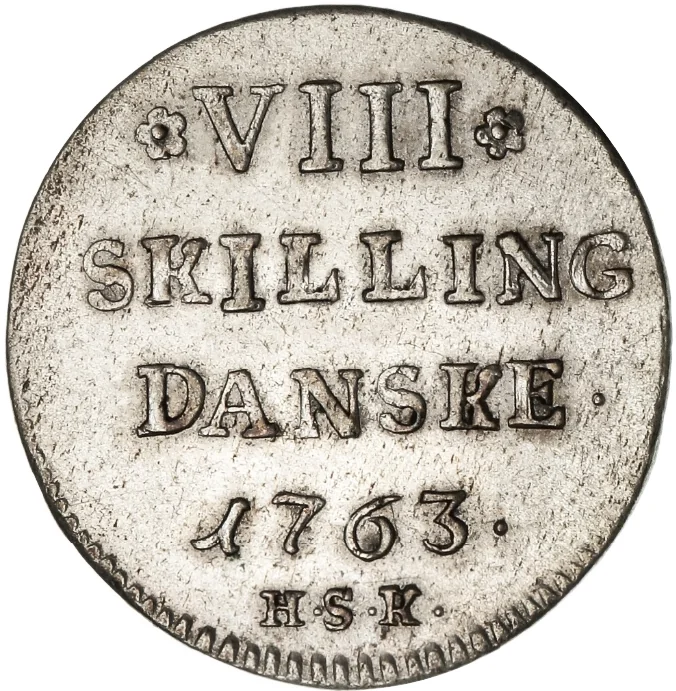
Reverse
Description:
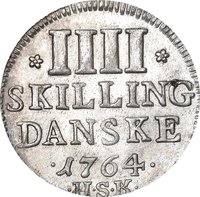
Value above date.
Mintmaster initials below.
Mintmaster initials below.
Inscription:
* VIII *
SKILLING
DANSKE
1763
H.S.K.
SKILLING
DANSKE
1763
H.S.K.
Script: Latin
Edge
Mints
| Name | Mark |
|---|---|
| Royal Danish Mint | — |
Mintings
| Year | Mint Mark | Mintage | Quality | Collection |
|---|---|---|---|---|
| 1763 | — | — |
Historical background
In 1763, Denmark found itself navigating the complex aftermath of the Seven Years' War (1756-1763). While officially neutral, the kingdom had engaged in lucrative trade with all belligerents, leading to a significant influx of silver. This wartime boom, however, created an unstable monetary environment. The Danish state, led by the ambitious finance minister Heinrich Carl von Schimmelmann, faced a heavy debt burden from earlier conflicts and was reliant on a mixed and often chaotic currency system comprising both Danish species (silver coins) and a vast array of foreign coins circulating within its borders.
The core of the 1763 situation was a severe credit crunch and a sharp economic downturn following the war's conclusion. The end of wartime demand caused a slump in prices for Danish agricultural exports, while the money supply contracted as foreign silver left the country. This triggered numerous bankruptcies among merchants and put extreme pressure on the two primary credit institutions: the Copenhagen Kurantbank (issuing paper kurant currency) and the state-owned Speciebanken, which held a monopoly on minting silver coins. A crisis of confidence emerged, as the public doubted the banks' ability to redeem paper notes for silver.
In response, the Danish government enacted a major monetary reform in September 1763. This decree aimed to stabilize the system by fixing the exchange rate between the silver rigsdaler specie and the paper rigsdaler kurant, effectively creating a silver standard. It also mandated the withdrawal of certain debased coins and restricted the circulation of foreign currency. While these measures provided immediate stabilization and defined the Danish monetary system for decades, they came at a social cost, exacerbating deflation and hardship for debtors, including many landowners and farmers, in the ensuing years.
The core of the 1763 situation was a severe credit crunch and a sharp economic downturn following the war's conclusion. The end of wartime demand caused a slump in prices for Danish agricultural exports, while the money supply contracted as foreign silver left the country. This triggered numerous bankruptcies among merchants and put extreme pressure on the two primary credit institutions: the Copenhagen Kurantbank (issuing paper kurant currency) and the state-owned Speciebanken, which held a monopoly on minting silver coins. A crisis of confidence emerged, as the public doubted the banks' ability to redeem paper notes for silver.
In response, the Danish government enacted a major monetary reform in September 1763. This decree aimed to stabilize the system by fixing the exchange rate between the silver rigsdaler specie and the paper rigsdaler kurant, effectively creating a silver standard. It also mandated the withdrawal of certain debased coins and restricted the circulation of foreign currency. While these measures provided immediate stabilization and defined the Danish monetary system for decades, they came at a social cost, exacerbating deflation and hardship for debtors, including many landowners and farmers, in the ensuing years.
✨ Legendary