

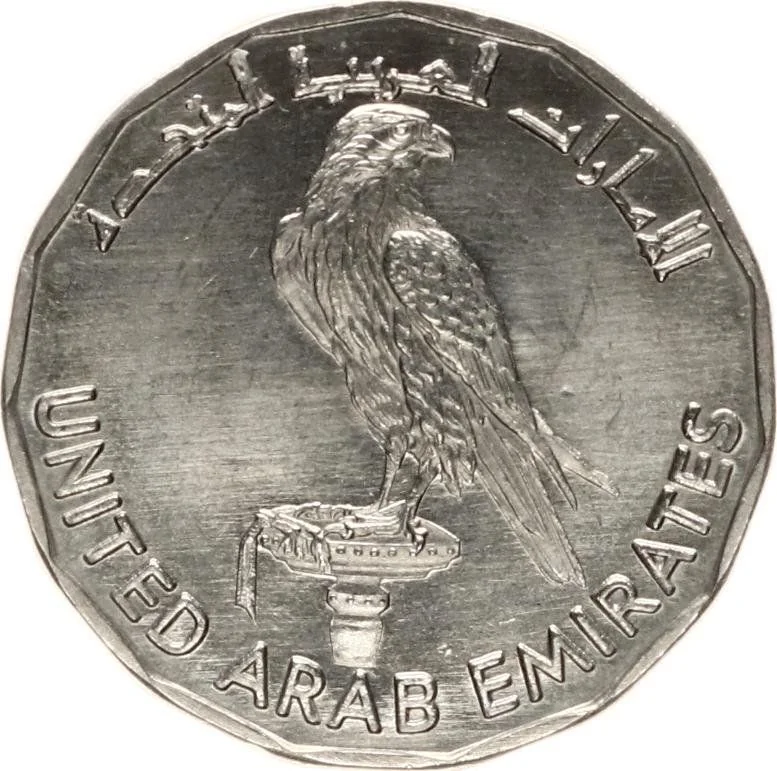
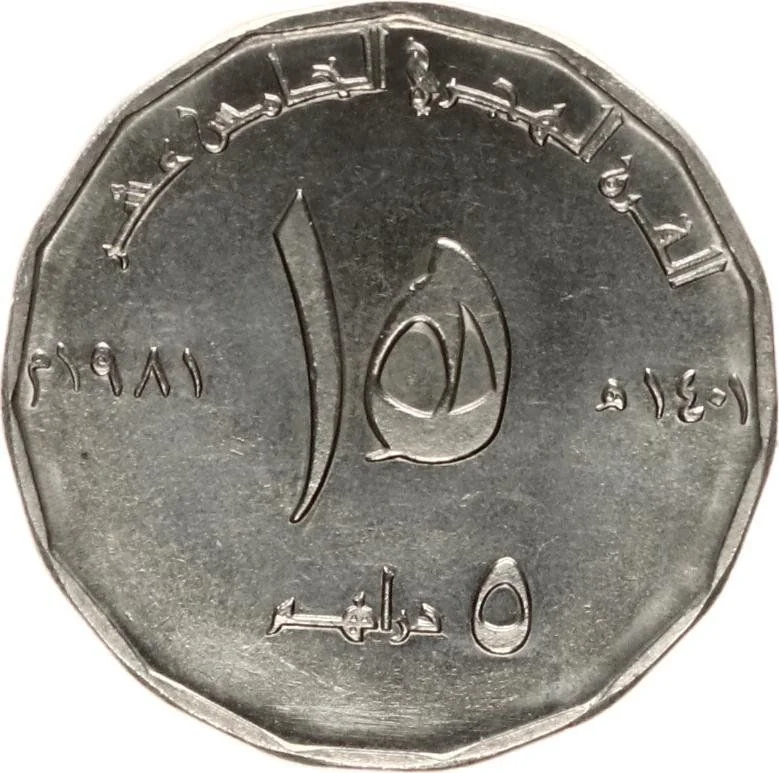
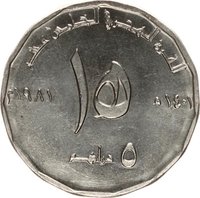
5 Dirhams – United Arab Emirates
Circulating commemorative coins
Commemoration: Beginning of the 15th Hijrah Century
United Arab Emirates
Context
Year: 1981
Islamic (Hijri) Year: 1401
Issuer: United Arab Emirates 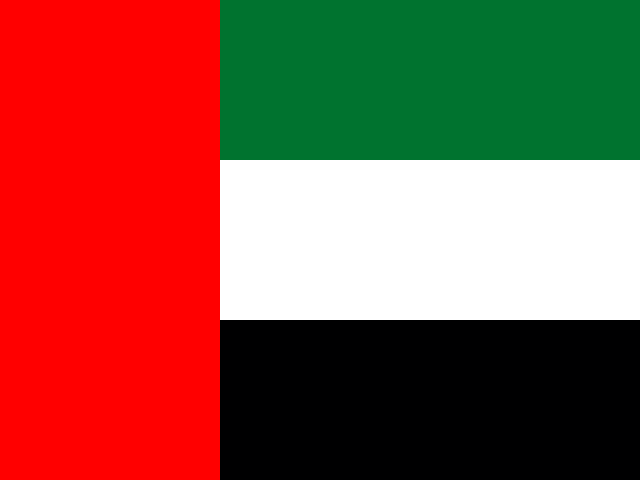
Ruler: Zayed bin Sultan Al Nahyan
Currency:
(since 1973)
Total mintage: 2,000,000
Material
Diameter: 32 mm
Weight: 14.25 g
Shape: Pentadecagonal
Composition: Copper-nickel
Technique: Milled
Alignment: Medal alignment
flip
References
KM: #Click to copy to clipboard9
Numista: #12137
Value
Exchange value: 5 AED
Obverse
Reverse
Edge
Plain
Mints
| Name | Mark |
|---|---|
| Royal Mint | — |
Mintings
| Year | Mint Mark | Mintage | Quality | Collection |
|---|---|---|---|---|
| 1981 | — | 2,000,000 |
Historical background
In 1981, the currency situation in the United Arab Emirates was defined by a period of transition and regional monetary cooperation. Since its formation in 1971, the UAE had initially used the Bahraini Dinar and the Qatar and Dubai Riyal as circulating currencies. However, the founding of the UAE Currency Board in 1973 led to the introduction of the UAE dirham (AED) as the national currency, pegged to the Special Drawing Right (SDR) of the International Monetary Fund. By 1981, this peg was firmly established, providing crucial stability for the young federation's rapidly growing, oil-driven economy, which was experiencing a massive influx of foreign workers and capital.
This period was also marked by active but ultimately stalled negotiations for a unified Gulf currency. Following the 1975 establishment of the Gulf Cooperation Council (GCC), member states, including the UAE, seriously explored creating a common monetary union. In 1981, these discussions were gaining momentum, with technical committees evaluating the feasibility of a single currency or a fixed exchange rate system. The UAE's existing peg to the SDR was seen as a potential model or stepping stone toward this broader regional goal, reflecting a commitment to economic integration alongside its national monetary sovereignty.
Despite the regional ambitions, the UAE's domestic currency regime in 1981 was notably stable and effective. The dirham's peg to the SDR (a basket of major currencies) indirectly linked it to the US dollar, which was becoming the dominant currency for global oil transactions. This linkage helped manage inflation, facilitate trade, and attract foreign investment during an era of significant infrastructure development. Thus, while looking outward to potential GCC monetary union, the UAE in 1981 possessed a secure and functional national currency system that underpinned its economic modernization and growing prominence on the world stage.
This period was also marked by active but ultimately stalled negotiations for a unified Gulf currency. Following the 1975 establishment of the Gulf Cooperation Council (GCC), member states, including the UAE, seriously explored creating a common monetary union. In 1981, these discussions were gaining momentum, with technical committees evaluating the feasibility of a single currency or a fixed exchange rate system. The UAE's existing peg to the SDR was seen as a potential model or stepping stone toward this broader regional goal, reflecting a commitment to economic integration alongside its national monetary sovereignty.
Despite the regional ambitions, the UAE's domestic currency regime in 1981 was notably stable and effective. The dirham's peg to the SDR (a basket of major currencies) indirectly linked it to the US dollar, which was becoming the dominant currency for global oil transactions. This linkage helped manage inflation, facilitate trade, and attract foreign investment during an era of significant infrastructure development. Thus, while looking outward to potential GCC monetary union, the UAE in 1981 possessed a secure and functional national currency system that underpinned its economic modernization and growing prominence on the world stage.
🌱 Fairly Common