

1 rupee – Mughal Empire
Add to wishlist
India
Context
Years: 1788–1806
Country: India
Issuer: Mughal Empire
Ruler: Shah Alam II
Currency:
(1540—1842)
Demonetized: Yes
Material
References
KM: #
Numista: #148968
Value
Bullion value: $27.26
Obverse
Description:
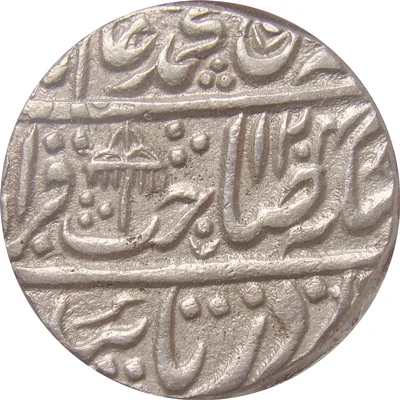
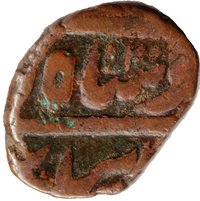
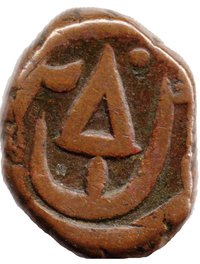
Sahib Qiran couplet with parasol and AH date.
Reverse
Description:
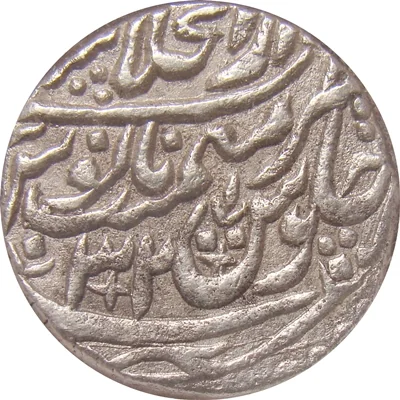
Mint, regnal year, inscription
Edge
Mintings
| Year | Mint Mark | Mintage | Quality | Collection |
|---|---|---|---|---|
| 1788 | — | — | ||
| 1789 | — | — | ||
| — | — | — | ||
| 1790 | — | — | ||
| 1791 | — | — | ||
| 1792 | — | — | ||
| 1793 | — | — | ||
| 1794 | — | — | ||
| 1795 | — | — | ||
| 1796 | — | — | ||
| 1797 | — | — | ||
| 1798 | — | — | ||
| 1799 | — | — |
Historical background
By 1788, the Mughal Empire's currency system, once a benchmark of stability and uniformity, was in a state of severe fragmentation and decline. The central authority of Emperor Shah Alam II was hollow; though he still nominally issued the silver rupee—the empire's foundational currency—his effective control scarcely extended beyond the Red Fort in Delhi. The imperial mints in major cities like Delhi, Lahore, and Ahmedabad continued to produce coins, but their output and purity were inconsistent, and they competed with a proliferation of regional issues. The empire's financial sovereignty had effectively devolved to a patchwork of successor states, European trading companies, and independent bankers.
The political landscape directly dictated the monetary chaos. Powerful regional rulers like the Nawab of Awadh, the Nizam of Hyderabad, and the newly ascendant Maratha Confederacy all struck their own rupees, often imitating Mughal designs but with varying weights and fineness to suit local treasuries. Most significantly, the British East India Company, after its victory at the Battle of Buxar (1764), had secured the diwani (revenue rights) of Bengal, Bihar, and Orissa. By 1788, the Company was not only collecting taxes but also operating its own mints in Calcutta and Bombay, issuing rupees that steadily displaced Mughal currency in eastern India. This created a complex and unreliable exchange environment where the value of a rupee depended heavily on its origin.
Consequently, trade and administration were hampered by the need for constant assay and discounting. Money changers (sarrafs) became indispensable economic intermediaries, their expertise required to navigate the bewildering array of coins in circulation. While the Mughal rupee remained a unit of account and a symbolic standard, the reality was a bimetallic system (silver and gold) suffering from erratic bullion supply and widespread debasement. The year 1788 thus represents a pivotal moment of transition, where the old imperial monetary order had collapsed, but a new uniform system—which the British would later impose—had not yet been consolidated, leaving the subcontinent's economy in a period of unstable flux.
The political landscape directly dictated the monetary chaos. Powerful regional rulers like the Nawab of Awadh, the Nizam of Hyderabad, and the newly ascendant Maratha Confederacy all struck their own rupees, often imitating Mughal designs but with varying weights and fineness to suit local treasuries. Most significantly, the British East India Company, after its victory at the Battle of Buxar (1764), had secured the diwani (revenue rights) of Bengal, Bihar, and Orissa. By 1788, the Company was not only collecting taxes but also operating its own mints in Calcutta and Bombay, issuing rupees that steadily displaced Mughal currency in eastern India. This created a complex and unreliable exchange environment where the value of a rupee depended heavily on its origin.
Consequently, trade and administration were hampered by the need for constant assay and discounting. Money changers (sarrafs) became indispensable economic intermediaries, their expertise required to navigate the bewildering array of coins in circulation. While the Mughal rupee remained a unit of account and a symbolic standard, the reality was a bimetallic system (silver and gold) suffering from erratic bullion supply and widespread debasement. The year 1788 thus represents a pivotal moment of transition, where the old imperial monetary order had collapsed, but a new uniform system—which the British would later impose—had not yet been consolidated, leaving the subcontinent's economy in a period of unstable flux.
✨ Legendary