

1 Krone – Denmark
Denmark
Context

Material
References
KM: #Click to copy to clipboard401.2
Numista: #146045
Value
Bullion value: $43.53
Obverse
Description:
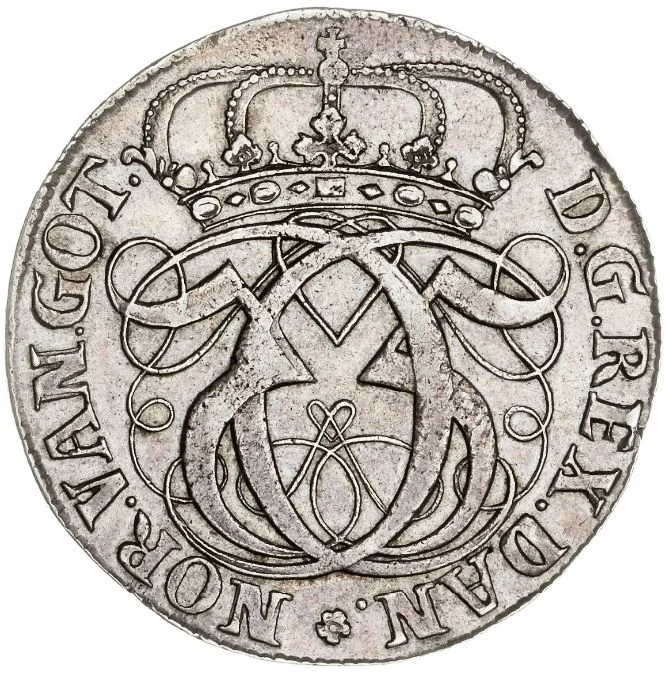
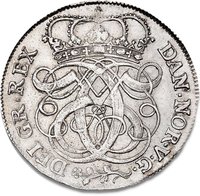
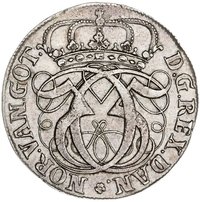
Crown over mirrored, ornate King's monogram. Side legend. Large or crossed flowers below.
Inscription:
5CC5
D. G · REX · DAN · | .NOR · VAN · GOT ·
D. G · REX · DAN · | .NOR · VAN · GOT ·
Script: Latin
Reverse
Description:
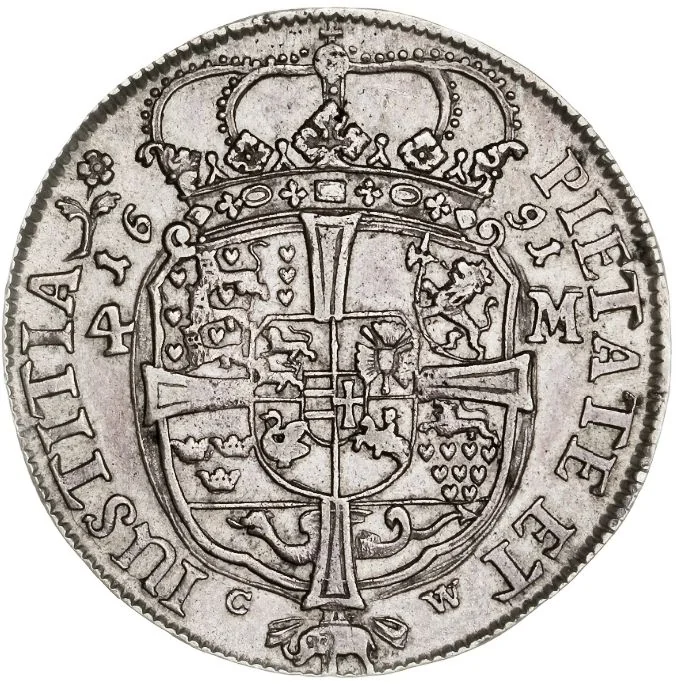
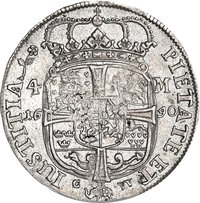
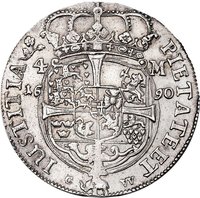
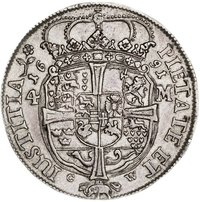
The crowned Danish coat of arms features the Order of Elephant pendant. The date and value flank the top, the mintmark is below the pendant, and the king’s motto encircles the rim.
Inscription:
PIETATE ET | IUSTITIA
16 91
4 M
C W
16 91
4 M
C W
Script: Latin
Edge
Categories
| Symbols> Coat of Arms |
Mints
| Name | Mark |
|---|---|
| Copenhagen | CW |
Historical background
In 1690, Denmark was grappling with a severe and complex monetary crisis, a direct consequence of the costly wars waged by King Christian V. To finance conflicts like the Scanian War against Sweden, the state had dramatically debased the currency, notably the skilling. The royal mint produced vast quantities of low-quality coins with reduced silver content, a practice that flooded the economy with unreliable money and drove older, full-value coins out of circulation or into hoards. This classic manifestation of Gresham's Law—"bad money drives out good"—created a chaotic multi-currency system where the value of a coin depended not on its face value but on its perceived metal content and date of minting.
The economic consequences were debilitating. The rapid devaluation led to rampant price inflation, as merchants and farmers demanded higher amounts of the debased coins for goods. This eroded public trust in the currency and the crown, stifling both domestic trade and international commerce. Foreign merchants were reluctant to accept Danish coins, and the kingdom's credit suffered. The situation was further complicated by the use of multiple monetary systems concurrently, including the Hamburg Bank currency for large international transactions and the unstable domestic coinage for everyday use, creating a confusing and inefficient economic environment.
Recognizing the crisis, the Danish government undertook a significant monetary reform in 1695, just a few years after the 1690 nadir. This reform introduced a new, stable silver-based rigsdaler as the standard unit, aiming to restore confidence by tying the currency firmly to its silver content. While the reform of 1695 was the turning point, the situation in 1690 represents the peak of the crisis—a period defined by financial instability, eroded trust, and economic hardship directly stemming from the crown's fiscal policies to fund its military ambitions.
The economic consequences were debilitating. The rapid devaluation led to rampant price inflation, as merchants and farmers demanded higher amounts of the debased coins for goods. This eroded public trust in the currency and the crown, stifling both domestic trade and international commerce. Foreign merchants were reluctant to accept Danish coins, and the kingdom's credit suffered. The situation was further complicated by the use of multiple monetary systems concurrently, including the Hamburg Bank currency for large international transactions and the unstable domestic coinage for everyday use, creating a confusing and inefficient economic environment.
Recognizing the crisis, the Danish government undertook a significant monetary reform in 1695, just a few years after the 1690 nadir. This reform introduced a new, stable silver-based rigsdaler as the standard unit, aiming to restore confidence by tying the currency firmly to its silver content. While the reform of 1695 was the turning point, the situation in 1690 represents the peak of the crisis—a period defined by financial instability, eroded trust, and economic hardship directly stemming from the crown's fiscal policies to fund its military ambitions.
Series: 1690 Denmark circulation coins
✨ Legendary