

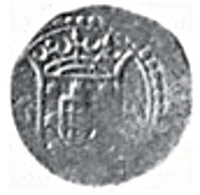
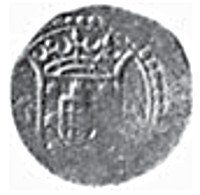
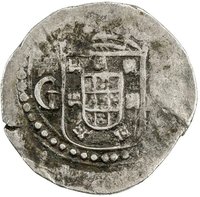
Obverse
Description:
Heraldic emblem
Inscription:
GA
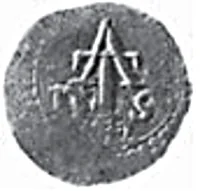
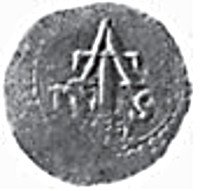
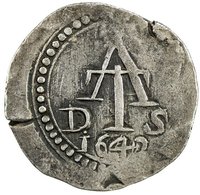
Reverse
Description:
Personalized initials on items
Inscription:
TA
DS
1647
DS
1647
Edge
Plain
Mintings
| Year | Mint Mark | Mintage | Quality | Collection |
|---|---|---|---|---|
| 1642 | — | — | ||
| 1643 | — | — | ||
| 1647 | — | — |
Historical background
In 1642, the island of Ceylon (modern Sri Lanka) was a focal point of intense economic and imperial rivalry, primarily between the Dutch East India Company (VOC) and the Kingdom of Kandy. The Portuguese, who had controlled much of the coastal lowlands since the 16th century, were in a state of retreat, besieged by a strategic alliance between the Kandyan king, Rajasinha II, and the Dutch. This military conflict created significant economic disruption, destabilizing existing trade networks and the circulation of currency. The Portuguese had introduced various silver coins, such as tangas and reis, but their authority and thus the reliability of their coinage were crumbling alongside their territorial control.
The currency situation was therefore fragmented and complex. In the Kandyan highlands, a traditional system of exchange using gold fanams, silver lari (often bent or cut for small change), and cowrie shells persisted, insulated from direct European control but affected by the wider war. Meanwhile, the Dutch VOC, having captured key ports like Galle and were advancing on Colombo, began to impose their own monetary system to facilitate trade and administration. They introduced Dutch rijksdaalders and stuivers, aiming to standardize transactions for their highly profitable cinnamon monopoly and other trade, but full monetary control was still a future objective amidst ongoing warfare.
Consequently, 1642 represents a transitional year of monetary overlap and uncertainty. Portuguese, Kandyan, Dutch, and various Indian and Arabian coins all circulated with fluctuating values, heavily dependent on location and the shifting fortunes of war. The ultimate goal for the VOC was to establish a uniform currency to secure economic dominance, but in 1642, the island’s currency landscape remained a contested and inconsistent patchwork, mirroring the broader battle for control of Ceylon itself.
The currency situation was therefore fragmented and complex. In the Kandyan highlands, a traditional system of exchange using gold fanams, silver lari (often bent or cut for small change), and cowrie shells persisted, insulated from direct European control but affected by the wider war. Meanwhile, the Dutch VOC, having captured key ports like Galle and were advancing on Colombo, began to impose their own monetary system to facilitate trade and administration. They introduced Dutch rijksdaalders and stuivers, aiming to standardize transactions for their highly profitable cinnamon monopoly and other trade, but full monetary control was still a future objective amidst ongoing warfare.
Consequently, 1642 represents a transitional year of monetary overlap and uncertainty. Portuguese, Kandyan, Dutch, and various Indian and Arabian coins all circulated with fluctuating values, heavily dependent on location and the shifting fortunes of war. The ultimate goal for the VOC was to establish a uniform currency to secure economic dominance, but in 1642, the island’s currency landscape remained a contested and inconsistent patchwork, mirroring the broader battle for control of Ceylon itself.
✨ Legendary