

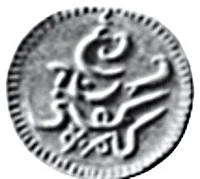
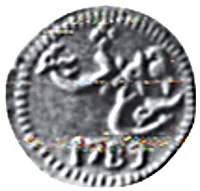
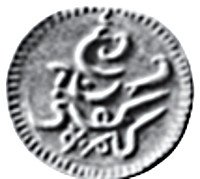
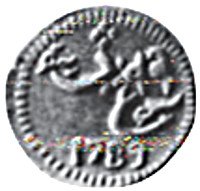
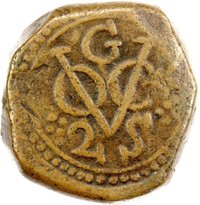
Obverse
Description:
Denomination
Inscription:
وڠ ولن د کمڤ ني کلم بو
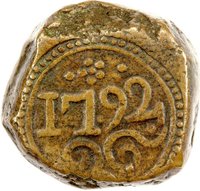
Reverse
Description:
Denomination
Inscription:
ڤوقو خزيره سيلوڠ
1789
1789
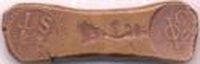
Edge
Plain
Mintings
| Year | Mint Mark | Mintage | Quality | Collection |
|---|---|---|---|---|
| 1784 | — | 122,000 | ||
| 1786 | — | 1,636 | ||
| 1787 | — | 20,000 | ||
| 1788 | — | 66,000 | ||
| 1789 | — | 37,000 |
Historical background
In 1784, Ceylon (modern-day Sri Lanka) was a colony under the administration of the Dutch East India Company (VOC), which was facing severe economic strain. The island's currency situation was chaotic and multifaceted, characterised by a confusing circulation of multiple coinages. The official currency consisted of Dutch silver coins like the rijksdaalder and stuiver, but these were chronically in short supply due to the VOC's restrictive monetary policies aimed at preventing the outflow of silver to the Indian subcontinent. This scarcity crippled everyday trade and official transactions.
To fill the void, a vast array of foreign coins circulated unofficially but ubiquitously. These included Portuguese tangas, various Indian gold pagodas and silver rupees, Spanish pieces of eight, and even coins from the Arabian Peninsula. The value of these coins was not fixed but fluctuated based on weight, metal purity, and local demand, leading to a complex and inefficient barter-like system. Furthermore, the VOC issued low-value copper coins (doits) for local small-scale trade, but these were prone to counterfeiting and often not accepted outside Company-controlled territories.
This monetary disorder severely hampered the colonial economy, creating uncertainty for merchants, complicating tax collection, and stifling economic growth. The VOC's inability to provide a stable, unified currency system undermined its own administrative control and commercial efficiency. This unstable financial backdrop in 1784 would persist until the British takeover of the island's coastal provinces in 1796, who later inherited and attempted to resolve the same currency complexities.
To fill the void, a vast array of foreign coins circulated unofficially but ubiquitously. These included Portuguese tangas, various Indian gold pagodas and silver rupees, Spanish pieces of eight, and even coins from the Arabian Peninsula. The value of these coins was not fixed but fluctuated based on weight, metal purity, and local demand, leading to a complex and inefficient barter-like system. Furthermore, the VOC issued low-value copper coins (doits) for local small-scale trade, but these were prone to counterfeiting and often not accepted outside Company-controlled territories.
This monetary disorder severely hampered the colonial economy, creating uncertainty for merchants, complicating tax collection, and stifling economic growth. The VOC's inability to provide a stable, unified currency system undermined its own administrative control and commercial efficiency. This unstable financial backdrop in 1784 would persist until the British takeover of the island's coastal provinces in 1796, who later inherited and attempted to resolve the same currency complexities.
✨ Legendary