

1 krone – Denmark
Add to wishlist
Denmark
Context
Material
References
KM: #
Numista: #143477
Value
Bullion value: $37.56
Obverse
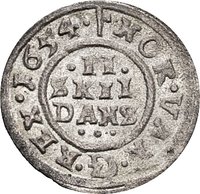
Description:
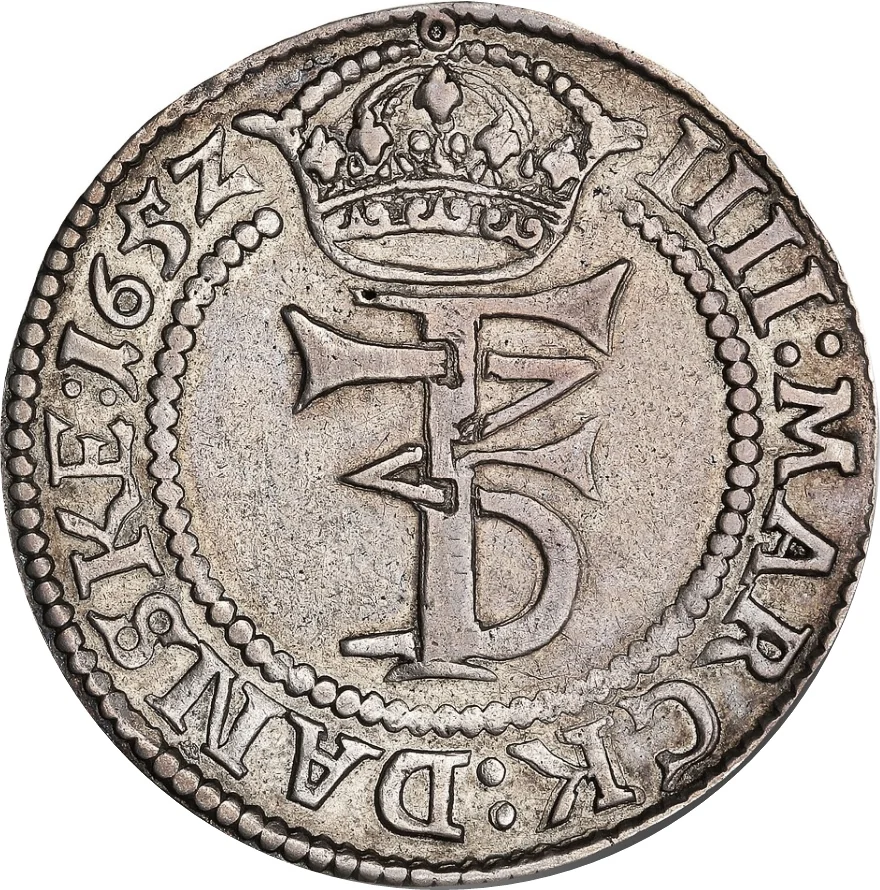
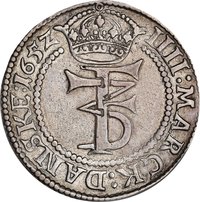
King's crowned monogram within partial beaded border. Value and date in outer legend.
Inscription:
IIII : MARCK : DANSKE : 165Z :
Script: Latin
Reverse
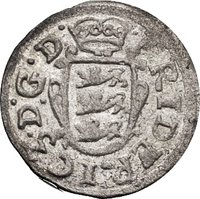
Description:
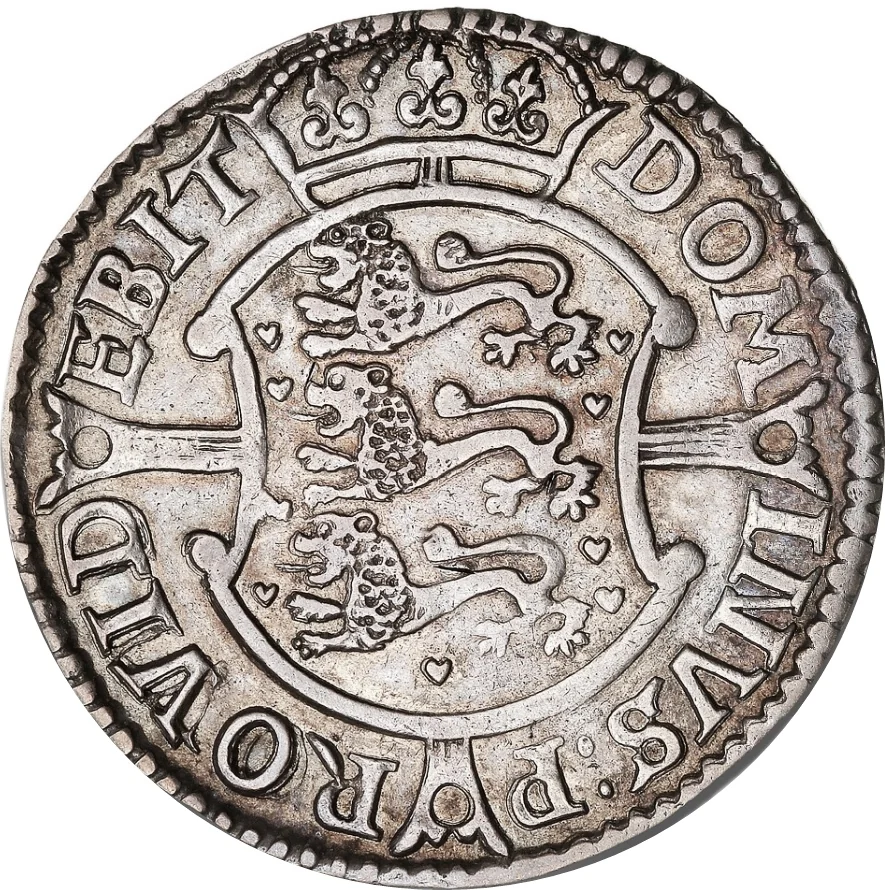
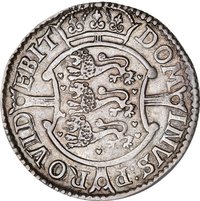
Denmark’s crowned coat of arms on a long cross. The king’s motto is along the rim, divided by the cross, sometimes with a beaded border.
Inscription:
DOM | INVS : P | ROVID | EBIT
Script: Latin
Edge
Mints
| Name | Mark |
|---|---|
| Copenhagen | — |
Mintings
| Year | Mint Mark | Mintage | Quality | Collection |
|---|---|---|---|---|
| 1652 | — | — | ||
| 1652 | h | — | ||
| 1653 | — | — | ||
| 1653 | h | — |
Historical background
In 1652, Denmark operated under a complex and strained monetary system. The country was on a silver standard, with the primary unit being the rigsdaler, divided into 96 skilling. However, the reality was one of chronic currency debasement and confusion. The state, frequently burdened by war debts (particularly from the Torstenson War against Sweden, which ended in 1645), often resorted to issuing coins with reduced silver content to generate short-term revenue. This led to a circulation filled with older, full-value coins and newer, inferior ones, causing Gresham's Law ("bad money drives out good money") to take hold as people hoarded the good silver.
The situation was further complicated by the widespread use of foreign currencies, especially Lübeck marks and skillings, in commercial hubs like Copenhagen. This was a legacy of the Hanseatic League's influence and the practical needs of Baltic trade. Consequently, merchants and the public had to navigate a daily calculation between multiple coin types with fluctuating values. The Danish state attempted to fix exchange rates by decree, but these measures were largely ineffective against market forces, leading to uncertainty and hindering commerce.
Overall, the currency situation in 1652 reflected a kingdom struggling with fiscal pressures and the transition to a more modern, state-controlled monetary system. The lack of uniform and trustworthy coinage was a significant economic weakness, creating an environment ripe for inflation and public distrust. This instability would persist until more comprehensive reforms were undertaken later in the century under King Christian V.
The situation was further complicated by the widespread use of foreign currencies, especially Lübeck marks and skillings, in commercial hubs like Copenhagen. This was a legacy of the Hanseatic League's influence and the practical needs of Baltic trade. Consequently, merchants and the public had to navigate a daily calculation between multiple coin types with fluctuating values. The Danish state attempted to fix exchange rates by decree, but these measures were largely ineffective against market forces, leading to uncertainty and hindering commerce.
Overall, the currency situation in 1652 reflected a kingdom struggling with fiscal pressures and the transition to a more modern, state-controlled monetary system. The lack of uniform and trustworthy coinage was a significant economic weakness, creating an environment ripe for inflation and public distrust. This instability would persist until more comprehensive reforms were undertaken later in the century under King Christian V.
✨ Legendary