

1 Goldgulden – Denmark
Denmark

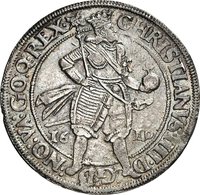
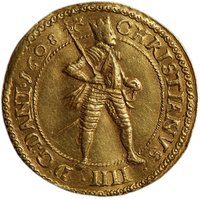
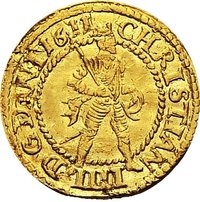
Obverse
Description:
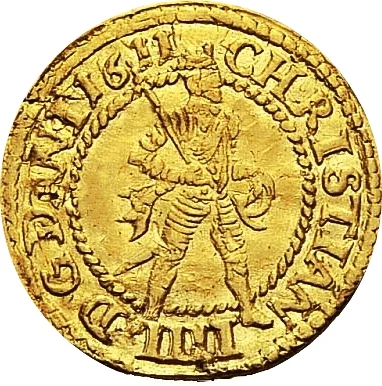
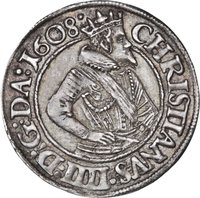
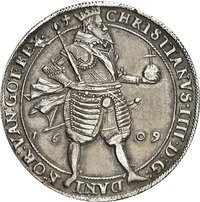
King crowned, holding scepter, hand on sword. Figure within rope circle, legend and date outside.
Inscription:
CHRISTIAN | IIII | D G DANI 16 11
Script: Latin
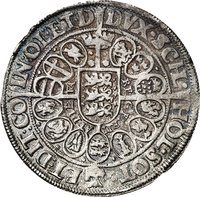
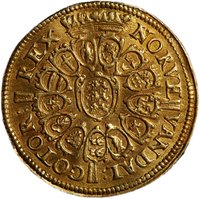
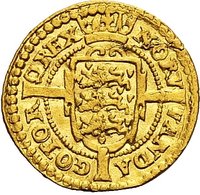
Reverse
Description:
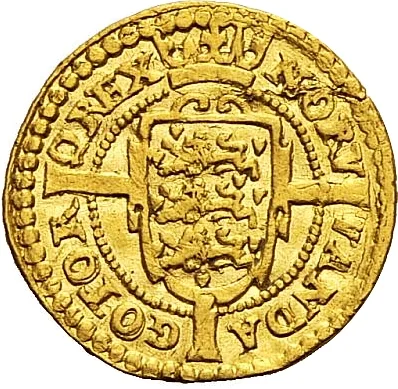
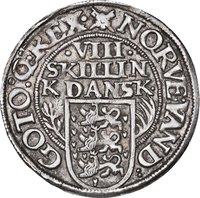
Danish coat of arms on a shield within a rope circle, topped by the royal crown and centered on a long cross.
Inscription:
NORV - VANDA - GOTOR - Q. REX +
Script: Latin
Edge
Mintings
| Year | Mint Mark | Mintage | Quality | Collection |
|---|---|---|---|---|
| 1608 | — | — | ||
| 1611 | — | — |
Historical background
In 1608, Denmark was navigating a complex and deteriorating currency situation, a direct legacy of the costly Kalmar War (1611-1613) against Sweden, which was already brewing. The state finances of King Christian IV were under severe strain from immense military expenditures and lavish court projects. To raise revenue, the government had increasingly resorted to debasement—reducing the silver content in coins while mandating they retain the same face value. This practice, while providing short-term liquidity, was eroding trust in the currency and fueling inflation, as people hoarded older, purer coins.
The monetary system itself was a patchwork, complicating matters further. While the primary unit of account was the Danish rigsdaler, actual circulation included a bewildering variety of domestic and foreign coins, such as kroner, marks, skilling, and German reichsthalers. The value of these coins fluctuated based on their metal content and royal proclamation. By 1608, the gap between the officially minted "good" coinage and the debased "light" coinage in everyday use was widening, creating a chaotic multi-currency environment where exchange rates were unstable and deceptive.
This instability caused significant economic distress and social tension. Merchants, particularly in Copenhagen and other trading centers, struggled with uncertain valuations, which disrupted both domestic commerce and vital Baltic trade. Ordinary citizens, especially those on fixed incomes or wages, found their purchasing power diminished as prices rose. The situation was unsustainable, prompting the government to consider serious reform. These pressures would culminate in the major currency revaluation of 1619, which aimed to restore stability by introducing new, standardized coins and retiring the debased currency, though not without further economic shock.
The monetary system itself was a patchwork, complicating matters further. While the primary unit of account was the Danish rigsdaler, actual circulation included a bewildering variety of domestic and foreign coins, such as kroner, marks, skilling, and German reichsthalers. The value of these coins fluctuated based on their metal content and royal proclamation. By 1608, the gap between the officially minted "good" coinage and the debased "light" coinage in everyday use was widening, creating a chaotic multi-currency environment where exchange rates were unstable and deceptive.
This instability caused significant economic distress and social tension. Merchants, particularly in Copenhagen and other trading centers, struggled with uncertain valuations, which disrupted both domestic commerce and vital Baltic trade. Ordinary citizens, especially those on fixed incomes or wages, found their purchasing power diminished as prices rose. The situation was unsustainable, prompting the government to consider serious reform. These pressures would culminate in the major currency revaluation of 1619, which aimed to restore stability by introducing new, standardized coins and retiring the debased currency, though not without further economic shock.
Series: 1608 Denmark circulation coins
✨ Legendary