

Copper – Republic of Vermont
United States
Context

Material
References
KM: #Click to copy to clipboard4
Numista: #142518
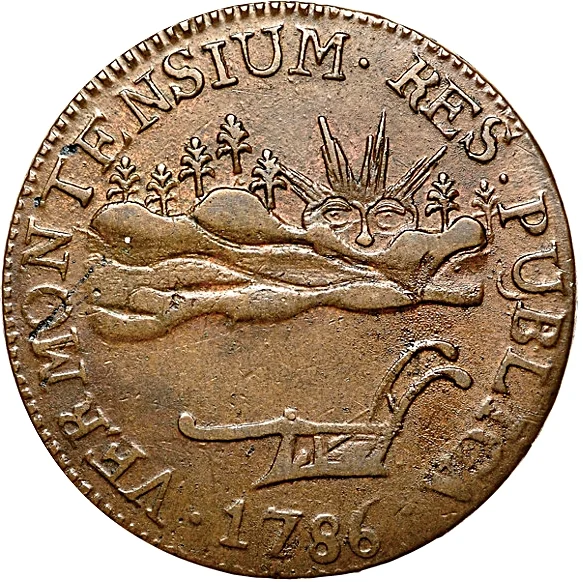
Obverse
Description:
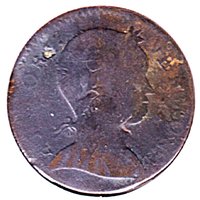
Plow below a sunrise over the Green Mountains, encircled by a Latin motto.
Inscription:
VERMONTESIUM. RES. PUBLICA
Script: Latin
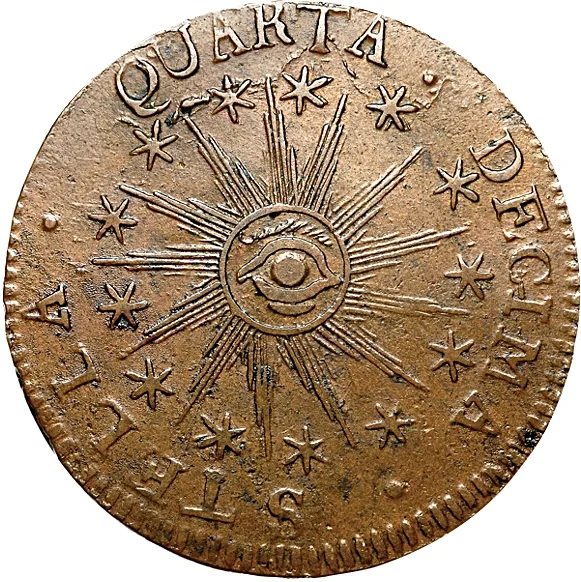
Reverse
Description:
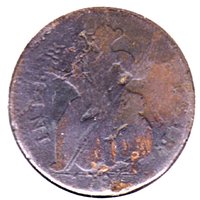
An "all-seeing eye" with 13 rays pointing to encircled stars, above a Latin motto.
Inscription:
QUARTA . DECIMA . STELLA
Script: Latin
Edge
Mints
| Name | Mark |
|---|---|
| Rupert, Vermont | — |
Mintings
| Year | Mint Mark | Mintage | Quality | Collection |
|---|---|---|---|---|
| 1785 | — | — | ||
| 1786 | — | — |
Historical background
In 1785, the Republic of Vermont, a de facto independent state since 1777, faced a complex and challenging currency situation born from its unresolved political status. While it had functioned autonomously during the American Revolution, it was not recognized by the Continental Congress and was entangled in territorial disputes with New York and New Hampshire. This political isolation forced Vermont to act as a sovereign entity in financial matters, leading to a circulation of multiple, competing forms of money. The most prominent was Vermont's own issue of paper currency, authorized by its legislature to finance government operations and stimulate its agrarian economy. However, these notes competed with a hodgepodge of other mediums, including Spanish milled dollars, British pounds, and paper currencies from neighboring states, all fluctuating in value and creating a chaotic monetary environment.
The value of Vermont's paper currency was inherently unstable, suffering from depreciation due to a lack of public confidence and limited specie (gold or silver) reserves for backing. This depreciation was exacerbated by the broader economic crisis of the 1780s that affected all the former colonies, known as the "Critical Period," which was characterized by war debt, inflation, and scarce hard currency. For Vermont's farmers and merchants, this meant prices and exchange rates were highly unpredictable, complicating trade both within the republic and with crucial external partners in British Canada and the American states.
Governor Thomas Chittenden and the Vermont legislature were acutely aware that this monetary instability threatened the republic's economic viability and its prospects for eventual union with the United States. Their efforts to manage the currency, including attempts to call in and burn old notes to reduce supply, had limited effect without a secure fiscal foundation. Ultimately, the currency situation of 1785 underscored a fundamental truth: Vermont's financial health was inextricably linked to its political future. The need for economic stability became a powerful argument for Vermont's leaders in their ongoing negotiations for statehood, which would finally be achieved in 1791, allowing Vermont to adopt the stable federal monetary system of the United States.
The value of Vermont's paper currency was inherently unstable, suffering from depreciation due to a lack of public confidence and limited specie (gold or silver) reserves for backing. This depreciation was exacerbated by the broader economic crisis of the 1780s that affected all the former colonies, known as the "Critical Period," which was characterized by war debt, inflation, and scarce hard currency. For Vermont's farmers and merchants, this meant prices and exchange rates were highly unpredictable, complicating trade both within the republic and with crucial external partners in British Canada and the American states.
Governor Thomas Chittenden and the Vermont legislature were acutely aware that this monetary instability threatened the republic's economic viability and its prospects for eventual union with the United States. Their efforts to manage the currency, including attempts to call in and burn old notes to reduce supply, had limited effect without a secure fiscal foundation. Ultimately, the currency situation of 1785 underscored a fundamental truth: Vermont's financial health was inextricably linked to its political future. The need for economic stability became a powerful argument for Vermont's leaders in their ongoing negotiations for statehood, which would finally be achieved in 1791, allowing Vermont to adopt the stable federal monetary system of the United States.
💎 Extremely Rare