

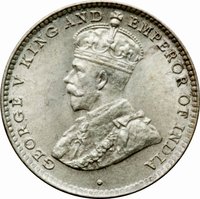
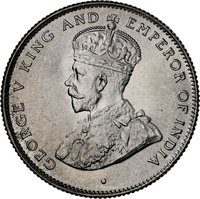
Obverse
Description:
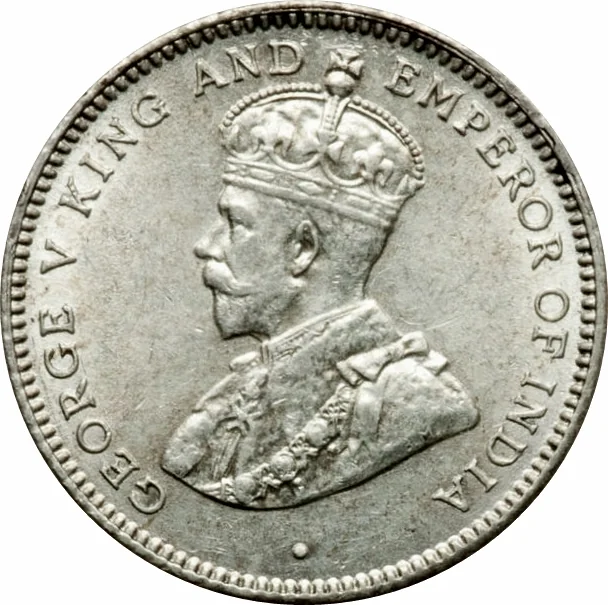
Crowned left-facing bust.
Inscription:
GEORGE V KING AND EMPEROR OF INDIA.
Translation:
GEORGE V KING AND EMPEROR OF INDIA.
Language: English
Engraver: Edgar Bertram MacKennal
Reverse
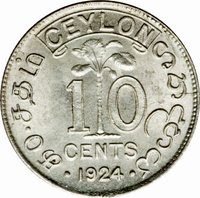
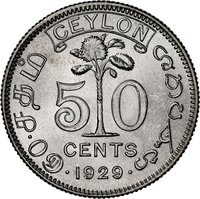
Description:
Denomination
Inscription:
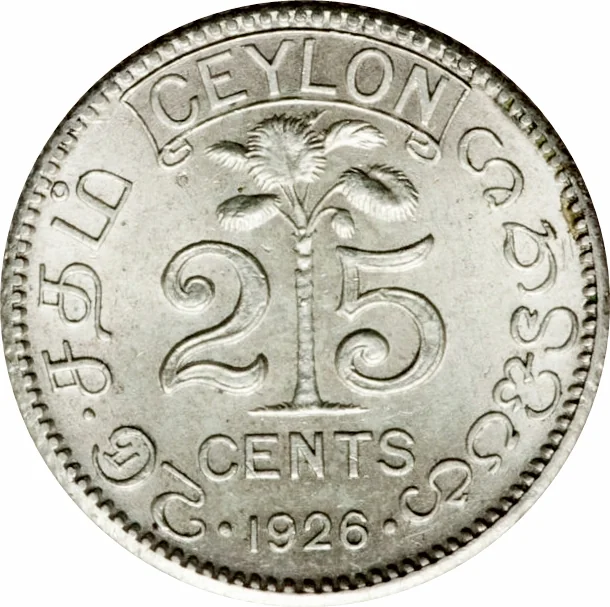
CEYLON
25
CENTS
௨௫ சதம்.
ශත චිසිපත
·1921·
25
CENTS
௨௫ சதம்.
ශත චිසිපත
·1921·
Translation:
CEYLON
25
CENTS
25 Cents.
Twenty Five Cents
·1921·
25
CENTS
25 Cents.
Twenty Five Cents
·1921·
Engraver: Leonard Charles Wyon
Edge
Reeded
Mints
| Name | Mark |
|---|---|
| Royal Mint (Tower Hill) | — |
| Mumbai / Bombay | B |
Mintings
Historical background
In 1919, Ceylon's currency situation was a direct legacy of its colonial monetary system, operating under a Currency Board established in 1884. This system rigidly tied the island's rupee to the British pound sterling, with the Ceylon rupee's value maintained by a 100% reserve of sterling securities held in London. While this ensured convertibility and monetary stability for imperial trade, it critically meant that Ceylon had no independent monetary policy; the money supply could only expand when the colony earned trade surpluses and accumulated more sterling reserves.
The immediate post-World War I context severely tested this system. The war had caused global inflationary pressures, which were acutely felt in Ceylon as the cost of imported goods, particularly rice, soared. However, the rigid Currency Board system prevented any discretionary increase in the money supply to stimulate the local economy. Instead, the money supply contracted after 1917 as government war expenditure ended, reducing sterling inflows just as prices were at their peak. This created a painful combination of high living costs and economic contraction, fuelling widespread public discontent.
This monetary inflexibility formed a crucial backdrop to the major political and social upheavals of 1919, most notably the Sinhalese-Muslim riots and the launch of organised nationalist agitation. Economic grievances over inflation and hardship were directly channelled into anti-colonial sentiment, as critics argued that the sterling-exchange system prioritised imperial financial interests over the welfare of Ceylon's people. Consequently, the currency situation of 1919 became more than a financial issue; it was a potent symbol of colonial economic control and a catalyst for the growing demand for self-governance.
The immediate post-World War I context severely tested this system. The war had caused global inflationary pressures, which were acutely felt in Ceylon as the cost of imported goods, particularly rice, soared. However, the rigid Currency Board system prevented any discretionary increase in the money supply to stimulate the local economy. Instead, the money supply contracted after 1917 as government war expenditure ended, reducing sterling inflows just as prices were at their peak. This created a painful combination of high living costs and economic contraction, fuelling widespread public discontent.
This monetary inflexibility formed a crucial backdrop to the major political and social upheavals of 1919, most notably the Sinhalese-Muslim riots and the launch of organised nationalist agitation. Economic grievances over inflation and hardship were directly channelled into anti-colonial sentiment, as critics argued that the sterling-exchange system prioritised imperial financial interests over the welfare of Ceylon's people. Consequently, the currency situation of 1919 became more than a financial issue; it was a potent symbol of colonial economic control and a catalyst for the growing demand for self-governance.
🌱 Common