

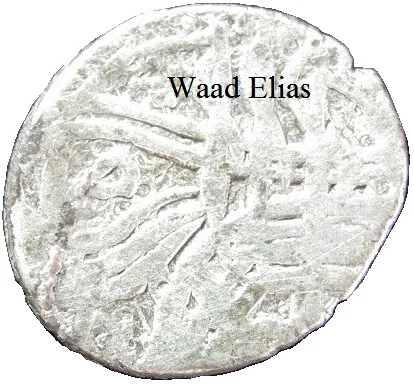
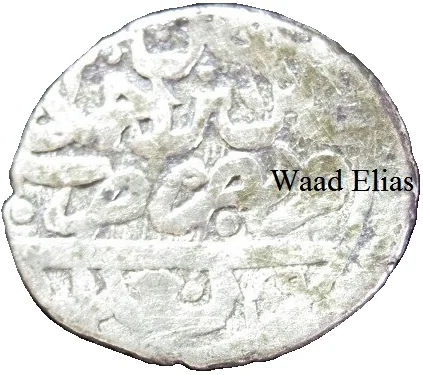
Dirhem – Baghdad Eyalet
Iraq
Context
Years: 1639–1640
Country: Iraq 
Issuer: Baghdad Eyalet
Ruler: Murad IV
Currency:
(1535—1688)
Demonetized: Yes
Material
Diameter: 18.35 mm
Weight: 3 g
Silver weight: 3.00 g
Shape: Irregular round
Composition: Silver
Magnetic: No
References
KM: #Click to copy to clipboard15
Numista: #142473
Value
Bullion value: $8.58
Obverse
Description:
Toughra
Script: Arabic
Reverse
Description:
Brief words,
carved in stone,
to honor a life,
remember a name,
and speak across time.
carved in stone,
to honor a life,
remember a name,
and speak across time.
Script: Arabic
Edge
Mintings
| Year | Mint Mark | Mintage | Quality | Collection |
|---|---|---|---|---|
| — | — | — | ||
| 1639 | — | — | ||
| 1640 | — | — |
Historical background
In 1639, the currency situation in the Baghdad Eyalet was defined by its recent and tumultuous reintegration into the Ottoman Empire. Following the decisive Ottoman victory over the Safavids in the Treaty of Zuhab (or Treaty of Qasr-e Shirin) that same year, the region was formally returned to Ottoman control after decades of back-and-forth conflict. This political shift immediately disrupted existing monetary systems, as the Safavid silver abbasi and other Persian coins, which had circulated during the prior occupation, began to be supplanted by official Ottoman currency. The central Ottoman mint in Istanbul, however, was distant, creating a practical vacuum and a period of monetary uncertainty in the immediate aftermath of the war.
The primary Ottoman unit of account was the silver akçe, but by this period it was heavily debased and prone to fluctuation. In practice, the larger para and the prestigious gold sultani were more significant for larger transactions and long-distance trade. The key challenge for the newly appointed Ottoman governor was re-establishing a reliable and standardized currency to facilitate taxation, pay the garrisoned Janissary forces, and revive the vital trade routes that passed through Baghdad. It is likely that a local mint (darphane) in Baghdad was reactivated or intensified its operations around this time to produce copper mangır and silver coins stamped with the Sultan's tughra, aiming to assert Ottoman sovereignty and economic control.
Furthermore, the currency landscape remained complex due to Baghdad's historic role as a commercial crossroads. Alongside emerging Ottoman coinage, older Ottoman and Safavid coins of varying purity remained in circulation, alongside a persistent inflow of European silver coins (like Spanish reales) via the Indian Ocean and Persian Gulf trade. This created a multi-currency environment where money-changers (sarrafs) played a crucial role in assessing the metallic content and value of diverse coins. Thus, in 1639, the monetary system was in a transitional state—officially shifting back to Ottoman standards, yet pragmatically mixed and unstable, reflecting the region's recent conquest and its enduring position at the nexus of regional empires and global trade networks.
The primary Ottoman unit of account was the silver akçe, but by this period it was heavily debased and prone to fluctuation. In practice, the larger para and the prestigious gold sultani were more significant for larger transactions and long-distance trade. The key challenge for the newly appointed Ottoman governor was re-establishing a reliable and standardized currency to facilitate taxation, pay the garrisoned Janissary forces, and revive the vital trade routes that passed through Baghdad. It is likely that a local mint (darphane) in Baghdad was reactivated or intensified its operations around this time to produce copper mangır and silver coins stamped with the Sultan's tughra, aiming to assert Ottoman sovereignty and economic control.
Furthermore, the currency landscape remained complex due to Baghdad's historic role as a commercial crossroads. Alongside emerging Ottoman coinage, older Ottoman and Safavid coins of varying purity remained in circulation, alongside a persistent inflow of European silver coins (like Spanish reales) via the Indian Ocean and Persian Gulf trade. This created a multi-currency environment where money-changers (sarrafs) played a crucial role in assessing the metallic content and value of diverse coins. Thus, in 1639, the monetary system was in a transitional state—officially shifting back to Ottoman standards, yet pragmatically mixed and unstable, reflecting the region's recent conquest and its enduring position at the nexus of regional empires and global trade networks.

✨ Legendary