

10 Para – Baghdad Eyalet
Iraq
Context
Year: 1780
Islamic (Hijri) Year: 1187
Country: Iraq 
Issuer: Baghdad Eyalet
Ruler: Abdul Hamid I
Currency:
(1688—1844)
Demonetized: Yes
References
KM: #Click to copy to clipboard48.1
Numista: #142422
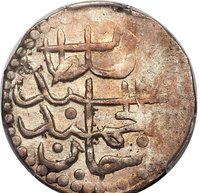
Obverse
Description:
Sultan
name
in 4
lines
name
in 4
lines
Inscription:
السلطان
عبد
الحميد
خان
عبد
الحميد
خان
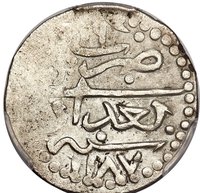
Reverse
Description:
Regnal year, mint, date in dotted circle.
Inscription:
٩٥
ضرب في
بغداد
١١٨٧
ضرب في
بغداد
١١٨٧
Edge
Mintings
| Year | Mint Mark | Mintage | Quality | Collection |
|---|---|---|---|---|
| 1780 | — | — |
Historical background
In 1780, the currency situation in the Ottoman Empire's Baghdad Eyalet was characterized by severe instability and complexity, reflecting the province's semi-autonomous status under the rule of the Mamluk Pashas. While nominally part of the empire, Baghdad operated with significant financial independence, leading to a fragmented monetary landscape. The official Ottoman akçe and kuruş (piastre) were theoretically in circulation, but in practice, they competed with a plethora of foreign and debased coins. Spanish silver dollars (pieces of eight), Indian rupees, and Persian coins flowed through Baghdad's bustling markets due to its key role in regional trade, creating a chaotic multi-currency environment where exchange rates fluctuated wildly.
This monetary chaos was exacerbated by chronic debasement and shortages. Local authorities, often financially strained by military expenses and tributes to the central Ottoman state, frequently resorted to striking their own copper mangır and silver coins with reduced precious metal content. This practice eroded public trust in the currency, leading to price inflation and market disputes. Furthermore, the supply of high-quality silver coins was irregular, dependent on trade revenues and the arrival of foreign specie, causing frequent liquidity crises. Merchants and money changers (sarrafs) therefore held significant power, acting as essential intermediaries who assessed and exchanged this jumble of coins, taking a profit from the complex arbitrage.
The situation was ultimately a direct reflection of the weakening central Ottoman control and the Eyalet's integration into regional, rather than imperial, economic circuits. Baghdad's economy was more closely tied to commerce with Persia, India, and the Gulf than to Istanbul, making it vulnerable to external shocks. The currency disorder of 1780 hindered efficient taxation and stable commercial contracts, posing a constant challenge to the Mamluk governors' attempts to consolidate power and administer the province. It remained a persistent problem until more unified reforms were attempted in the early 19th century.
This monetary chaos was exacerbated by chronic debasement and shortages. Local authorities, often financially strained by military expenses and tributes to the central Ottoman state, frequently resorted to striking their own copper mangır and silver coins with reduced precious metal content. This practice eroded public trust in the currency, leading to price inflation and market disputes. Furthermore, the supply of high-quality silver coins was irregular, dependent on trade revenues and the arrival of foreign specie, causing frequent liquidity crises. Merchants and money changers (sarrafs) therefore held significant power, acting as essential intermediaries who assessed and exchanged this jumble of coins, taking a profit from the complex arbitrage.
The situation was ultimately a direct reflection of the weakening central Ottoman control and the Eyalet's integration into regional, rather than imperial, economic circuits. Baghdad's economy was more closely tied to commerce with Persia, India, and the Gulf than to Istanbul, making it vulnerable to external shocks. The currency disorder of 1780 hindered efficient taxation and stable commercial contracts, posing a constant challenge to the Mamluk governors' attempts to consolidate power and administer the province. It remained a persistent problem until more unified reforms were attempted in the early 19th century.

✨ Legendary